For some reason this memory of my dad popped into my head tonight.
My dad was a connoisseur of opera. Saturday afternoons the radio broadcast of the Metropolitan Opera was always on (and invariably gave me a headache, although the true cause might have been his stinky pipe tobacco.) He was especially fond of Mozart and Gilbert & Sullivan. He had no interest in the popular music of his generation and he seemed totally unaffected by the popular music his kids listened to: Herman's Hermits, the Beatles, Sam Sham and the Pharoahs … their popularity with the younger generation in our house waxed and waned, but never seemed to register on his radar screen -- except for two notable exceptions in my memory:
Sylvia's Mother by Dr. Hook and the Medicine Show and A Horse With No Name by America. There was something about these two songs that he found particularly irksome, enough to comment on it each and every time he heard them. I think he found Sylvia's Mother to just be awfully whiney. I chuckle when I think about his reaction to A Horse With No Name. I can hear his voice saying in a slightly amused and incredulous tone, "What the hell is this song supposed to mean?"
He wasn't narrow in his musical tastes. He gave me my love for Tom Lehrer and the British duo Flanders & Swann. We had Ed McCurdy's and Alan Arkin's recording of bawdy Renaissance songs, When Dalliance Was In Flower. When I was older and had discovered The Bonzo Dog Band, my dad was really taken with their song Hunting Tigers Out in India; their brand of humor was right up his alley.
Thanks Daddy, for making me smile, so many years later.
Thursday, May 13, 2010


Monday, May 10, 2010
NCLB, AYP and other Egregious Acronyms
NCLB is the "No Child Left Behind" Act, a legacy of the Bush Administration. You would be hard-pressed to find any educator who thinks it is good policy, but a whole lot of politicians -- Rethuglicans and Dimocrats -- thought it sounded good [for them] back in 2001 when they voted it in. There was some hope that the Obama Administration might take another look at it, and at least get rid of the more offensive aspects of it, but if anything, the policy seems to be "Let's get even more punitive." Never mind that they've done nothing about child poverty, which is a major indicator of school success. Nope, punish the staff at the "failing" schools.
And what are they failing to do? Why, meet AYP -- Adequate Yearly Progress. Every year, almost exclusively using data collected from standardized tests, each and every public school is given a grade. If your school fails to meet AYP, sanctions are imposed. The sanctions become harsher every year; ultimately an entire staff can be fired. School superintendents can be removed and replaced with someone selected by the mayor of a city (as happened in Milwaukee), and the replacement superintendents don't have to be educators. For example, school districts can be (and have been) placed under the leadership of military personnel, as well as CEOs of major corporations. Not educators.
The kicker is, AYP is not a fixed thing. The percentage of students expected to make AYP goes up every year, until it reaches 100%. NCLB does not distinguish between students with special needs, students who are English language learners, or anyone else. Everyone takes the same test. Everyone is held to the same standard. If you were raised by wolves for the first nine years of your life and walked into school in fourth grade, guess what: your score counts the same as every other fourth grader's. So essentially schools are being expected to do something that is questionably worthy, and a statistical impossibility.
Schools that aren't making AYP are identified as SIFI (no, not Sci-Fi although you might think so with such a loony-tunes policy.) SIFI -- Schools Identified For Improvement. What I realized today -- what I should have realized long ago -- is that AYP only applies to schools receiving Title I federal funds, in other words, high poverty schools. If NCLB continues as it is right now, there will come a time when every Title I school in the country will be SIFI, and subject to the sanctions. Just another road to school privatization (or corporatization, the more accurate term.)
My school is a SIFI school, projected not to make AYP next year. At our staff meeting today we had a visit from two district muckety mucks to talk to us about what that means. Word from other schools was that they were going to be harsh and beat us over the head with the sanctions. In reality, I was most pleasantly surprised. They were both exceedingly positive about our school, the path we are on, and the efforts we are making. Clearly, as lifelong educators (even though they have crossed over to the Dark Side of administration) they have deep misgivings about NCLB.
To the credit of our State Department of Public Instruction, they have been directing more, not less, money to the schools that are "in need of improvement." Our school district has been using the extra funds for staff development, and I can say that, veteran teacher I may be, but it has made me a much more effective teacher. I can see a big difference in the progress my students have made. We have been thinking strategically, and are making steps to help all of our students, and I do think that's a good thing.
I absolutely hate the carrot and stick approach, however. "Race to the Top" and the punitive sanctions of NCLB are two sides of the same coin.
One colleague was asking today, given the bleak outlook and the sanctions, what incentives are there to remain a teacher at a high poverty school like ours? It's a good question, and certainly one that each teacher has to answer for him/herself. For me it's simple: I have taught at wealthy schools and I have taught at high poverty schools. I was mostly miserable at the wealthy schools, where at least a percentage of the parents treat you like you're the hired help. The last six years that I've been at my current school (my neighborhood school and my kids' alma mater) have been wonderful, the best years of my teaching career. I plan to stay, and I predict that we will spit in the eye of NCLB as we continue refining what we've been doing.
And what are they failing to do? Why, meet AYP -- Adequate Yearly Progress. Every year, almost exclusively using data collected from standardized tests, each and every public school is given a grade. If your school fails to meet AYP, sanctions are imposed. The sanctions become harsher every year; ultimately an entire staff can be fired. School superintendents can be removed and replaced with someone selected by the mayor of a city (as happened in Milwaukee), and the replacement superintendents don't have to be educators. For example, school districts can be (and have been) placed under the leadership of military personnel, as well as CEOs of major corporations. Not educators.
The kicker is, AYP is not a fixed thing. The percentage of students expected to make AYP goes up every year, until it reaches 100%. NCLB does not distinguish between students with special needs, students who are English language learners, or anyone else. Everyone takes the same test. Everyone is held to the same standard. If you were raised by wolves for the first nine years of your life and walked into school in fourth grade, guess what: your score counts the same as every other fourth grader's. So essentially schools are being expected to do something that is questionably worthy, and a statistical impossibility.
Schools that aren't making AYP are identified as SIFI (no, not Sci-Fi although you might think so with such a loony-tunes policy.) SIFI -- Schools Identified For Improvement. What I realized today -- what I should have realized long ago -- is that AYP only applies to schools receiving Title I federal funds, in other words, high poverty schools. If NCLB continues as it is right now, there will come a time when every Title I school in the country will be SIFI, and subject to the sanctions. Just another road to school privatization (or corporatization, the more accurate term.)
My school is a SIFI school, projected not to make AYP next year. At our staff meeting today we had a visit from two district muckety mucks to talk to us about what that means. Word from other schools was that they were going to be harsh and beat us over the head with the sanctions. In reality, I was most pleasantly surprised. They were both exceedingly positive about our school, the path we are on, and the efforts we are making. Clearly, as lifelong educators (even though they have crossed over to the Dark Side of administration) they have deep misgivings about NCLB.
To the credit of our State Department of Public Instruction, they have been directing more, not less, money to the schools that are "in need of improvement." Our school district has been using the extra funds for staff development, and I can say that, veteran teacher I may be, but it has made me a much more effective teacher. I can see a big difference in the progress my students have made. We have been thinking strategically, and are making steps to help all of our students, and I do think that's a good thing.
I absolutely hate the carrot and stick approach, however. "Race to the Top" and the punitive sanctions of NCLB are two sides of the same coin.
One colleague was asking today, given the bleak outlook and the sanctions, what incentives are there to remain a teacher at a high poverty school like ours? It's a good question, and certainly one that each teacher has to answer for him/herself. For me it's simple: I have taught at wealthy schools and I have taught at high poverty schools. I was mostly miserable at the wealthy schools, where at least a percentage of the parents treat you like you're the hired help. The last six years that I've been at my current school (my neighborhood school and my kids' alma mater) have been wonderful, the best years of my teaching career. I plan to stay, and I predict that we will spit in the eye of NCLB as we continue refining what we've been doing.
Monday, May 03, 2010
Book Review: Hotel on the Corner of Bitter and Sweet
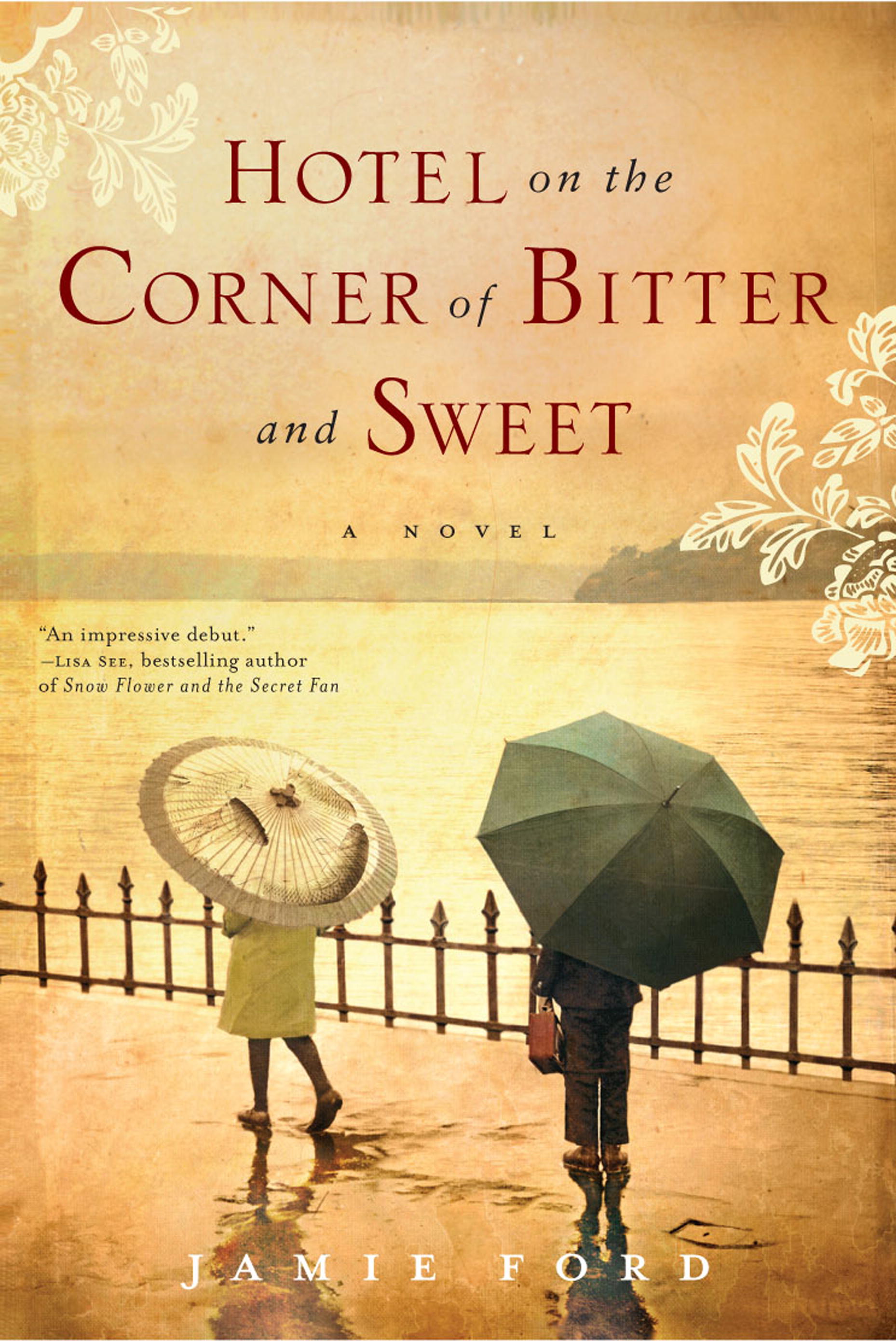
Hotel on the Corner of Bitter and Sweet is Jamie Ford's first novel. Henry Lee is the American-born son of a fiercely nationalistic Chinese father. The story takes place in Seattle, and jumps back and forth between 1942 when Henry is 12 years old, and 1986 when he is middle-aged and recently widowed. It is the story of Henry's friendship with Keiko Okabe, a Japanese American girl, who -- along with every other Japanese-American citizen on the west coast -- is imprisoned in a U.S. concentration camp for the duration of the war, and the impact that friendship had on Henry's adult life.
Henry and Keiko meet as the only two non-white students at their private school; both are there on work scholarships. Both are deeply resented by the other students, who make little distinction between Japanese and Chinese. But to Henry's father, who follows Japan's atrocities against China on a daily basis, Henry's friendship with Keiko is unforgivable.
I have never given any thought to the other Asians living on the west coast at the time of the Japanese-American interment. That aspect of the book was fascinating. It was also interesting that Ford mentioned the interment of both Italian- and German-Americans, a very little known part of U.S. history.
I hate to be so hard on a book that was obviously well-intentioned. I didn't hate it, but I won't necessarily recommend it either. Maybe you will read it with a less crabby disposition than mine. Who knows?
Deep, Dark Secrets of a Bad Grad Student
I've been trying to be a graduate student for almost 9 years now. I take classes one at a time, until I can't stand it anymore, and then I stop for a while. In this fashion I've earned a license to be a school library media specialist (a.k.a. school librarian.) However, here is the rub -- we have a two-tier licensing system in Wisconsin. My license is non-renewable, so now I am taking the courses to earn my professional license, which I have to finish within the next three years. There is no reprieve now; if I want the license (and I do) I have to push on through, one class every semester -- including the summer -- until December 2011 when I am finally done.
I tried a regular graduate program where I would have gotten a Masters in Library Science along with my license. I lasted for two semesters there, before throwing in the towel. I hated it so much! Now I am in an online program designed to get classroom teachers into school libraries. It has been a much better fit for me, relevant, interesting …
It is always a challenge. I'm a fairly intelligent person (I think.) I read a lot, I am able to apply what I am learning to real-life situations. However, when I am enrolled in a class I constantly feel rotten, like I am a bad person. I believe I have finally pinpointed what that is about. School these days involves a lot of the dreaded group project. In an online course, this involves group projects with people I may have only met in person one time; all of our communication takes place in that tricky medium of email and online discussion. I realize that my overall feeling in this context is one of shame. I beat myself up if I don't go to the discussion forum often enough, don't add to the Googledoc or wiki in a timely enough manner, when it's my turn I don't summarize the discussion until the end of the day on which it's due. I feel as if I am always letting my group-mates -- who are essentially strangers to me, but in my mind, far better students than I am -- down.
It's so bad that once I turn in an assignment I don't want look at it again, because I'm so ashamed of my work. I have to browbeat myself before I log onto the class site. I'm procrastinating right now as I write this blog post!
Basically I always feel like a fuck-up as a graduate student. (Pardon my language, but I do.) I just don't want to do this. I would rather be walking my dog, playing my guitar, reading for fun, knitting, decorating Ukrainian Easter eggs, making soap, sewing, and being with my family. I don't care if I get an A. I just want to pass each course.
Whew -- got that off my chest. I feel as if I've been in the confessional. I have two more weeks of this course. The next one is a literature course; hopefully it will be more flying solo.
I tried a regular graduate program where I would have gotten a Masters in Library Science along with my license. I lasted for two semesters there, before throwing in the towel. I hated it so much! Now I am in an online program designed to get classroom teachers into school libraries. It has been a much better fit for me, relevant, interesting …
It is always a challenge. I'm a fairly intelligent person (I think.) I read a lot, I am able to apply what I am learning to real-life situations. However, when I am enrolled in a class I constantly feel rotten, like I am a bad person. I believe I have finally pinpointed what that is about. School these days involves a lot of the dreaded group project. In an online course, this involves group projects with people I may have only met in person one time; all of our communication takes place in that tricky medium of email and online discussion. I realize that my overall feeling in this context is one of shame. I beat myself up if I don't go to the discussion forum often enough, don't add to the Googledoc or wiki in a timely enough manner, when it's my turn I don't summarize the discussion until the end of the day on which it's due. I feel as if I am always letting my group-mates -- who are essentially strangers to me, but in my mind, far better students than I am -- down.
It's so bad that once I turn in an assignment I don't want look at it again, because I'm so ashamed of my work. I have to browbeat myself before I log onto the class site. I'm procrastinating right now as I write this blog post!
Basically I always feel like a fuck-up as a graduate student. (Pardon my language, but I do.) I just don't want to do this. I would rather be walking my dog, playing my guitar, reading for fun, knitting, decorating Ukrainian Easter eggs, making soap, sewing, and being with my family. I don't care if I get an A. I just want to pass each course.
Whew -- got that off my chest. I feel as if I've been in the confessional. I have two more weeks of this course. The next one is a literature course; hopefully it will be more flying solo.
Subscribe to:
Posts (Atom)