Sunday, December 27, 2009
Hot Tub! or, Reenacting "The Titanic"
Gives a whole new meaning to "toiletries".
Secret Santa?
Friday, December 25, 2009
Now bring in the figgy pudding!
Monday, December 21, 2009
Life …
Thursday, December 17, 2009
I finally finished another book!

When I went to hear Wendell Berry back in October, he read a short story entitled Making It Home from a collection of short stories. That Distant Land is the title of that collection. It spans nearly 100 years in the lives of the inhabitants of the fictional town of Port William, Kentucky. If you are at all familiar with Berry's fiction, you will find many characters that you recognize in this collection: Jayber Crow, the Coulters, Feltners, Rowanberrys, and Catletts -- all part of what Burley Coulter referred to as "the membership" of Port William who farmed the area going back 200 or more years.
Tuesday, December 15, 2009
Battered and Bruised
Sunday, November 29, 2009
Musing on Music
Thursday, November 19, 2009
Makin' a List and Checkin' It Twice.
Wednesday, November 18, 2009
I'm still here.
Saturday, October 31, 2009
The Natural Laws of Good Luck: A Memoir of an Unlikely Marriage

Ellen Graf was a lonely sculptor and mother of 4 mostly grown children living in rural upstate New York, when a Chinese friend suggested that she might like to meet her brother in China, who was also a lonely divorcée. Graf decides to take a chance, travels to China to meet Zhong-hua lu, and marries him. What follows is a moving and frequently hilarious account of two people from exceedingly different cultures attempting to make a life together. Graf has an advantage, as it is Zhong-hua who emigrates and must learn English and try to fit in to American culture. However, Graf too must adapt to living with someone whose most basic assumptions about human interactions -- and in fact, life in general -- are alien to her.
Monday, October 26, 2009
Book Review: Hannah Coulter by Wendell Berry

This was a reread for me. When I first read Hannah Coulter a few years ago, it instantly became one of my favorites. I was a little bit worried that if I read it a second time, I wouldn't like it as much. Having finished it, I can say that the writing is nothing short of astonishing.
I began to know my story then. Like everybody's, it was going to be the story of living in the absence of the dead. What is the thread that holds it all together? Grief, I thought for a while. And grief is there sure enough, just about all the way through. From the time I was a girl I have never been far from it. But grief is not a force and has no power to hold. You only bear it. Love is what carries you, for it is always there, even in the dark, or most in the dark, but shining out at times like gold stitches in a piece of embroidery.
The chance you had is the life you've got. You can make complaints about what people, including you, make of their lives after they have got them, and about what people make of other people's lives, even about your children being gone, but you mustn't wish for another life. You mustn't want to be somebody else. What you must do is this: "Rejoice evermore. Pray without ceasing. In every thing give thanks." I am not all the way capable of so much, but those are the right instructions.
My mind, I think, has started to become, it is close to being, the room of love where the absent are present, the dead are alive, time is eternal, and all the creatures prosperous. The room of love is the love that holds us all, and it is not ours. It goes back before we were born. It goes all the way back. It is Heaven's. Or it is Heaven, and we are in it only by willingness. By whose love … do we love this world and ourselves and one another? Do you think we invented it ourselves? I ask with confidence, for I know you know we didn't.
Sunday, October 18, 2009
Tuesday, October 13, 2009
Wendell Berry
Enduring much snark and eye-rolling from my teen-aged daughter -- who thinks her mother has gone way over the top when it comes to food-related things -- I went to hear the farmer/poet/essayist/novelist Wendell Berry speak on Sunday afternoon. Here is something that was truly mind-blowing: After so many free tickets were distributed that his presentation had to be moved to a larger venue, he ended up speaking to a capacity crowd of 2000! Let me repeat -- Berry is a farmer/poet/essayist/novelist from rural Kentucky, not a rock star! I think he was a little blown away by the crowd as well.I had no idea what to expect from his talk. I guess I had it in my mind that he might address the politics of agriculture, perhaps because he writes about that sometimes and he was here on the heels of Michael Pollan. That would have been great. What he did though, was to read aloud one of his short stories -- Making It Home from the collection entitled That Distant Land. It was enthralling. One of my all-time favorite novels is Berry's Hannah Coulter, and hearing him read aloud his own words reminded me of why I love that book so much. The language of his writing is luminous.
He also took questions from the audience. The thing that he said that has stayed with me is that we Americans keep thinking that the big problems should have big, global solutions, which in some ways absolves us as individuals of taking responsibility. However, in reality, big problems are solved by many, many people finding small, localized solutions, and in most cases individual contributions will go unrecognized and unrewarded by the larger world. But each of us must still work on solutions in our own way. It reminds me of this passage from Britain Yearly Meeting Faith & Practice, or of Margaret Mead's famous quote: Never doubt that a small group of thoughtful people could change the world. Indeed, it's the only thing that ever has.
I did purchase a copy of Hannah Coulter, but I didn't wait in line to have it signed, because the line was too long. (Rock star …) If you haven't read any Wendell Berry, he kind of has something for everyone. I recommend giving his writing a try.
Monday, October 12, 2009
The Ant and the Grasshopper
Pumpkins galore, potatoes, doughnuts, ostrich meat … Roma tomatoes, $20 for 25 lbs! I paid for a 25 lb. box, finished shopping (buying apples from novelist Jane Hamilton -- one of the perks at the Dane County Farmers' Market) and drove my car around to pick up my tomatoes. Thinking, "Hmmm … are those tomatoes going to be enough to carry me over until next tomato season?" With my car in the middle of the street, emergency flashers going, I quickly made a deal to buy another 25 lbs. of tomatoes.
This is the 3rd year I have canned tomatoes and the first time I did it all by myself. I canned half yesterday and half today, all in all 6 hours of intensive labor -- blanching, peeling and coring the tomatoes, partially cooking them, sterilizing the jars, filling the jars, boiling them in a hot water bath … Rather than trying to multi-task, I broke the process down into discrete steps -- a decision that I think saved time in the end. Hallelujah, all the jars sealed nicely, and lined up on the kitchen counter they look like sparkling jewels.
Tuesday, September 29, 2009
Food For Thought
On Saturday I attended the annual Food for Thought festival, put on in Madison by the REAP (Research, Education, Action, and Policy) Food Group. It is such a cool event, starting in the morning and going into the early afternoon, in conjunction with the Dane County Farmers' Market. I roused myself from my Saturday morning stupor to go and hear Michael Pollan speak. He was speaking under a large tent, with many people spilling out the edges. I settled myself on the sidewalk, pulled out my knitting (of course), and was thoroughly inspired.There was some (what I consider to be) trumped up controversy surrounding Pollan's visit to Madison. This from a REAP email:
The president of the Wisconsin Farm Bureau suggested that Pollan is against farmers and in an op-ed called some of his ideas "disturbing and immoral."A bus load of farmers showed up, wearing "In Defense of Farmers" t-shirts and calling Pollan's work "elitist". Personally, I think they lost a great deal of credibility when I found out that a big agri-business had chartered the bus and rallied them. I also wondered how many of them actually have read Pollan's work. It smacked of tea party politics.
Pollan called for a regional food economy, saying he is not a dogmatic locavore. A regional food economy has room not only for the small farms producing heritage and artisan foods, but the mid-sized farms as well. He emphasized the need for all farmers to diversify, noting that separating animals from crops (to paraphrase Wendell Berry) took a near-perfect system and created 2 big problems: what to use for fertilizer and where to dump the animal waste.
He also issued a passionate call for people to prepare meals at home using real food. I know that will raise some people's hackles -- but tell me, just how convenient is so-called "convenience food"? I was thinking, I can make a pan of mac & cheese in 25 minutes, plus baking time. The boxed stuff is not much quicker than that!
He also warned that the food industry is beginning to fight back, and it is important to vote with your dollars and be a food activist.
I also enjoyed browsing among the many displays from food-oriented businesses and non-profits. I had to resist the urge not to say something snide to the Whole Foods people. I went out of my way to greet chef Tori from L'Etoile and thank him for everything he does for my daughter's middle school (while munching on one of his homemade brats -- mmmm.) I picked up a recipe for making an anti-viral tea ('flu preventative) from Community Pharmacy.
Oh yeah, and I bought In Defense of Food from A Room of One's Own, my favorite independent bookstore. I was so happy to see them there and told the owner so, as I paid cash for my book. "Thanks, Suzy. We appreciate your support," and I thought, "She knows my name!!" Guess I'm a preferred customer now. (Yeah, yeah. Little things can give me big thrills.)
I was still a bit buzzed about the festival when I went a book sale at one of our branch libraries on Sunday. I bought a 1946 edition of Irma Rombauer's Joy of Cooking for $2.00! At first I was thinking it would just be a neat curiosity, but as I read through the recipes I realized that it has a lot of relevance to what Michael Pollan had been saying. Real food, prepared at home, on a family budget. I quickly cleared two froo-froo cookbooks off the shelf -- ones that I sometimes salivate over, but never cook from -- to make room for my vintage Joy. (And I just read that this is a virtually the same as the 1943 edition -- the one that Julia Child received as a wedding gift -- and has a collectors' value of $60 - $200! How cool is that? Of course, I will not be selling it.)
That was my weekend. Yours?Monday, September 28, 2009
More from the mouths of kindergartners …
Saturday, September 26, 2009
Making the Case for Manual Labor
I just finished reading the book Shop Class As Soulcraft: An Inquiry Into the Value of Work by Matthew B. Crawford. I have to say, I knew nothing about this book when I first opened it. I selected it purely because of the title. In fact, I thought it might have something to do with the sort of projects you find in the magazines Readymade or Make. Silly me. But, boy, was I glad that I read it.Matthew Crawford holds a PhD in Philosophy, and now supports himself doing motorcycle repair. Shop Class is a difficult book to classify. Part autobiography, part pornography for motorcycle geeks, Crawford makes a very strong case for manual labor. He begins the book by talking about the history of "shop class" in the twentieth century and the dismantling of most high school shop programs in the eighties and nineties, as everyone was supposed to become "knowledge workers." He shows how disastrous this trend has been for American workers as more and more jobs have been shipped overseas where labor costs less, and points out that your x-rays can be read by a technician in India while plumbers, on the other hand, must be local.
Crawford discusses the disconnect that so many workers feel in white collar "knowledge" jobs where they never see the results of their work, compared to jobs in the trades where there is a very clear connection between the work and the results. (I was pleased that he included teachers in that second category.)
Yet the trend continues, where high school students are steered toward 4-year colleges, 2-year technical colleges are offering more "college prep", and the trades -- some of the most stable professions around -- are stigmatized. (This is personal for me as I watch my daughter struggle to pay off the $30,ooo loan she accrued in just one year of college, and people don't understand why she "dropped out" to work in a restaurant.) I found it curious when I watched President Obama address the nation's schoolchildren, that he encouraged them to go on to college, to become doctors, lawyers, teachers, join the military … and he did not say a word about entering the trades!
My one criticism of this book is that the writing was fairly dense -- or maybe just too geared toward gearheads. I am neither a motorcycle mechanic nor a rider, and there were points where my eyes glazed over and I skipped whole chunks of the text. But the overall theme resonated so strongly with me, and I had a hard time putting it down. In fact, I will be buying this book to re-read and mark certain passages. This is a very important book -- highly recommended.
Friday, September 25, 2009
Saturday, September 19, 2009
Looking forward to …
- seeing Brandi Carlile in concert this Monday. Gratitude to David for introducing me to her music!
- going to hear author/local food advocate Michael Pollan speak on Thursday. (No, he's not local; he passionately advocates for the buying and eating of locally grown food.) He is also speaking at a $200/plate fundraiser for my daughter's middle school, which is just so cool.
- going to hear author/poet/farmer Wendell Berry speak on October 11. (He is the author of one of my favorite novels ever, Hannah Coulter.)
Friday, September 18, 2009
INDOCTRINATION!!!
(It was shown at our first all school assembly of the school year. One youngster was escorted out in tears. When the principal questioned her about why she was crying she said, "I'm - I'm just so happy he's president, it makes me cry.")
Wednesday, September 09, 2009
Paddling My Own Canoe
Well, since we've had it, we've gone canoing exactly twice -- once when we loaded it on top of the car and drove across town to Lake Wingra, our smallest lake. It was lovely. We paddled across the lake to the University of Wisconsin Arboretum and visited haunts that we normally access by foot. The other time we took it up to Lake Michigan with us on our annual camping trip. It is definitely not designed for the bigger waves. I got scared, Mr. Ether got exasperated with me, and we had a little fight out on the water. Since then the canoe has held the concrete of our driveway down very nicely and that's all.
Recently I had been thinking of getting rid of it. It's monstrously heavy. We live, literally, two blocks from a gentle peaceful river that connects two of our lakes, and we never use the canoe. Last weekend I was talking with a friend about it, and she threw out the idea that some of us could go in on a nice lightweight canoe as a kind of time-share and rent space from the city parks department to store it.
*Lightbulb above my head* Why don't we -- DUH -- instead of buying a new canoe, just rent a spot for the canoe we already possess? I called the parks department today, and for $75/year I am leasing a berth on a canoe rack that is right next to the river three blocks from our house! I am psyched!
Tuesday, September 08, 2009
Kindergartners -- Can't Live With 'Em, Can't Live Without 'Em
Monday, September 07, 2009
Three Little Words: A Memoir by Ashley Rhodes-Courter
This book made me late yesterday. (Really, I would have been on time otherwise.) Each time I sat down to read just a little, I became so totally engrossed in Ms. Rhodes-Courter's story that I could not put the book down. When Ashley Rhodes-Courter was 3 years old, she was removed from her mother's custody and became a ward of Florida's foster care system. Thus began a 9 year long nightmare, over the course of which she had 19 different foster parents, some okay, some marginal, and one in particular, frighteningly bad. When she was finally adopted by a loving couple at the age of 12, it took many years for Ashley to trust that these parents were really there for her, and she finally began the long journey toward healing.While the book was clumsily written at times (she wrote it as a very young adult) Ashley Rhodes-Courter impressed me with her resilience, her clear-eyed observations, and her amazingly positive outlook even after everything that she went through. This is a scathing commentary on Florida's foster care system. At a couple of different points she poses the question of why the state was willing to pay millions of dollars for a failed system where people ran foster homes like puppy mills and caseworkers looked the other way, but was utterly unwilling to spend even a penny to help teenaged mothers like Ashley's so they could provide a home for their own children. She also wondered why -- even when the evidence was in plain sight -- the caseworkers and therapists always assumed that the children were lying about their mistreatment, to get attention. (They even ignored multiple phone calls to the child abuse hotline from Ashley's teachers!)
Ashley eventually brought a suit against the state of Florida. In reviewing her files, she figured out that out of 195 people who had had some responsibility for her case over those 9 years, the two who had really advocated for her and gotten her out of the system -- a Guardian ad Litem and a lawyer -- were volunteers.
I admit that I wept while I read this book. It made me consider the carelessness with which some people treat their lives and the lives of others. Ashley's mother was not a bad person, but was herself a product of careless parenting -- as was the abusive foster mother. I found Ashley's story to be very important and moving. Highly recommended.
Book Review: A Yellow Watermelon by Ted Dunagan
A Yellow Watermelon was published by Junebug Books -- the children's division of New South Books, a publisher that specializes in contemporary Southern authors. It tells the story of one memorable summer in the life of 11 year old Ted Dillon. Ted is the youngest of 3 boys in a family that is just barely scraping by in small town Alabama. His dad works in the local sawmill which, like just about everything else in the vicinity, is owned by Mr. Cliff Creel. Ted makes pocket money by selling the weekly newspaper Grit.One evening Ted sneaks into the sawmill after hours to explore, where he meets Jake -- a black man who has been hired to watch the mill. Through Jake he learns of the Robinsons, a dirt-poor black family who are in danger of losing their farm through the dirty dealings of Old Man Creel. Mr. Creel, in collusion with the local preacher, is also stirring up prejudice against the Robinsons. Ted befriends Poublum Robinson, a boy his own age, and is determined to help them out.
A Yellow Watermelon tells an interesting story and has a whole lot of heart, and I really, really wanted to like it, but in the end I found it disappointing. I thought that it oversimplified the whole idea of racial prejudice in the Jim Crow South, to the point of making it seem insignificant. The onus for the hateful behavior was put on mean Old Man Creel and the weak-willed drunkard preacher with everyone else being bystanders who didn't say much but acted sympathetic to the Robinsons because no one liked Mr. Creel very much. In no way was the hateful institution of Jim Crow laws ever even addressed! In fact, while it was believable that Ted might have befriended both Jake and Poublum, I found it utterly unbelievable that everybody accepted the friendships with almost nary a word, even while they all referred to their black neighbors as "niggers" and "darkies."
This may be a trifling point, but the dialogue when the black characters spoke was cartoon Southern black dialect, peppered with "sho 'nuffs" and "dis" and "dats". It reminded me of reading a vintage version of The Bobbsey Twins in the Land of Cotton and really bugged me.
There were also references that were way too modern, and seemed designed to teach young readers a lesson about prejudice rather than to make a good story; for example, when Ted crosses the invisible line in his uncle's cotton field to pick cotton with Poublum he says, "In the summer of 1948, I reverse integrated the cotton field."
One review on the back of the book compared A Yellow Watermelon to the classics To Kill A Mockingbird and Huckleberry Finn. I beg to differ. This isn't an awful book, but if you're interested in something to show kids what racial prejudice in the South was like, they'd be better off reading Mildred Taylor's Roll of Thunder, Hear My Cry or Christopher Paul Curtis' The Watsons Go to Birmingham - 1963.
Friday, September 04, 2009
Whoa, W-a-a-a-y Behind On My Book Reviews
The Invention of Air by Steven Johnson is a biography of Joseph Priestly, the eighteenth century scientist who, among other things, discovered a process for carbonating water, founded Unitarianism, counted Benjamin Franklin and Thomas Jefferson among his friends, and conducted pioneering experiments in his home laboratory on the nature of the air we breathe. He was hounded as a heretic from his comfortable life in England and settled in the United States in its infancy as a nation. This was a fascinating and fun book to read. Highly recommended. (Steven Johnson also wrote The Ghost Map, a story of the last cholera epidemic to hit London. Also a fine book.)
I have a love-hate relationship with Made From Scratch: Discovering the Pleasures of a Handmade Life by Jenna Wogenrich. On the one hand, she is writing about many of the things that have long been near and dear to my heart: shopping at thrift stores, making your own music, knitting, preserving food, living sustainably, raising chickens … it was like looking into a mirror! (In fact, Mr. Ether declared that she had stolen my identity and I might have to kill her.) On the other hand, here she is, a sniveling 26 year old upstart who has essentially lifted all these things from other people and then has the chutzpa to write a bestseller about it as if she had discovered all of these wonders and was imparting them to us. Harumph. (Here's the super mortifying part. It is a library book and I took it with me on our camping trip. We had a torrential rain storm and the book got wet. I didn't realize how bad it was, returned it to the library, and got a call from a librarian in Monroe, Wisconsin informing me that the book I had returned was wet and moldy! I was so embarrassed! So now I own the book, and I didn't even like it all that much! Oh well.)
Dr. Monkey and I share a common interest in the artist Dahlov Ipcar, author/illustrator of many children's picture books. A few years ago I picked up a copy of A Dark Horn Blowing, a novel she wrote for young adults, and I finally got around to reading it. What a treat! The story is based on several different traditional Scots ballads, as well as Norse folktales. If you like fantasy, this is a great addition to the genre. It reminded me of both Peter S. Beagle's The Last Unicorn and an obscure little book by folklorist Katherine Briggs, called Kate Crackernuts.
Most recently I finished The Evolution of Calpurnia Tate by Jacqueline Kelly. Written for the middle grades, it tells the story of one year in the life of an 11 year old Texas girl at the end of the 19th century. Calpurnia is a spunky heroine in the Anne Shirley, Jo March, Rebecca of Sunnybrook Farm tradition. The only girl in the middle of 6 brothers, she is expected to learn "the science of housewifery" when she really wants to be studying the world around her. She finds an unlikely ally in her grandfather, who educates her in the scientific method, loans her his personal copy of the scandalous new book The Origin of the Species by Charles Darwin, and shows her that she can follow her dreams. I loved this book! Not to sound sexist, but I think it would be an excellent choice for a girl in the 9-12 year old range, if you know any. It's really a nice break from fantasy stories, as well as the pre-teen "problem novels" that seem to abound. It falls into the category of what my friend Sminthia calls "sciency fiction." (I am looking forward to reviewing Sminthia's book when it comes out!) Highly recommended.
Next up: A Yellow Watermelon by Ted Dunagan. I'll keep you posted.
Monday, August 24, 2009
Street Scenes
It was a quintessential near-eastside Madison experience.
Sunday, August 23, 2009
Reflections on Getting Older
If we are getting older it will be harder to acknowledge that we have not been called to spectacular service, that we are unlikely now to make a stir in the world, that our former dreams of doing some great healing work had a great deal of personal ambition in them.
A great many men and women have had to learn this unpalatable lesson -- and then have discovered that magnificent opportunities lay all around them. We need not go to the ends of the earth to find them, we need not be young, clever, fit, beautiful, talented, trained, eloquent, or very wise. We shall find them among our neighbors as well as among strangers, in our own families as well as in unfamiliar circles -- magnificent opportunities to be kind and patient and understanding.
This is a vocation just as truly as some more obviously seen as such -- the vocation of ordinary men and women called to continual unspectacular acts of loving kindness in the ordinary setting of every day. They need no special medical boards before they embark on their service, need no inoculation against anything but indifference and lethargy and perhaps a self-indulgent shyness. How simple it sounds; how difficult it often is; how possible it might become by the grace of god.
-- Clifford Haigh, 1962
Saturday, August 22, 2009
Forgiveness, Part 2
William Calley, the former Army lieutenant convicted on 22 counts of murder in the infamous My Lai Massacre in Vietnam, publicly apologized for the first time this week while speaking in Columbus.
“There is not a day that goes by that I do not feel remorse for what happened that day in My Lai,” Calley told members of the Kiwanis Club of Greater Columbus on Wednesday. His voice started to break when he added, “I feel remorse for the Vietnamese who were killed, for their families, for the American soldiers involved and their families. I am very sorry.”
Calley claims that he was following orders on that day, and I suspect that he was. In fact, I have read that the orders for the massacre and the cover-up go all the way up to a certain Maj. Colin Powell. War is hell on soldiers as well as civilians, and I often wonder how some -- like Hugh Thompson, Glenn Andreotta, and Lawrence Colburn -- find the moral strength to intervene when something is so terribly wrong, while others follow orders and perpetrate events such as the My Lai massacre.
I am moved by Calley's apology. I wonder if he could/would return to My Lai on a mission of peace and restorative justice. What would that be like for him, and for the survivors of the massacre and their families?
A Question of Justice Being Served -- or Not
My recent post about the release of the alleged "Lockerbie bomber" made me think of Leonard Peltier, and then this showed up on HuffPo today:I ask, where is the justice or the mercy in continuing to hold Peltier? I suspect that releasing Peltier -- and there is some pretty compelling evidence that he did not pull the trigger on the weapon that killed the FBI agents -- would draw attention to other prisoners being held under questionable circumstances. In fact, Amnesty International considers him a political prisoner. So holding him prisoner serves a purpose beyond a question of justice and accountability for a crime he may or may not have committed. This underscores one of the great failures of our penal system.BISMARCK, N.D. — American Indian activist Leonard Peltier, imprisoned since 1977 for the deaths of two FBI agents, has been denied parole after authorities decided that releasing him would diminish the seriousness of his crime, a federal prosecutor said Friday.
Peltier, who claims the FBI framed him, will not be eligible for parole again until July 2024, when he will be 79 years old.
Thursday, August 20, 2009
Forgiveness
I don't know if I would be able to forgive someone who took my child's life. Or a sibling's or my husband's or someone else's whom I love very much. I would like to think that I would try, even if it took the rest of my life.
I read this article with interest. Abdel Baset al-Megrahi, one of the men convicted in the downing of the Pan Am jet over Lockerbie, Scotland has been released from prison and allowed to return to Libya on "compassionate grounds." He has prostate cancer and has been given just a few more months to live. Under Scottish law, terminally ill prison inmates can be released to spend their final days with their families.
If you read the article, you will see that some of the family members of Lockerbie victims are upset and angry. The Obama administration has expressed their unhappiness with the decision. However, al-Megrahi has maintained his innocence from the start, and there are many in Britain as well as Libya who believe he was wrongfully convicted.
Isn't it interesting that the pleas for showing "no mercy" come from the U.S.?
As I said, I cannot say how I would feel about his release if my child had been on that plane. Still, questions of guilt or innocence aside, I find it very heartening that Scotland has this law. Isn't it in keeping with the essential teachings of Jesus? Yesterday I saw a bumper sticker with this quote from His Holiness, the Dalai Lama: "Compassion is the radicalism of our time."
Your thoughts?
Thursday, August 06, 2009
Near and Dear To My Heart
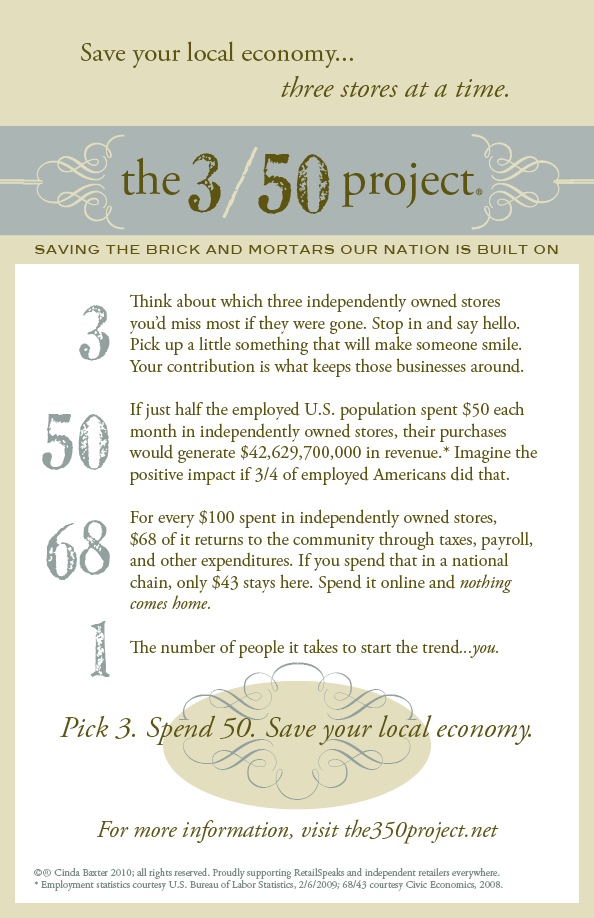
My regular readers (all 7!) know that I am passionate about "buy local" initiatives. I firmly believe that every dollar one spends is a vote, and I try to spend my dollars at locally owned businesses most of the time. So when I read about the 3/50 Project in the newspaper, I was pretty excited. The concept is easy. Choose 3 independently-owned businesses in your local community that you would really miss if they went out of business, and pledge to spend $50/month at each of them.
Can you think of 3 favorite independently-owned stores in your community that you would like to support?
Tuesday, August 04, 2009
Blogger Meet-Up
Answer: They are Not in the Picture above!
Who are these 4 Mysterious Bloggers?
- First Prize: A Free Subscription to one of their blogs (you choose)!
- Second Prize: A Free Subscription to two of their blogs (you choose)!
- Third Prize: Enrollment (as soon as it's available) in the Republican Party's new National Healthcare Plan - at its Market Driven - Bargain Price!
- Which 2 of these bloggers are married to each other?
- Which one was not married when the picture was snapped (2 weeks ago) but is married now?
- Which one owns a poodle?
- Which one had the farthest to go to get home?
- What's in that little white carton?
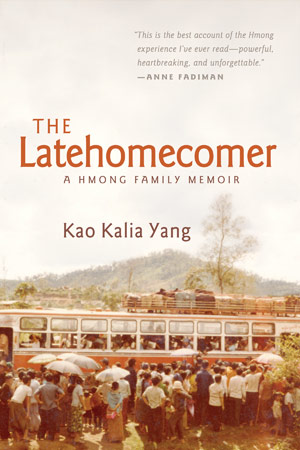
Book Review: The Latehomecomer, a Hmong Family Memoir
I am often surprised when I talk to people from other parts of the U.S. who don't know about Hmong-Americans. The Hmong were mountain people living in Laos. During the Vietnam war, they were recruited by our CIA to wage a Secret War against the communist forces in Laos (a fact that was long-denied by the U.S.) When the Americans departed in 1975, the Communist government of Laos waged genocide on the Hmong people. Thousands were massacred, while others fled into the jungles of Laos to hide or to make their long way to the Mekong River, to cross to Thailand and life in a refugee camp. In the mid-eighties Thailand no longer wanted to be host to thousands of Hmong refugees, and many of them came to the U.S., settling primarily in southern California, central and southern Wisconsin, and the Minneapolis/St. Paul area. In the mid-nineties when Clinton "ended welfare as we know it", there was another large Hmong migration from California to Minnesota, which had kinder policies toward people in poverty.The Latehomecomer was written by Kao Kalia Yang, a young woman who was born in the Ban Vinai Refugee Camp in Thailand in 1980 and came to Minnesota with her parents and sister when she was 6 years old. They were eventually joined by many aunts and uncles, as well as her beloved paternal grandmother. She tells a story of hard work and abject poverty, the parents working long hours in mostly menial, low-paying jobs, always with the goal of their children getting ahead through education, but not losing their essential Hmong-ness. This is also very much a love story for Yang's grandmother, a woman whose strength and fortitude kept her family together through unimaginably trying circumstances.
Madison has a sizable Hmong community and I have had a handful of Hmong students over the years, but I still know very little about the culture and would like to know more. The Latehomecomer was a beautifully written and fascinating book, and certainly provides food for thought as a teacher. It was also interesting to compare it with the only other book about the Hmong I've read: The Spirit Catches You and You Fall Down by Anne Fadiman.
I highly recommend The Latehomecomer. The author, Kao Kalia Yang, has also produced a documentary about Hmong American refugees, The Place Where We Were Born.
Book Review: Up In the Old Hotel

Up In the Old Hotel by Joseph Mitchell is a collection of articles that Mitchell wrote for The New Yorker over a period of time spanning from the early 1930s to the mid-1960s. They were originally collected and published in 4 separate books, long out of print. McSorley's Wonderful Saloon profiles characters Mitchell met in and around the Bowery in his early days in New York City. These include saloon-owners, a self-described Gypsy king, a colorful street preacher, the "Don't Swear Man", a freak show bearded lady, and many others, as well as several works of fiction. Old Mr. Flood describes one elderly man living around the Fulton Fish Market. The Bottom of the Harbor is about the fish market, and the fishermen -- the bay men and the river men -- who kept it supplied. The book ends with Joe Gould's Secret, a follow-up to one of Mitchell's earlier profiles (which my brother informs me was made into a movie a few years ago.)
I thoroughly enjoyed reading this book. It paints a picture of a New York city that is mostly long gone, a fact that is echoed in places all around the country and is to be mourned. It was dense reading, like a well-aged fruitcake. I read with a dictionary close at hand to look up unknown words, which is always fun.
If you enjoy the kind of books that explore one subject in depth -- in the vein of John McPhee or Mark Kurlansky -- check out Up In the Old Hotel. It was a treat.
Monday, August 03, 2009
What's the trouble with Harry?
Why Oh Why Isn't Paul Krugman Our Treasury Secretary?
Americans are angry at Wall Street, and rightly so. First the financial industry plunged us into economic crisis, then it was bailed out at taxpayer expense. And now, with the economy still deeply depressed, the industry is paying itself gigantic bonuses. If you aren’t outraged, you haven’t been paying attention. (Read the rest here.)I am outraged, but feel impotent to do much. When it comes to money, I don't have a lot in the first place to use as any kind of leverage, and I'm already trying my hardest to do socially responsible things with it. I guess the best I can do is attempt to educate people.
Sunday, August 02, 2009
To Facebook Or Not To Facebook -- That Is the Question
Yesterday a young (F)friend's status update stated that he was going out to check the neighborhood garage sales for a bike. Reading that, I sent him a message telling him that we had some salvaged, but stalwart bicycles sitting in our garage if his shopping proved fruitless. Sometime in the afternoon he popped up in a chat window on Facebook, asking about the bikes. I invited him to come check them out. He came over yesterday evening while we were out, selected a bike and took it home.
This morning he showed up after Meeting, hands covered in grease and grime, to settle up on a price. He said he had been attending Meeting for Worship with Attention to Bicycle Repair, and had happily ridden his new bicycle over to the Meetinghouse. It's probably a pretty decent bike -- an older American-made (which in all likelihood means Wisconsin-made) 10-speed Trek touring bike. I'm happy to see it go to a good home, after rescuing it from a trip to a landfill.
As you might expect, I drive a hard bargain. "It's a graduation gift, Martin!" I said, and then added that if he wanted to donate some money to AFSC (American Friends' Service Committee) or another worthy cause, he could do so. I was rewarded with a very sweet smile. It makes me smile just to think of it.
So there you have it. Sure, it could have happened without Facebook, but that would have required Martin or his mom to come to Meeting and announce that he was looking for a bicycle or submit it to the weekly announcements, etc. etc. This way it was all so serendipitous. Community at work, facilitated by Facebook. Cool.
Friday, July 31, 2009
Common Sense Trumps Fanaticism of Celibate Old Men
ROME — Italy has approved the use of the abortion drug RU-486, drawing fierce protests by the Vatican.
The drug, which terminates pregnancy by causing the embryo to detach from the uterine wall, is already available in several other European countries. But approval in Italy had been held up so far by the Catholic Church, which opposes abortion and contraception. (read the rest)
Thursday, July 30, 2009
Steve Earle Show
- nonviolence
- labor unions
- immigration
- human rights
- energy (you don't burn food -- i.e. corn -- for fuel when there are people going hungry and there's no such thing as "clean coal")
- rich vs. poor
High points of the evening? Pancho & Lefty, Good-bye, Jerusalem, Lungs, City of Immigrants … During the encore he announced that he became a first-time grandpa a few days ago and played Little Rock & Roller. (If my kids had been there, they would have checked at that point to see if I was crying. I plead the 5th.)
It was a most satisfying show, and we were in good company with friends Alice and Rob. Here is a list of tour dates, if you're inclined to try to see it. I'd recommend it.
Wednesday, July 29, 2009
Woo Hoo!
Here is a sample of what he'll be playing tonight:
Tuesday, July 21, 2009
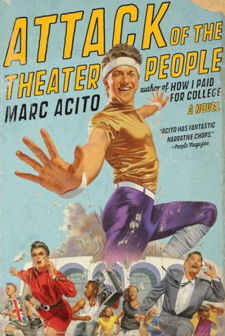
Attack of the Theater People!
It's a book review, silly. Attack of the Theater People is the sequel to How I Paid For College: A Novel of Sex, Theft, Friendship & Musical Theater. It was slightly less madcap, and delved into the very serious issue of coming out as a gay man in the early days of AIDS awareness. Otherwise it was a delightful romp from Hell's Kitchen to Upper Manhattan. If you're looking for something to read that is both fun and intelligent, look no further. Recommended.
Friday, July 17, 2009
The Incomparable, Irreplaceable Warren Zevon
Here is Mohammed's Radio -- a timeless classic that proves the old saying: the more things change the more they stay the same. Or maybe that we never stopped mucking about in the Middle East.
More Summer Reading
What can I say? Read. It. I don't want to say too much about it, but it was, in a word, delicious. With echoes of Red Sky At Morning (the Richard Bradford novel) and and A Prayer For Owen Meany -- two of my favorite coming-of-age novels, I enjoyed every minute of reading this book. It almost made me want to go back and repeat my senior year of high school. (Oh, wait. I didn't have a senior year of high school. I graduated after my junior year with about a million credits in folk dancing augmented by juggling. Life at an alternative high school in the seventies ...)
This kind of book is what summer reading is all about. Ahhhhh. Highly recommended.
Monday, July 13, 2009
Hostile Takeovers of the Corporate Kind, a book review
This was a really compelling read. As a lowly Midwestern schoolteacher who has never aspired to the kind of lifestyle that Katz describes, I experienced a kind of guilty pleasure in reading about these people. It was a little like reading a Kitty Kelly tell-all.
Beyond the story however, I think that Sign Off made some important points. If the slash-and -burn mentality that Katz describes is accurate -- and I have no reason to believe otherwise; he did a stint as executive producer of the CBS Morning News -- it speaks volumes to the miserable failure of the mainstream media to take on the corporate culture of American politics, which we saw flourish under the Bush Administration, and sadly continues under Obama.
The novel also underscores something that I have thought about a lot in the last couple of years, watching people I love -- mostly middle-aged men -- struggle with unemployment. I believe from the bottom of my heart that a covenant was broken with American workers, people who spent the better part of their adult lives working hard and paying into "the system" only to be discarded as if they were yesterday's garbage. If you haven't been there, let me tell you -- it shatters a person's sense of self like nothing else can and has enormous impact on family relationships as well.
Furthermore, I question whether when businesses say that they are "losing money" is it really a matter of having a smaller profit margin? I think, in many cases, yes, absolutely. When corporations "downsize" or "cut the fat" it is all about increasing the profits for the stockholders. Tell me, where in the Constitution does it say that stockholders have a right to make huge profits?
Reading Sign Off, I would almost say that Katz was prescient. What happened to television news has also happened in print media, and in fact has reached into almost every corner of our society. I suspect though, that he was just observing the beginning of the corporatization of the U.S. (and the world.) Michael Moore was certainly talking about it and Ralph Nader, of course.
It was also utterly fascinating to see the anatomy of a hostile takeover. It is a term I have heard plenty of times, but really only had the most superficial understanding of what it meant. It strikes me that, among the provisions of that most horrible No Child Left Behind legislation are the sanctions for "failing schools" that include "reconstituting" a school's staff. That's nothing more than a hostile takeover -- welcome to corporatized America. (Don't get me started on Obama and education. I can hardly write about it, I am so furious.)
Sign Off is a very well-written, illuminating, and entertaining book. After many years of writing memoir, Katz is once again returning to fiction. I am looking forward to it.
Recommended, but it might take some digging to find it. It's worth the search.
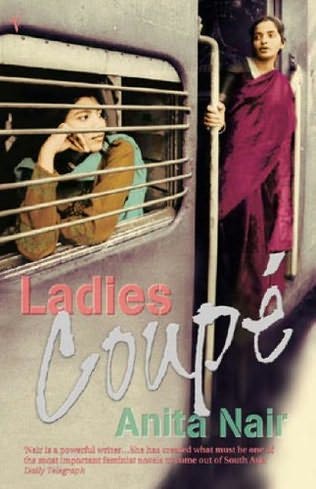
Book Review: Ladies' Coupe by Anita Nair
I picked up Ladie's Coupe for 80¢ in the St. Vinnie's book room, because I liked the cover. I liked the cover, OK? I defied years of people intoning, "Don't judge a book by its cover ..." and you know what? The Library Goddess did not smite me with her bun and spectacles. That's a good thing.Reading Ladies' Coupe was a good thing too. This is a novel about Akhila, 45-years old and never married. Her father died when she was in her late teens; as an acknowledgment of his years spent working in an income tax office, Akhila is given a position as an income tax clerk so that she can support her mother, sister and two brothers. And so the years slip by, until one day Akhila realizes that she has done nothing for herself. She decides to take a short vacation to a seaside resort -- alone, much to her family's consternation.
Up until quite recently female travelers on India's railways had the option of riding in the "ladies' coupe" -- a compartment set aside strictly for women. Akhila reserves a seat in a ladies' coupe, and traveling among women whom she knows she will never see again, she feels free to ask them, does she really need a marriage to be fulfilled? During the course of the journey, each of the other 5 women in the coupe has a chance to tell her life story.
For some reason I have a special interest in India. I've loved the films of Mira Nair (no relation to the author of this book that I know of) and have read quite a few novels as well. This really was a marvelous addition to the canon. I recommend it.
Wednesday, July 08, 2009
Paul and his girlfriend Des

Apparently this eagle, Des, was notoriously cranky with 'most everybody else at the nature center, but took a liking to my brother. He always has been a bit of a ladies' man ...
Tuesday, July 07, 2009
Bursting With Pride!

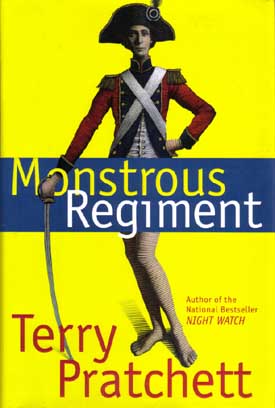
Book Review: Monstrous Regiment by Terry Pratchett
It is difficult to say much about Monstrous Regiment without giving too much away and spoiling it for you, so I'll keep my review brief. In Monstrous Regiment Pratchett skewers the military industrial complex, the war on Iraq, religious fundamentalists, and traditional English folk songs. This is among my favorite books by Terry Pratchett. It's a hoot.
Saturday, July 04, 2009
Believe it or not, I've wondered about this ...
Here in Wisconsin we have our own version, although ours is not part of the state constitution ... yet. The other thing unique about our revenue caps that supposedly give tax relief to property owners, is that they specifically target K-12 public school districts. Our then-Governor Tommy Thompson (remember Tommy? He ran for the Republican nomination in the last presidential election) had a personal vendetta against teachers. He gave us the revenue caps and took away our right to bargain fair contracts, two gifts that have kept on giving for the last 16 years.
Friday, July 03, 2009
Support Your Local Food Pantries!
Summer is typically a time when food pantries are hurting. Kids who normally get breakfast and lunch at school are home. There is a strain on the resources of food pantries.
Behold, the Million Can March. An alternative to the ridiculous "tea parties" being held around the country this weekend. Something that will make a real difference in the lives of members of our communities.
From Les Enrages.org (the brilliant masterminds behind this movement)
Here are some food suggestions:• If in doubt, call the agency you plan to donate to and ask them what they need.
Here's a basic list:
• cereal, instant oatmeal
• Canned meats & fish (tuna, salmon, deviled ham, canned chicken, etc)
• Peanut butter, jelly, crackers
• fruits and vegetables
• Soups, stews, canned pasta dishes like beefaroni, lasagna, ravioli
• Boxed potatoes and rice and pasta mixes in a box or pouch
• "Just add water" cake, pancake, muffin mixes, etc.
• Canned and powdered milk
• Infant formula and baby foods
You can also think in terms of a meal:
• Spaghetti sauce and pasta
• Tuna and macaroni and cheese
• Beans & Rice
You get the idea, and then add a vegetable, a fruit, and a sweet treat.
Really, this isn't rocket science. Give what you like to eat!
Here is a link to food pantry and meal sites in the Madison (Wisconsin) area.
Thursday, July 02, 2009
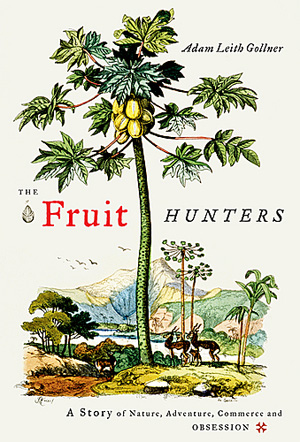
A Fruity Book Review
I am a fan of those monomaniacal nonfiction books, the ones that go into great depth on one subject. In this case the subject is fruit and the book is Adam Leith Gollner's The Fruit Hunters: A Story of Nature, Adventure, Commerce and Obsession. Why fruit? It hasn't really ever before been an obsession of mine. I try to eat my 5 servings a day with varying degrees of success. However, as I read the book, I became aware that I may be a little more fruit-obsessed than I thought. I like growing fruit in my yard: I've been quite successful with currants and raspberries, less so with cherries, choke cherries, and service berries. Those are fruits of the north. Gollner's book is filled with tropical fruits, more fruits than you can imagine."The diversity is dizzying: most of us have never heard of the araça, but Amazonian fruit authorities say there are almost as many types of araças as there are beaches in Brazil. Within the tens of thousands of edible plant species, there are hundreds of thousands of varieties – and new ones are continually evolving. Magic beans, sundrops, cannonballs, delicious monsters, zombi apples, gingerbread plums, swan egg pears, Oaxacan trees of little skulls, Congo goobers, slow-match fruits, candle fruits, bastard cherries, bignays, belimbings, bilimbis and biribas. As Hamlet might’ve said: 'There are more fruits in heaven and earth, Horatio, than are dreamt of in your philosophy.' ”Suddenly I feel fruit-deprived; of the small percentage of the world's fruits that are grown or allowed into the U.S., by the time they get to my landlocked city, they will have been on the road for days, sometimes weeks, and the flavor a mere shadow of what it should be. There are the hundreds of varieties of more familiar fruits that have been neglected in our commercial fruit monoculture, so we only ever get to eat one or two varieties of pears, strawberries, bananas, figs, avocadoes, pomegranates, etc. etc. etc. And then there are the fruits that will never make it here: the chupa chupas, bignays, sapotes, gourkas ... Sigh.
(I can't say I'm sad about the durian though. I once had the bad fortune to eat a durian-filled cookie from the Asian grocery store. I absolutely could not choke it down, ended up gagging into the garbage can, and even so, I burped up durian taste all day long. Then again, some people say they have the same reaction to cheese.)
If you ever thought that fruit was just a side dish, an afterthought, guess again. Gollner shows, in no uncertain terms, how fruit has shaped and defined life on earth in general, and human life in particular. He takes the reader to the very extreme edges of his subject: the fanatics who stop at nothing to get their hands on a fruit and the fruitarians -- people who eat nothing but fruit (and their subsets such as the "rockguacamolians" who only eat avocadoes sprinkled with asteroid dust,) and shows us the underbelly of the fruit world as well. The way that the fruit trade is linked to organized crime, for example. The creepy, underhanded treatment and marketing of "wholesome" fruit. The geopolitics of fruit. Or the fact that the idling semi-trucks that serve the huge Hunts Point Fruit Market in the Bronx are responsible for way elevated, life-shortening asthma rates (which I've read about in Jonathan Kozol's books about the work he does with schoolchildren in the South Bronx.)
Reading The Fruit Hunters has made it difficult for me to think about fruit in the same way that I did before. Shopping at my local food co-op this week, I was sorely disappointed to see that, with the exception of one small bin of local apples, virtually all the other fruit was imported from California or Mexico, including the strawberries, raspberries, and blueberries. I had a hard time buying anything!
I have been, however, deeply appreciative of every red raspberry that I have plucked off the bushes in my backyard. I'm thinking of planting a paw paw tree. I am also heading back to a serviceberry tree that I found growing on a city street a few blocks from here, dropping its sweet, delicious berries onto the sidewalk. There are a lot of fruits to forage, right here.
Oh! Am I reviewing a book? Sorry, I forgot. The Fruit Hunters: dripping with sex (yes, really!) An entertaining and enlightening read. Recommended.