There is a lot of fear floating around these days, as Wisconsin prepares to inaugurate a new governor: the climate change-denying, virulently anti-union, anti-high speed rail, anti-teacher, anti-everything Fighting Bob LaFollette stood for Scott Wanker (oops -- there's that pesky typo again; my finger slips off the "L" onto the "N" every time!) Fear has also been on my mind since I finished Barbara Kingsolver's stunning novel The Lacuna a few days ago, some of which revolves around McCarthyism and the ability to control people through their fear.
One of the things I truly looked forward to when Obama was elected was an end to the kind of fear that the Bush Administration constantly stirred up, and to some extent I think that has been the case. But election 2010 happened, with fairly draconian overtones for us in Wisconsin, and there is a lot of fear of what it will mean for the public servants that the new governor seems to hate so much. I don't want to be a Pollyanna, nor do I want to put my head in the sand. However, I'm not finding it helpful when people come up to me and say, "What do you think it's going to mean for us teachers? Don't you wish you could retire?" etc. etc.
I've been wishing (not for the first time) that I could talk to my parents about their experiences living through dark and scary political times, because from my perspective they did so with their heads held high, without fear, and managing to convey an unfailing sense of hope.
This is how I want to meet the new regime: to speak truth to power (and not just in the vacuum of Blogdom or Facebook,) to be effective, to not give in to fear and to give my children hope. Being on the Left means being frequently lonely, but I will seek out like-minded people, I will try to lead by example, I will encourage the quiet ones to speak their truth as well. I choose to remember that there is power in numbers, and perhaps this is the kick in the beehind that's needed for the masses to stand up. (And if not, I'll still hold my head up high.)
One of my favorite quotes for times like these is from Bayard Rustin, the long-unsung hero of the civil rights movement, when he was asked where he found the hope to go on. His response (paraphrased) was that hope isn't something you find, it's something you make.
Friends, go forth into the new year without fear and make hope.
Friday, December 31, 2010


Wednesday, December 29, 2010
Have you been naughty, or nice?
Hogswatch is coming, the pigs are getting fat …
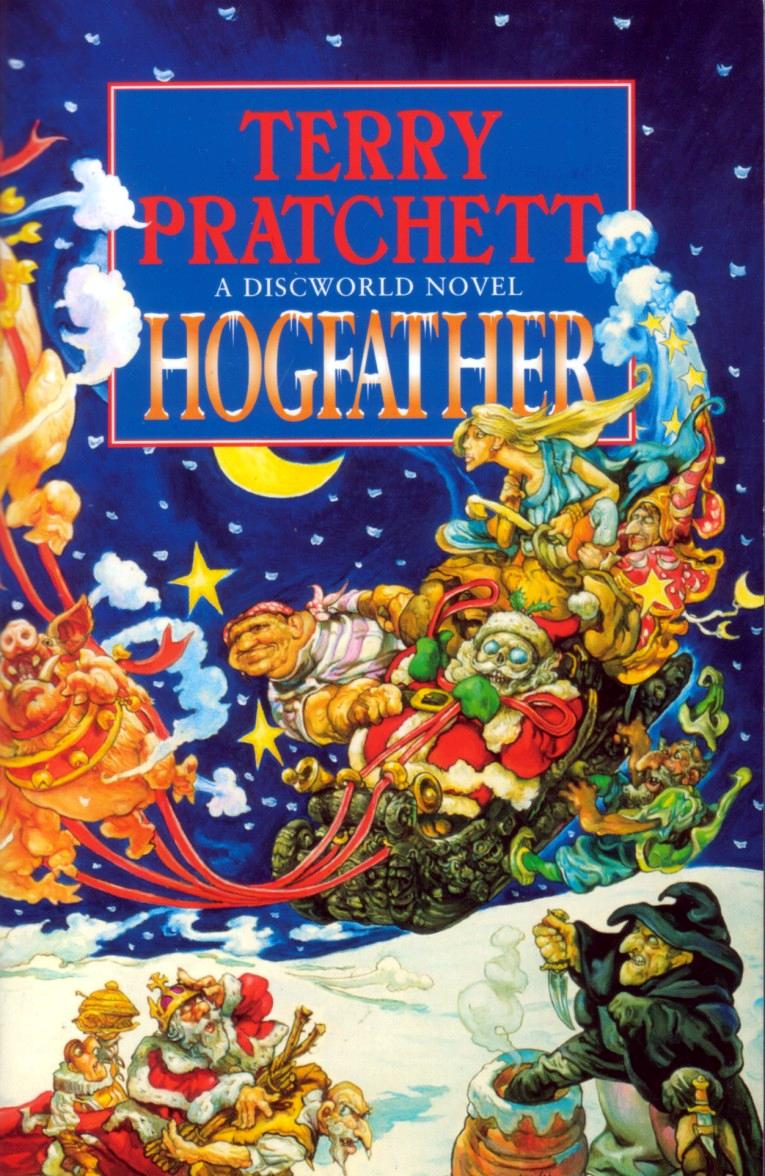
Yes, it's that time of year, when you hear the scraping of sleigh runners and the prancing of
16 tiny hooves on your rooftop, when the fellow in the red robe comes down your chimney
with his HO HO HO, a time to be jolly, with mistletoe and holly and -- other things ending
in olly. That can only mean one thing: It's time for the annual reading of Terry Pratchett's
Hogfather!
It's Hogswatch Eve, and the Hogfather has gone missing under mysterious circumstances.
Paid assassin, Mr. Teatime (pronounced Te-ah teem-eh) and a band of petty thieves are
messing with the beliefs of the world's children, leaving an inconvenient surplus of belief
elsewhere -- especially at the Unseen University in Ankh-Morpork. Someone has to step in
to save Hogswatch so that the sun will continue to rise each day, and that someone is …
Death? HO HO HO. Also featuring the Verucca Gnome and the Oh God of Hangovers.
Another delectable offering in the Discworld series, Hogfather manages to poke fun at
everything associated with holidays while honoring the underpinnings of tradition. A story
with many twists, turns, and seemingly loose ends, but in the end you are richly rewarded.
Pratchett's books may seem light and insignificant, but they offer so much food for thought.
Honestly, what are you waiting for? HO HO HO, Happy Hogswatch!
Monday, November 08, 2010
We interrupt this reading of Terry Pratchett for a [so far] rather depressing novel.
My book group is reading Let the Great World Spin by Colum McCann. I have 200+ pages to read in order to finish it by Thursday night's book group meeting. But that's not why I'm writing tonight. This is a book review of Terry Pratchett's most recent book -- his fourth YA novel about the young witch, Tiffany Aching.

The Tiffany Aching series begins with the delightful The Wee Free Men, when the 9-year old Tiffany first is identified as a witch, meets the Nac Mac Feegle (or "wee free men", a race of tiny blue men in kilts who enjoy drinkin', fightin', and drinkin') and goes head to head with the queen of the fairies to rescue her younger brother, as well as Roland, the son of the local baron. In A Hat Full of Sky, Tiffany is 11. She's left her home on the Chalk to go to the mountains and get formal training as a witch, but a malevolent spirit called a "hiver" has taken up residence in her body and she must outwit it or die. In the third book, Wintersmith, when the 13-year old Tiffany makes the impetuous decision to join in the age-old Morris dance honoring Winter and Summer, she attracts the amorous attention of the Wintersmith and stirs up jealousy in the heart of the real Lady Summer.
In I Shall Wear Midnight Tiffany is 16 and has returned to be the local witch for the people of her beloved Chalk. But all is not well. She has had a falling-out with Roland, whom she had supposed she would marry one day, and he is betrothed to someone else. Furthermore, there is rising sentiment against witches that threatens to break out into the kind of violence that was seen in the past, and whatever is causing it appears to be focused on Tiffany.
Like the previous Tiffany Aching books, this one is filled with Pratchett's trademark intelligent humor spiced with a little bawdiness (courtesy of the Nac Mac Feegle and the delightful old witch Nanny Ogg) and infused with serious social commentary. There is also a bittersweetness to it: Pratchett has been very public about his diagnosis with early-onset Alzheimer's disease, and this book felt like an extended good-bye to many beloved characters from his earlier Discworld books. At any rate, Tiffany Aching is a child no longer, so I suspect it is the last children's book about her.
My introduction to Terry Pratchett was The Wee Free Men, and after that I was hooked. Tiffany is one of the best female characters to come along in a very long time, and I absolutely love Pratchett's take on witchcraft. I highly recommend that you read this series (and then make the leap over to his Discworld books for adults.)
The Tiffany Aching series begins with the delightful The Wee Free Men, when the 9-year old Tiffany first is identified as a witch, meets the Nac Mac Feegle (or "wee free men", a race of tiny blue men in kilts who enjoy drinkin', fightin', and drinkin') and goes head to head with the queen of the fairies to rescue her younger brother, as well as Roland, the son of the local baron. In A Hat Full of Sky, Tiffany is 11. She's left her home on the Chalk to go to the mountains and get formal training as a witch, but a malevolent spirit called a "hiver" has taken up residence in her body and she must outwit it or die. In the third book, Wintersmith, when the 13-year old Tiffany makes the impetuous decision to join in the age-old Morris dance honoring Winter and Summer, she attracts the amorous attention of the Wintersmith and stirs up jealousy in the heart of the real Lady Summer.
In I Shall Wear Midnight Tiffany is 16 and has returned to be the local witch for the people of her beloved Chalk. But all is not well. She has had a falling-out with Roland, whom she had supposed she would marry one day, and he is betrothed to someone else. Furthermore, there is rising sentiment against witches that threatens to break out into the kind of violence that was seen in the past, and whatever is causing it appears to be focused on Tiffany.
Like the previous Tiffany Aching books, this one is filled with Pratchett's trademark intelligent humor spiced with a little bawdiness (courtesy of the Nac Mac Feegle and the delightful old witch Nanny Ogg) and infused with serious social commentary. There is also a bittersweetness to it: Pratchett has been very public about his diagnosis with early-onset Alzheimer's disease, and this book felt like an extended good-bye to many beloved characters from his earlier Discworld books. At any rate, Tiffany Aching is a child no longer, so I suspect it is the last children's book about her.
My introduction to Terry Pratchett was The Wee Free Men, and after that I was hooked. Tiffany is one of the best female characters to come along in a very long time, and I absolutely love Pratchett's take on witchcraft. I highly recommend that you read this series (and then make the leap over to his Discworld books for adults.)
Wednesday, September 29, 2010
Thanks to "Seedy Pete" at Worldwide Hippies
I loved this response to a "Gawker" column at Worldwide Hippies: President Orders College Kids To Do Something.
Here's the deal, Mr. President.
I am going to vote Democrat in the midterms. Not because I believe you or your party will accomplish a single goddamned thing that I care about; they are clearly inept to the point of ridiculousness and your fetish for compromise would be laudable if the other party shared it but since they have openly stated they are unwilling to negotiate on anything it's an enormous handicap. But I will vote Democrat, because the alternative is actually horrifying.
I am disappointed that the public option was dropped without a fight in favor of drug price fixing deals with Big Pharma and a mandate to purchase insurance from the same handful of companies whose monopoly on insurance is why we have a WHO score on par with a third world country in the first place. I am disappointed that your party has rolled over on fighting the crooked Bush tax cuts, or extending health benefits for 9/11 first responders, or repealing DADT. Want to know what those four things have in common? They were all overwhemingly popular with the public during a period when your party had a majority (briefly even a supermajority) and yet without exception the Democrats in Congress either traded away core parts of their party platform in exchange for absofuckinglutely nothing or just completely bobbled the ball and let the GOP control the debate. You people are sexually attracted to failure.
Just a few years ago the GOP passed spectacularly unpopular legislation with considerably less votes in Congress...granted, unlike you they were able to count on the fact that the opposition party was so spineless they'd vote for things they claimed to oppose out of fear of being painted as unpatriotic. But the Democrats don't have the advantage of getting to fight against Democrats, so at some point you people are going to have to grow a goddamned backbone.
So why vote Democrat at all, if your party is determined to fail at everything you try? Because at least you're trying, and the opposition party is a veritable death cult with no plan beyond getting back into power so that they can do the exact same things that ran the country off the rails in the first place.
But don't expect me to get excited about it. Don't expect me to volunteer my time and money to help Democrats get elected the way I did in 2008. You squandered every opportunity we gave you, ignored your professed values, punted on the first down at every opportunity, and ignored your base in order to court the votes of people who wouldn't piss on you if you were on fire. Then election season rolls back around and suddenly you remember to pay lip service to our values? Piss off. You don't get another dime from me until I see you people care about progress sometime other than election season. And stop mistaking my disgust for apathy, or my expectation that Democrats in Congress do their goddamned jobsfor unrealistic magical thinking. No one expected a magic wand to be waved and the trainwreck the GOP spent 8 years created to be undone in 2, but what we did expect was that you would at least make an effort. Your party has failed to meet the already exceedingly low expectations I set for it.
Here's the deal, Mr. President.
I am going to vote Democrat in the midterms. Not because I believe you or your party will accomplish a single goddamned thing that I care about; they are clearly inept to the point of ridiculousness and your fetish for compromise would be laudable if the other party shared it but since they have openly stated they are unwilling to negotiate on anything it's an enormous handicap. But I will vote Democrat, because the alternative is actually horrifying.
I am disappointed that the public option was dropped without a fight in favor of drug price fixing deals with Big Pharma and a mandate to purchase insurance from the same handful of companies whose monopoly on insurance is why we have a WHO score on par with a third world country in the first place. I am disappointed that your party has rolled over on fighting the crooked Bush tax cuts, or extending health benefits for 9/11 first responders, or repealing DADT. Want to know what those four things have in common? They were all overwhemingly popular with the public during a period when your party had a majority (briefly even a supermajority) and yet without exception the Democrats in Congress either traded away core parts of their party platform in exchange for absofuckinglutely nothing or just completely bobbled the ball and let the GOP control the debate. You people are sexually attracted to failure.
Just a few years ago the GOP passed spectacularly unpopular legislation with considerably less votes in Congress...granted, unlike you they were able to count on the fact that the opposition party was so spineless they'd vote for things they claimed to oppose out of fear of being painted as unpatriotic. But the Democrats don't have the advantage of getting to fight against Democrats, so at some point you people are going to have to grow a goddamned backbone.
So why vote Democrat at all, if your party is determined to fail at everything you try? Because at least you're trying, and the opposition party is a veritable death cult with no plan beyond getting back into power so that they can do the exact same things that ran the country off the rails in the first place.
But don't expect me to get excited about it. Don't expect me to volunteer my time and money to help Democrats get elected the way I did in 2008. You squandered every opportunity we gave you, ignored your professed values, punted on the first down at every opportunity, and ignored your base in order to court the votes of people who wouldn't piss on you if you were on fire. Then election season rolls back around and suddenly you remember to pay lip service to our values? Piss off. You don't get another dime from me until I see you people care about progress sometime other than election season. And stop mistaking my disgust for apathy, or my expectation that Democrats in Congress do their goddamned jobsfor unrealistic magical thinking. No one expected a magic wand to be waved and the trainwreck the GOP spent 8 years created to be undone in 2, but what we did expect was that you would at least make an effort. Your party has failed to meet the already exceedingly low expectations I set for it.
Stop mistaking my disgust for apathy … Do I have an AMEN?
Why I didn't go to the Obama rally …
President Obama spoke in my hometown yesterday, and I had a hard time mustering much enthusiasm for him. I made some comments on Facebook to that effect, and a friend of a friend commented that liberals shouldn't be blaming him for his failure to right the wrongs of the Bush administration's 8 years in just 20 months -- something which I have heard often. It led me to want to clarify why I am so disappointed in the Obama presidency, to find a way to put it into words so I don't just sound like a disenchanted liberal who feels that Obama has failed to deliver the goods fast enough.
The essence of it is this: Aside from the backpedaling on campaign promises (which I consider to be standard political fare,) I resent that the Obama White House treats people on the progressive left (like me) as part of the problem instead of part of the solution. Because the ideas that we champion -- ideas such as universal single payer health care, a WPA-style employment recovery plan, removing troops from Iraq and Afghanistan -- are common sense, good for the country, and tried and true. We are not obstructionists, nor are we naysayers. We are the yea-sayers, the ones who would happily pick up the mops and get to work, as Obama exhorted his critics to do last year.
We are the ones who got to work to elect this guy.
And they treat us as if we are, at best, inconsequential. Irrelevant. Then we are chastised for not wanting to come to the rallies to hear the pretty words. And it disturbs me greatly that so many who do the chastising are other progressives.
Obama is charasmatic. He is smart, and a good speaker. However I am wary of the cult of personality that continues to surround him. I want action in the right direction on his administration's part. I want acknowledgement and respect.
BTW, this doesn't mean that I am not voting in November. I am quite aware that people in other places die for the right to vote. But let me remind other liberals who might criticize my stance, questioning my government is also a right we hold dear -- or used to.
The essence of it is this: Aside from the backpedaling on campaign promises (which I consider to be standard political fare,) I resent that the Obama White House treats people on the progressive left (like me) as part of the problem instead of part of the solution. Because the ideas that we champion -- ideas such as universal single payer health care, a WPA-style employment recovery plan, removing troops from Iraq and Afghanistan -- are common sense, good for the country, and tried and true. We are not obstructionists, nor are we naysayers. We are the yea-sayers, the ones who would happily pick up the mops and get to work, as Obama exhorted his critics to do last year.
We are the ones who got to work to elect this guy.
And they treat us as if we are, at best, inconsequential. Irrelevant. Then we are chastised for not wanting to come to the rallies to hear the pretty words. And it disturbs me greatly that so many who do the chastising are other progressives.
Obama is charasmatic. He is smart, and a good speaker. However I am wary of the cult of personality that continues to surround him. I want action in the right direction on his administration's part. I want acknowledgement and respect.
BTW, this doesn't mean that I am not voting in November. I am quite aware that people in other places die for the right to vote. But let me remind other liberals who might criticize my stance, questioning my government is also a right we hold dear -- or used to.
Saturday, September 25, 2010
Oh Dear Blog, Do You Still Love Me?

Nation opens in a time of upheaval in the mid-nineteenth century. There has been a flu epidemic in Britain which has claimed the King and a great number of his heirs, and a ship has been dispatched to one of the furthest outposts of the British empire to fetch the next living heir. Meanwhile in the great Pelagic Ocean there has been a massive tsunami that brought death and destruction to the many island nations there.
Mau is an inhabitant of one of the islands, his people known simply as "the Nation." No longer a boy and not yet a man, Mau was returning from his initiation into adulthood on a distant island when the wave struck. He returns to his home island to find that he is the only survivor.
Daphne is a well brought up British girl, who was sailing out to join her father in Port Mercia in the Pelagic Ocean. The Sweet Judy, the ship on which she travels, has already withstood an attempted mutiny when the tsunami hits. The captain and remaining crew are drowned in the wave and the ship is driven to Mau's island. Daphne and a foul-mouthed parrot have survived.
Inevitably Mau and Daphne meet. They form a bond based on mutual survival, that grows into a friendship over time. As time goes on, more survivors of the tsunami find their way to the Nation, and Mau -- lost in his grief, in limbo between childhood and manhood, and questioning the gods of his people who would take so many innocent lives -- must act as the chief of the Nation.
In some ways Nation is less satirical than Pratchett's other books, but many of the themes are familiar. As always he raises questions about government and organized religion, and also white supremacy, class, and empire. Because it was written for a younger audience, at times the narrative seems too simple, but ultimately Nation is a very wise and thought-provoking book. I recommend it, and if you can read it while marooned on an island, so much the better.
Tuesday, July 06, 2010
What's Up With All the Teacher Bashing?
Excellent article from the editors of an excellent publication, Rethinking Schools.
That was 15 years ago. Since then I have taught both first grade and kindergarten (sometimes both at the same time, which is just crazy-making.) And while I am still very concerned about teaching in a developmentally appropriate way, I have also made my peace with the increased emphasis on academic achievement -- as long as it is done effectively. Over the last couple of years my district, and particularly my school, has been looking very closely at targeted interventions to give kids the basic skills they need, and I think we are slowly seeing what is known as "the achievement gap" close. And I feel good about it because it is good for the kids and their families. I understand that some of my teaching practices from the past were good for the kids that were going to succeed anyway, but less so for the kids that struggled.
How does this relate to teacher bashing? Every teacher I know who is working in so-called failing schools is committed to seeing all of their students succeed. We work hard and are willing to partner with parents to see our schools become the best that they can be for all students. Oh yeah, and we are the teachers' union.
I would like to see the people who bash teachers, who want to weaken the unions that represent us (and tangentially the students and families) spend a week doing my job. Just one week. I'll bet they couldn't even finish it out, much less actually teach anything. The article is correct to point out that it is patently unfair to single out teachers.
Read the article in its entirety here.
Teachers have always been devalued in the United States, but in the past months the pace and intensity of the attacks have escalated sharply. Spurred by the June 2 deadline for the second round of Race to the Top, states have raced to fire more teachers, tie pay and evaluation to student test scores, close or reconstitute more schools, and disempower teachers' unions and teaching as a profession-trampling teachers, students, and communities in the process.
What lies behind this unprecedented assault on teachers? And, even more important, what can we do about it? We believe that these attacks are part of an effort to dismantle public education and that we need an effective, collaborative strategy to combat it.I was teaching first grade at a high poverty school back in the mid-nineties, when a lot of these so-called reforms started coming down the pike. The changes we were being asked to make at that time were distressing. We were being told to give up what I considered to be developmentally appropriate practices in the name of meeting the "standards and benchmarks." It was so distressing that I fled first grade for a Pre-K program, and even considered leaving teaching altogether.
That was 15 years ago. Since then I have taught both first grade and kindergarten (sometimes both at the same time, which is just crazy-making.) And while I am still very concerned about teaching in a developmentally appropriate way, I have also made my peace with the increased emphasis on academic achievement -- as long as it is done effectively. Over the last couple of years my district, and particularly my school, has been looking very closely at targeted interventions to give kids the basic skills they need, and I think we are slowly seeing what is known as "the achievement gap" close. And I feel good about it because it is good for the kids and their families. I understand that some of my teaching practices from the past were good for the kids that were going to succeed anyway, but less so for the kids that struggled.
How does this relate to teacher bashing? Every teacher I know who is working in so-called failing schools is committed to seeing all of their students succeed. We work hard and are willing to partner with parents to see our schools become the best that they can be for all students. Oh yeah, and we are the teachers' union.
I would like to see the people who bash teachers, who want to weaken the unions that represent us (and tangentially the students and families) spend a week doing my job. Just one week. I'll bet they couldn't even finish it out, much less actually teach anything. The article is correct to point out that it is patently unfair to single out teachers.
It would be nice if Newsweek were suddenly worried about how race and class affect student success. But these diatribes against teachers are not based in a commitment to equity.
No, if closing the achievement gap were the goal, we would see demands for adequate, equitable resources and funding for every student in every school-demands, for example, for quality early childhood education programs, full-time librarians, robust arts and physical education programs, mandated caps on class size, and enough time for teachers to prepare and collaborate. We would also see a renewed commitment to affirmative action in university admissions; a drive to recruit and nurture teachers of color; a commitment to ensure that students come to school ready to learn because their families have housing, food, medical care, and jobs; and an end to zero tolerance discipline policies that criminalize youth.
But if these attacks on teachers aren't about ending the systemic racism that continues to undermine our education system, what is the goal? With forces as seemingly disparate as the Obama administration, the Walton Foundation, the late Milton Friedman, and the New York Times all pushing the same ideas, this is a complicated question, but there are at least two major goals: destroy the power of the teachers' unions, and turn the public school system from a public trust into a new market for corporate development. From the time of Reagan, who used his "welfare queen" stories to scapegoat the poor as a basis on which to destroy the welfare system, this has been a tried-and-true approach to privatization: use visceral anecdotes to whip up hysteria that a system is "broken," argue that only market competition can fix the situation, and then sell off pieces of the public sector to private corporations. This time, teachers are the scapegoats.What can you do? It is as easy as speaking up the next time your co-worker or ill-informed brother-in-law starts bashing teachers and public education. Ask them if maybe they'd like companies like BP, Blackwater, or Halliburton to be running their children's schools.
Read the article in its entirety here.
Tuesday, June 29, 2010
Large Print Edition of my blog …
… courtesy of Daisy. >^..^< (She stepped on something behind the monitor.)
Left Behind?
I have been exceedingly disappointed with the Obama Administration's stance on education. Rather than reaffirming support for public education, this president -- with former "CEO" of Chicago schools Arne Duncan at his side -- has been pushing harder for so-called "school choice" and reinforcing the more punitive pieces of the Elementary and Secondary Education Act (ESEA, formerly No Child Left Behind.) As an educator this upsets me so much, but it is difficult to articulate all of the ways in which I find it abhorrent.
I subscribe to a listserv called Public Education Network (PEN) but I rarely make the time to look at it. Sneaking a peek this morning, I was reminded why I should be paying attention. There was a link to the Washington Post's education column "The Answer Sheet", with the headline Christian Churches Oppose Race To The Top, Obama Blueprint:
Here is an extraordinary letter that should erase any doubt that opposition to the Obama administration's $4 billion Race to the Top is wide and deep.
Sent recently to President Obama and U.S. lawmakers by the National Council of the Churches of Christ in the USA, a community of 36 communions with a combined membership of 45 million people, this letter expresses deep concern about the education priorities of Race to the Top and of Obama's “blueprint” for education reform.
It criticizes the administration's effort to push states to increase the number of charter schools, its plan to turn some of the federal money used to help poor children into competitive grants, its punitive approach to dealing with low-performing schools, and the "ugly" demonization of public school teachers.
This Pastoral Letter is so absolutely spot-on, I wanted to stand up and cheer. I urge you to read it in its entirety. The thing is though, it came out on May 18, and this is the first I have seen it. Its content needs to be shouted from rooftops. Members of Congress need to read it. Dismantling public schools not only undermines our alleged democracy, but Obama's blueprint for education hurts the very children that everyone claims to care the most about.
Monday, June 28, 2010
Book Review: Ash

It took me a little while to get into Ash, and there were times when I bogged down in Lo's descriptive text. Now that I have finished it and am reflecting on it as a whole, I can say that I thoroughly enjoyed it. It is very well written. Retellings of fairy tales are a genre of fantasy unto themselves. If you enjoy reading them, you will probably like Ash.
Recommended for young teens and up. There is some sexual innuendo, but nothing explicit.
Sunday, June 27, 2010
Angst
I am struggling with something. It has to do with money, and I have a very complicated and angst-ridden relationship with money (and those whom I perceive to have money.) My 14-year old daughter worked for 2 weeks at a summer camp which she has attended before as a camper. Later in the summer they will have a program for teen campers. Tuition is out of our price range: close to $2000. Last week when I picked our daughter up for a night off, she mentioned that there was still space in the teen camp, that she really wanted to go, and that the directors had told her that there was scholarship money available; we had only to apply.
This week I received an email, and then a phone call, from a camp board member -- who handles much of the registrar duties -- asking whether we had given any more thought to our daughter's attendance at the camp and how much money we thought we could contribute toward her tuition. Here is my struggle: We really hadn't planned for her to attend camp, she hadn't shown much of an interest earlier in the spring, and in no way had we budgeted for it (not that we are particularly good at budgeting anyway.) I feel that this opportunity should not have been offered to her -- with the implied promise of scholarship money -- without including us in the conversation, if there was going to be an expectation of a monetary contribution on our part. It puts us in the position of being the bad guys to our daughter -- having to say no, we can't afford it.
Now, nobody has said that we can't apply for a full scholarship. However, just the fact that the question was raised of us making a contribution tells me that there is an expectation, spoken or not. And what that does is put me in a place of feeling ashamed.
Having to ask for help with money makes me feel ashamed. It is a gut-level, emotional response on my part that I haven't really been able to cleanse myself of, even after years of therapy. It touches on all kinds of things: the thought that I haven't gone on in higher education so that I can make more money, questions about how we choose to spend any extra money we might have, the thought that maybe if we were "better" with our money we wouldn't need scholarships, etc. etc. etc. There's room there for a lot of self-recrimination, and I go there very easily.
Yet I have a big problem with "strings attached" scholarships. People for whom money is not an issue do not understand that it can be an emotional and psychological burden, as well as a financial burden on a family or individual. Even if the strings are just asking one to justify their request for financial help. It is putting up one more roadblock for people who already have a lot of roadblocks to get over.
I'm not saying all of this to elicit sympathy for poor me and my economic plight. Our finances aren't great, but we're okay for now, and a hell of a lot better off than some others. I know that. We probably could come up with a token contribution of $100, and forgo something else, and ultimately not really notice too much. But if it is hard for me, what is it like for other people, for whom there is little flexibility?
Individuals -- even very decent, well-meaning, generous individuals -- who operate from a place of privilege don't, or maybe can't, understand what it feels like.
This maybe the subject of another blog post, but it's uncomfortable and painful, so I'd better spill it out here while I'm on a roll. I run into this a lot among Quakers, my spiritual community. There is a saying that Quakers came to the so-called new world to do good, and did very well indeed. That is to say, that on the whole, Friends tend to be quite comfortably well off. There is an expectation that Friends will practice "right giving" with their money, and indeed Friends are very generous. For example, if the children are selling cookies at the rise of Meeting to raise money for earthquake relief in Haiti, it is not unusual for them to raise $500 very quickly. Friends in my Meeting have also been very quick to respond when it comes to hooking up someone in need with an agency that can help. And even to make private, personal financial donations.
However during the 2 years that my husband was unemployed, when we came close to losing our house (and I know we're lucky to own a house,) again and again I ran up against individuals that simply didn't get that when I said we didn't have extra money, we didn't have extra money. And when it came to making a financial contribution to Camp Woodbrooke for appearance's sake because I was on the board and we were fundraising, or when as a congregation we are asked to increase our individual donations to the Meeting, I feel angry and ashamed at the same time: ashamed for the reasons discussed above, and angry that when all is said and done, my "in kind" contributions really don't carry the same weight as a monetary contribution.
I suspect this will continue to cause me angst, and I just have to deal with it. But it is tormenting me right now, and I really needed to unload. No response necessary, but as always I do welcome your thoughts.
This week I received an email, and then a phone call, from a camp board member -- who handles much of the registrar duties -- asking whether we had given any more thought to our daughter's attendance at the camp and how much money we thought we could contribute toward her tuition. Here is my struggle: We really hadn't planned for her to attend camp, she hadn't shown much of an interest earlier in the spring, and in no way had we budgeted for it (not that we are particularly good at budgeting anyway.) I feel that this opportunity should not have been offered to her -- with the implied promise of scholarship money -- without including us in the conversation, if there was going to be an expectation of a monetary contribution on our part. It puts us in the position of being the bad guys to our daughter -- having to say no, we can't afford it.
Now, nobody has said that we can't apply for a full scholarship. However, just the fact that the question was raised of us making a contribution tells me that there is an expectation, spoken or not. And what that does is put me in a place of feeling ashamed.
Having to ask for help with money makes me feel ashamed. It is a gut-level, emotional response on my part that I haven't really been able to cleanse myself of, even after years of therapy. It touches on all kinds of things: the thought that I haven't gone on in higher education so that I can make more money, questions about how we choose to spend any extra money we might have, the thought that maybe if we were "better" with our money we wouldn't need scholarships, etc. etc. etc. There's room there for a lot of self-recrimination, and I go there very easily.
Yet I have a big problem with "strings attached" scholarships. People for whom money is not an issue do not understand that it can be an emotional and psychological burden, as well as a financial burden on a family or individual. Even if the strings are just asking one to justify their request for financial help. It is putting up one more roadblock for people who already have a lot of roadblocks to get over.
I'm not saying all of this to elicit sympathy for poor me and my economic plight. Our finances aren't great, but we're okay for now, and a hell of a lot better off than some others. I know that. We probably could come up with a token contribution of $100, and forgo something else, and ultimately not really notice too much. But if it is hard for me, what is it like for other people, for whom there is little flexibility?
Individuals -- even very decent, well-meaning, generous individuals -- who operate from a place of privilege don't, or maybe can't, understand what it feels like.
This maybe the subject of another blog post, but it's uncomfortable and painful, so I'd better spill it out here while I'm on a roll. I run into this a lot among Quakers, my spiritual community. There is a saying that Quakers came to the so-called new world to do good, and did very well indeed. That is to say, that on the whole, Friends tend to be quite comfortably well off. There is an expectation that Friends will practice "right giving" with their money, and indeed Friends are very generous. For example, if the children are selling cookies at the rise of Meeting to raise money for earthquake relief in Haiti, it is not unusual for them to raise $500 very quickly. Friends in my Meeting have also been very quick to respond when it comes to hooking up someone in need with an agency that can help. And even to make private, personal financial donations.
However during the 2 years that my husband was unemployed, when we came close to losing our house (and I know we're lucky to own a house,) again and again I ran up against individuals that simply didn't get that when I said we didn't have extra money, we didn't have extra money. And when it came to making a financial contribution to Camp Woodbrooke for appearance's sake because I was on the board and we were fundraising, or when as a congregation we are asked to increase our individual donations to the Meeting, I feel angry and ashamed at the same time: ashamed for the reasons discussed above, and angry that when all is said and done, my "in kind" contributions really don't carry the same weight as a monetary contribution.
I suspect this will continue to cause me angst, and I just have to deal with it. But it is tormenting me right now, and I really needed to unload. No response necessary, but as always I do welcome your thoughts.
Wednesday, June 23, 2010
Book Review: The Invention of Hugo Cabret

Hugo Cabret is an orphan who, due to tragic circumstances, lives by himself in a Paris train station. His most treasured possessions are a notebook of drawings from his deceased father and a rusty automaton from the attic of a museum. His path crosses that of an old toymaker and his young god-daughter, and there is a mystery that Hugo must solve. (I don't want to say much more because it might spoil the magic of this book.)
Author Brian Selznick says that he was inspired by real events that were recounted in the book Edison's Eve: a Magical History of the Quest for Mechanical Life. I found the format hard to get into at first, although veteran readers of comic books and graphic novels won't be disturbed by it at all. As an adult reader, I thought that the story moved a little too quickly and was tied up a little too neatly at the end. Still, I thoroughly enjoyed it, and would have loved it when I was about 10. Judging by the number of copies of this book in my summer school library, it is a popular book with middle grade readers.
If you like reading kids' books, if you like old movies, or if you're looking for a fun book for a 9-12 year old reader, I recommend this book.
Wednesday, June 16, 2010
The Book Thief

I just finished The Book Thief for the second time, sitting on the back porch with tears running down my face. Once again I am absolutely stunned by the terrible beauty of this book. How anyone could read it, and still believe that war belongs in this world, is beyond me. Narrated by Death, it tells the story of a young German girl, Liesel Meminger, sent to live with foster parents in a suburb of Munich at the outset of WWII. The Book Thief is about the power of words to bring about both evil and good in the world, and how ultimately, decency and love can transcend the daily brutality of war.
The Book Thief makes me wonder -- Do ideas and words ever just find an author for themselves? I don't mean to discredit Markus Zusak in any way. I am in awe of his writing. It's only that The Book Thief stands out from all but a handful of books that I have read, and gives the impression of a story that demanded to be told in just the way that Zusak told it. (If that makes any sense.)
Thursday, June 10, 2010

Wednesday, June 09, 2010
Lost
I have a recurring dream where I look at one of my rings and realize that a gemstone has fallen out. I think it is a cousin of the teeth-falling-out dream. But I was dismayed last night to realize that I had indeed lost the diamond from my engagement/wedding set. What is strange is that the stone didn't just fall out. The entire setting broke off of the ring! You would have thought that I would be aware of it catching on something for that to happen.
I am not a woman who pines for fancy jewelry. In fact, I know enough about the exploitation of workers and the environment in pursuit of the Earth's treasures, that I hesitate to buy any precious metals or gems new (as opposed to pre-owned) these days. When we had our wedding rings made, we found a goldsmith who was willing to use a combination of old rings and dental gold from both of our grandparents. My diamond was from a ring that had belonged to Ed's great aunt Mandy. I wanted to cry when I discovered that it was gone.
Then I started telling myself that it's just a diamond, expensive to replace, yes, but a small thing in light of so many other things in the world. It has no bearing on our marriage, which is strong and loving. Yeah, well … I'm still sad.
Our 23rd wedding anniversary is this Sunday. Ed's wedding band hasn't fit him for several years; perhaps my loss is the kick in the butt needed to rectify that situation. Most goldsmiths seem unwilling to make rings out of old gold that may contain impurities (or so I've been told,) but I wonder if someone would be willing to remake our old bands into two new bands for us.
My hand feels naked without it.
I am not a woman who pines for fancy jewelry. In fact, I know enough about the exploitation of workers and the environment in pursuit of the Earth's treasures, that I hesitate to buy any precious metals or gems new (as opposed to pre-owned) these days. When we had our wedding rings made, we found a goldsmith who was willing to use a combination of old rings and dental gold from both of our grandparents. My diamond was from a ring that had belonged to Ed's great aunt Mandy. I wanted to cry when I discovered that it was gone.
Then I started telling myself that it's just a diamond, expensive to replace, yes, but a small thing in light of so many other things in the world. It has no bearing on our marriage, which is strong and loving. Yeah, well … I'm still sad.
Our 23rd wedding anniversary is this Sunday. Ed's wedding band hasn't fit him for several years; perhaps my loss is the kick in the butt needed to rectify that situation. Most goldsmiths seem unwilling to make rings out of old gold that may contain impurities (or so I've been told,) but I wonder if someone would be willing to remake our old bands into two new bands for us.
My hand feels naked without it.
Thursday, May 13, 2010
A Visit From My Dad
For some reason this memory of my dad popped into my head tonight.
My dad was a connoisseur of opera. Saturday afternoons the radio broadcast of the Metropolitan Opera was always on (and invariably gave me a headache, although the true cause might have been his stinky pipe tobacco.) He was especially fond of Mozart and Gilbert & Sullivan. He had no interest in the popular music of his generation and he seemed totally unaffected by the popular music his kids listened to: Herman's Hermits, the Beatles, Sam Sham and the Pharoahs … their popularity with the younger generation in our house waxed and waned, but never seemed to register on his radar screen -- except for two notable exceptions in my memory:
Sylvia's Mother by Dr. Hook and the Medicine Show and A Horse With No Name by America. There was something about these two songs that he found particularly irksome, enough to comment on it each and every time he heard them. I think he found Sylvia's Mother to just be awfully whiney. I chuckle when I think about his reaction to A Horse With No Name. I can hear his voice saying in a slightly amused and incredulous tone, "What the hell is this song supposed to mean?"
He wasn't narrow in his musical tastes. He gave me my love for Tom Lehrer and the British duo Flanders & Swann. We had Ed McCurdy's and Alan Arkin's recording of bawdy Renaissance songs, When Dalliance Was In Flower. When I was older and had discovered The Bonzo Dog Band, my dad was really taken with their song Hunting Tigers Out in India; their brand of humor was right up his alley.
Thanks Daddy, for making me smile, so many years later.
My dad was a connoisseur of opera. Saturday afternoons the radio broadcast of the Metropolitan Opera was always on (and invariably gave me a headache, although the true cause might have been his stinky pipe tobacco.) He was especially fond of Mozart and Gilbert & Sullivan. He had no interest in the popular music of his generation and he seemed totally unaffected by the popular music his kids listened to: Herman's Hermits, the Beatles, Sam Sham and the Pharoahs … their popularity with the younger generation in our house waxed and waned, but never seemed to register on his radar screen -- except for two notable exceptions in my memory:
Sylvia's Mother by Dr. Hook and the Medicine Show and A Horse With No Name by America. There was something about these two songs that he found particularly irksome, enough to comment on it each and every time he heard them. I think he found Sylvia's Mother to just be awfully whiney. I chuckle when I think about his reaction to A Horse With No Name. I can hear his voice saying in a slightly amused and incredulous tone, "What the hell is this song supposed to mean?"
He wasn't narrow in his musical tastes. He gave me my love for Tom Lehrer and the British duo Flanders & Swann. We had Ed McCurdy's and Alan Arkin's recording of bawdy Renaissance songs, When Dalliance Was In Flower. When I was older and had discovered The Bonzo Dog Band, my dad was really taken with their song Hunting Tigers Out in India; their brand of humor was right up his alley.
Thanks Daddy, for making me smile, so many years later.
Monday, May 10, 2010
NCLB, AYP and other Egregious Acronyms
NCLB is the "No Child Left Behind" Act, a legacy of the Bush Administration. You would be hard-pressed to find any educator who thinks it is good policy, but a whole lot of politicians -- Rethuglicans and Dimocrats -- thought it sounded good [for them] back in 2001 when they voted it in. There was some hope that the Obama Administration might take another look at it, and at least get rid of the more offensive aspects of it, but if anything, the policy seems to be "Let's get even more punitive." Never mind that they've done nothing about child poverty, which is a major indicator of school success. Nope, punish the staff at the "failing" schools.
And what are they failing to do? Why, meet AYP -- Adequate Yearly Progress. Every year, almost exclusively using data collected from standardized tests, each and every public school is given a grade. If your school fails to meet AYP, sanctions are imposed. The sanctions become harsher every year; ultimately an entire staff can be fired. School superintendents can be removed and replaced with someone selected by the mayor of a city (as happened in Milwaukee), and the replacement superintendents don't have to be educators. For example, school districts can be (and have been) placed under the leadership of military personnel, as well as CEOs of major corporations. Not educators.
The kicker is, AYP is not a fixed thing. The percentage of students expected to make AYP goes up every year, until it reaches 100%. NCLB does not distinguish between students with special needs, students who are English language learners, or anyone else. Everyone takes the same test. Everyone is held to the same standard. If you were raised by wolves for the first nine years of your life and walked into school in fourth grade, guess what: your score counts the same as every other fourth grader's. So essentially schools are being expected to do something that is questionably worthy, and a statistical impossibility.
Schools that aren't making AYP are identified as SIFI (no, not Sci-Fi although you might think so with such a loony-tunes policy.) SIFI -- Schools Identified For Improvement. What I realized today -- what I should have realized long ago -- is that AYP only applies to schools receiving Title I federal funds, in other words, high poverty schools. If NCLB continues as it is right now, there will come a time when every Title I school in the country will be SIFI, and subject to the sanctions. Just another road to school privatization (or corporatization, the more accurate term.)
My school is a SIFI school, projected not to make AYP next year. At our staff meeting today we had a visit from two district muckety mucks to talk to us about what that means. Word from other schools was that they were going to be harsh and beat us over the head with the sanctions. In reality, I was most pleasantly surprised. They were both exceedingly positive about our school, the path we are on, and the efforts we are making. Clearly, as lifelong educators (even though they have crossed over to the Dark Side of administration) they have deep misgivings about NCLB.
To the credit of our State Department of Public Instruction, they have been directing more, not less, money to the schools that are "in need of improvement." Our school district has been using the extra funds for staff development, and I can say that, veteran teacher I may be, but it has made me a much more effective teacher. I can see a big difference in the progress my students have made. We have been thinking strategically, and are making steps to help all of our students, and I do think that's a good thing.
I absolutely hate the carrot and stick approach, however. "Race to the Top" and the punitive sanctions of NCLB are two sides of the same coin.
One colleague was asking today, given the bleak outlook and the sanctions, what incentives are there to remain a teacher at a high poverty school like ours? It's a good question, and certainly one that each teacher has to answer for him/herself. For me it's simple: I have taught at wealthy schools and I have taught at high poverty schools. I was mostly miserable at the wealthy schools, where at least a percentage of the parents treat you like you're the hired help. The last six years that I've been at my current school (my neighborhood school and my kids' alma mater) have been wonderful, the best years of my teaching career. I plan to stay, and I predict that we will spit in the eye of NCLB as we continue refining what we've been doing.
And what are they failing to do? Why, meet AYP -- Adequate Yearly Progress. Every year, almost exclusively using data collected from standardized tests, each and every public school is given a grade. If your school fails to meet AYP, sanctions are imposed. The sanctions become harsher every year; ultimately an entire staff can be fired. School superintendents can be removed and replaced with someone selected by the mayor of a city (as happened in Milwaukee), and the replacement superintendents don't have to be educators. For example, school districts can be (and have been) placed under the leadership of military personnel, as well as CEOs of major corporations. Not educators.
The kicker is, AYP is not a fixed thing. The percentage of students expected to make AYP goes up every year, until it reaches 100%. NCLB does not distinguish between students with special needs, students who are English language learners, or anyone else. Everyone takes the same test. Everyone is held to the same standard. If you were raised by wolves for the first nine years of your life and walked into school in fourth grade, guess what: your score counts the same as every other fourth grader's. So essentially schools are being expected to do something that is questionably worthy, and a statistical impossibility.
Schools that aren't making AYP are identified as SIFI (no, not Sci-Fi although you might think so with such a loony-tunes policy.) SIFI -- Schools Identified For Improvement. What I realized today -- what I should have realized long ago -- is that AYP only applies to schools receiving Title I federal funds, in other words, high poverty schools. If NCLB continues as it is right now, there will come a time when every Title I school in the country will be SIFI, and subject to the sanctions. Just another road to school privatization (or corporatization, the more accurate term.)
My school is a SIFI school, projected not to make AYP next year. At our staff meeting today we had a visit from two district muckety mucks to talk to us about what that means. Word from other schools was that they were going to be harsh and beat us over the head with the sanctions. In reality, I was most pleasantly surprised. They were both exceedingly positive about our school, the path we are on, and the efforts we are making. Clearly, as lifelong educators (even though they have crossed over to the Dark Side of administration) they have deep misgivings about NCLB.
To the credit of our State Department of Public Instruction, they have been directing more, not less, money to the schools that are "in need of improvement." Our school district has been using the extra funds for staff development, and I can say that, veteran teacher I may be, but it has made me a much more effective teacher. I can see a big difference in the progress my students have made. We have been thinking strategically, and are making steps to help all of our students, and I do think that's a good thing.
I absolutely hate the carrot and stick approach, however. "Race to the Top" and the punitive sanctions of NCLB are two sides of the same coin.
One colleague was asking today, given the bleak outlook and the sanctions, what incentives are there to remain a teacher at a high poverty school like ours? It's a good question, and certainly one that each teacher has to answer for him/herself. For me it's simple: I have taught at wealthy schools and I have taught at high poverty schools. I was mostly miserable at the wealthy schools, where at least a percentage of the parents treat you like you're the hired help. The last six years that I've been at my current school (my neighborhood school and my kids' alma mater) have been wonderful, the best years of my teaching career. I plan to stay, and I predict that we will spit in the eye of NCLB as we continue refining what we've been doing.
Monday, May 03, 2010
Book Review: Hotel on the Corner of Bitter and Sweet
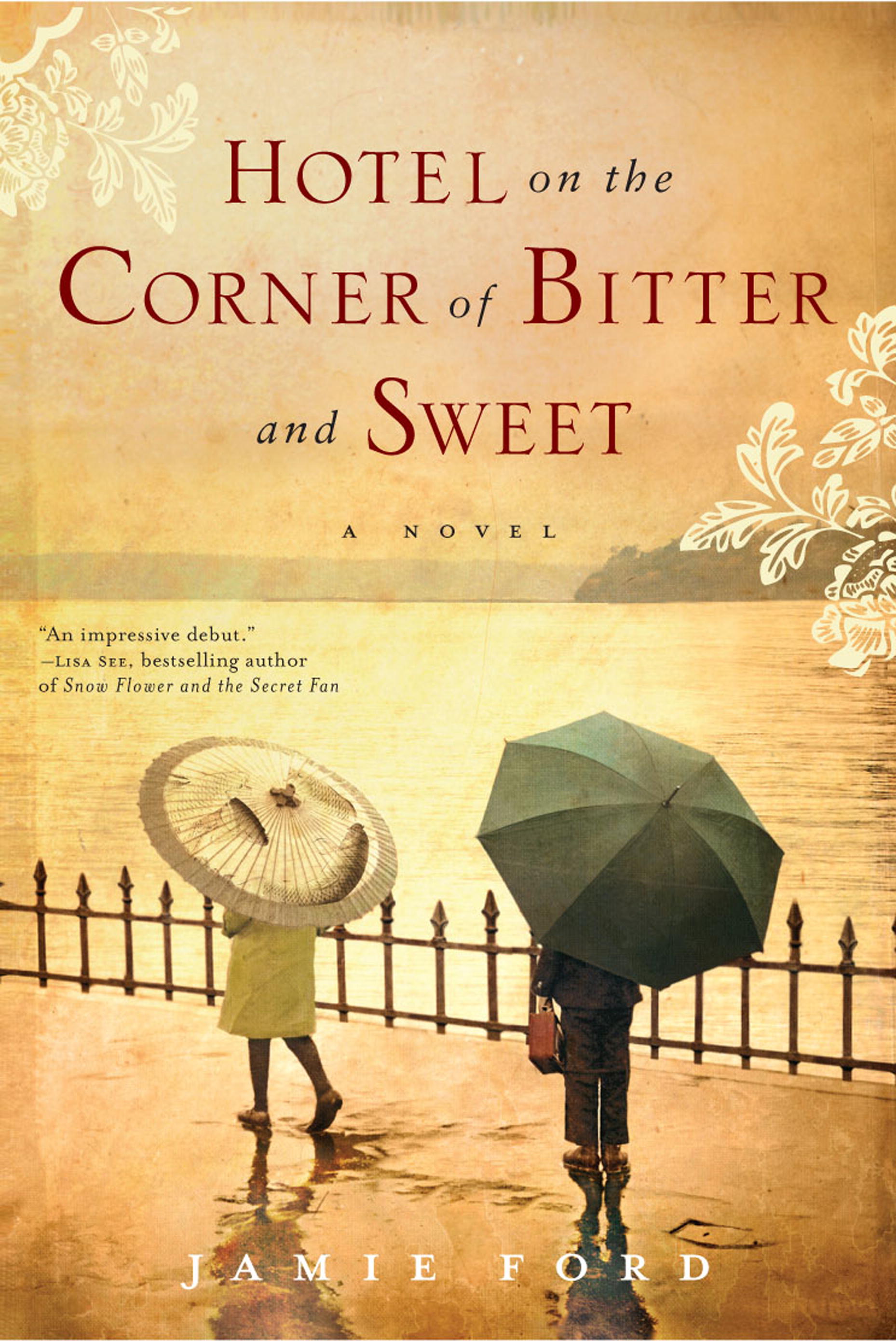
Hotel on the Corner of Bitter and Sweet is Jamie Ford's first novel. Henry Lee is the American-born son of a fiercely nationalistic Chinese father. The story takes place in Seattle, and jumps back and forth between 1942 when Henry is 12 years old, and 1986 when he is middle-aged and recently widowed. It is the story of Henry's friendship with Keiko Okabe, a Japanese American girl, who -- along with every other Japanese-American citizen on the west coast -- is imprisoned in a U.S. concentration camp for the duration of the war, and the impact that friendship had on Henry's adult life.
Henry and Keiko meet as the only two non-white students at their private school; both are there on work scholarships. Both are deeply resented by the other students, who make little distinction between Japanese and Chinese. But to Henry's father, who follows Japan's atrocities against China on a daily basis, Henry's friendship with Keiko is unforgivable.
I have never given any thought to the other Asians living on the west coast at the time of the Japanese-American interment. That aspect of the book was fascinating. It was also interesting that Ford mentioned the interment of both Italian- and German-Americans, a very little known part of U.S. history.
I hate to be so hard on a book that was obviously well-intentioned. I didn't hate it, but I won't necessarily recommend it either. Maybe you will read it with a less crabby disposition than mine. Who knows?
Deep, Dark Secrets of a Bad Grad Student
I've been trying to be a graduate student for almost 9 years now. I take classes one at a time, until I can't stand it anymore, and then I stop for a while. In this fashion I've earned a license to be a school library media specialist (a.k.a. school librarian.) However, here is the rub -- we have a two-tier licensing system in Wisconsin. My license is non-renewable, so now I am taking the courses to earn my professional license, which I have to finish within the next three years. There is no reprieve now; if I want the license (and I do) I have to push on through, one class every semester -- including the summer -- until December 2011 when I am finally done.
I tried a regular graduate program where I would have gotten a Masters in Library Science along with my license. I lasted for two semesters there, before throwing in the towel. I hated it so much! Now I am in an online program designed to get classroom teachers into school libraries. It has been a much better fit for me, relevant, interesting …
It is always a challenge. I'm a fairly intelligent person (I think.) I read a lot, I am able to apply what I am learning to real-life situations. However, when I am enrolled in a class I constantly feel rotten, like I am a bad person. I believe I have finally pinpointed what that is about. School these days involves a lot of the dreaded group project. In an online course, this involves group projects with people I may have only met in person one time; all of our communication takes place in that tricky medium of email and online discussion. I realize that my overall feeling in this context is one of shame. I beat myself up if I don't go to the discussion forum often enough, don't add to the Googledoc or wiki in a timely enough manner, when it's my turn I don't summarize the discussion until the end of the day on which it's due. I feel as if I am always letting my group-mates -- who are essentially strangers to me, but in my mind, far better students than I am -- down.
It's so bad that once I turn in an assignment I don't want look at it again, because I'm so ashamed of my work. I have to browbeat myself before I log onto the class site. I'm procrastinating right now as I write this blog post!
Basically I always feel like a fuck-up as a graduate student. (Pardon my language, but I do.) I just don't want to do this. I would rather be walking my dog, playing my guitar, reading for fun, knitting, decorating Ukrainian Easter eggs, making soap, sewing, and being with my family. I don't care if I get an A. I just want to pass each course.
Whew -- got that off my chest. I feel as if I've been in the confessional. I have two more weeks of this course. The next one is a literature course; hopefully it will be more flying solo.
I tried a regular graduate program where I would have gotten a Masters in Library Science along with my license. I lasted for two semesters there, before throwing in the towel. I hated it so much! Now I am in an online program designed to get classroom teachers into school libraries. It has been a much better fit for me, relevant, interesting …
It is always a challenge. I'm a fairly intelligent person (I think.) I read a lot, I am able to apply what I am learning to real-life situations. However, when I am enrolled in a class I constantly feel rotten, like I am a bad person. I believe I have finally pinpointed what that is about. School these days involves a lot of the dreaded group project. In an online course, this involves group projects with people I may have only met in person one time; all of our communication takes place in that tricky medium of email and online discussion. I realize that my overall feeling in this context is one of shame. I beat myself up if I don't go to the discussion forum often enough, don't add to the Googledoc or wiki in a timely enough manner, when it's my turn I don't summarize the discussion until the end of the day on which it's due. I feel as if I am always letting my group-mates -- who are essentially strangers to me, but in my mind, far better students than I am -- down.
It's so bad that once I turn in an assignment I don't want look at it again, because I'm so ashamed of my work. I have to browbeat myself before I log onto the class site. I'm procrastinating right now as I write this blog post!
Basically I always feel like a fuck-up as a graduate student. (Pardon my language, but I do.) I just don't want to do this. I would rather be walking my dog, playing my guitar, reading for fun, knitting, decorating Ukrainian Easter eggs, making soap, sewing, and being with my family. I don't care if I get an A. I just want to pass each course.
Whew -- got that off my chest. I feel as if I've been in the confessional. I have two more weeks of this course. The next one is a literature course; hopefully it will be more flying solo.
Monday, April 26, 2010
Book Review: Going Postal

Going Postal opens on the very last day of the unfortunate Moist Von Lipwig's (a.k.a. Albert Spangler and any number of other aliases) life. He's made a good run of it as a swindler and a con man, but he's been apprehended and sentenced to hang that morning. Sometimes, however, you get an angel, this time in the guise of Ankh Morpork's tyrannical ruler Lord Vetinari. Moist has a choice to make -- execution or … become Postmaster of the Ankh Morpork Post Office, which has fallen on hard times in recent years.
Being Postmaster isn't all golden suits and wingéd hats. First, Von Lipwig must prove himself to the Post Office Workers, then he finds himself in direct competition with the Grand Trunk Semaphore Company, a telecommunications conglomerate that's "too big to fail." (Which begs the question, does Pratchett possess some weird sixth sense or does Tim Geithner read Terry Pratchett?)
Terry Pratchett is simply a genius. He has a knack for hitting every nail squarely on the head. His writing is often classified as "fantasy" because it takes place on Discworld, but make no mistake about it: Pratchett's feet are planted firmly on Earth and he is satirizing everything about it he can get his hands on.
As far as I am concerned, Terry Pratchett is among the best living writers in the English-speaking world. He incorporates science, sociology, and fantasy with a wicked sense of humor. He leaves nothing unskewered, but he does it all with an absolutely generous heart.
Highly, highly recommended.
Sunday, April 25, 2010
Jerry, the Mail Carrier
Last Tuesday, my stepfather Bob was taking his daily walk to Einstein Bagels for coffee. He had been commenting recently how tired he gets (which doesn't seem surprising because he is in his late eighties.) On Tuesday he barely made it to the strip mall where Einstein's is located, when he started having severe chest pains, causing him to almost fall over. Jerry was delivering mail at the time, saw him, and rushed to him. He got Bob to an outdoor seating area of a Chinese restaurant, got Bob's pills from his pocket and gave him one, called 911, and stayed with him until he was on the ambulance.
I intend to go find Jerry this week, so that I can personally thank him. And after I ascertain that he won't get in trouble (you never know with the Post Office) I will let his superiors know what he did.
Meanwhile, Bob arrived at the hospital where it was determined that he had a blocked artery, and as he was being taken to the cardiac cath lab, he had a second heart attack because another artery was blocked as well. So he received two stents at the same time.
All is well that ends well. Bob is doing okay and going home today. Had Jerry not been there or not been paying attention, I'm afraid that the outcome would have been very different. Jerry is a hero in my mind.
I intend to go find Jerry this week, so that I can personally thank him. And after I ascertain that he won't get in trouble (you never know with the Post Office) I will let his superiors know what he did.
Meanwhile, Bob arrived at the hospital where it was determined that he had a blocked artery, and as he was being taken to the cardiac cath lab, he had a second heart attack because another artery was blocked as well. So he received two stents at the same time.
All is well that ends well. Bob is doing okay and going home today. Had Jerry not been there or not been paying attention, I'm afraid that the outcome would have been very different. Jerry is a hero in my mind.
Friday, April 23, 2010
What about a simple kiss?
The dramatic play can become quite dramatic in my kindergarten classroom. Take today, for instance. There was a group of five or six children in the housekeeping area. One child -- obviously a princess -- took a bite of a poisoned apple, and fell down dead. The other children laid her out on a bier, covered her with a blanket and surrounded her with plastic fruit. My teaching partner intervened momentarily when they commenced with the CPR compressions (apparently the fruit wasn't working its magic) because she was afraid they would hurt the victim patient. Then they all kneeled around her in a circle and put their hands together and prayed. And a miracle occurred! The expired princess leapt to her feet, alive again, and then the whole group refused to clean up their mess. Hallelujah!
Ah yes, never a boring moment in my profession.
Saturday, April 03, 2010
Book Review: Boys and Girls Forever: Children's Classics from Cinderella to Harry Potter

This is a book of essays on children's literature by Alison Lurie, who is a Pulitzer Prize winner and a professor of children's literature at Cornell University. Most of these essays appeared at an earlier time in the New York Times Book Review. I picked this up on a whim from a display at my branch library, being a sucker for reading about children's literature.
To tell you the truth, these essays really annoyed me. I really didn't see a point to this book, except maybe to gather her essays in one place -- if gathered they needed to be. Each one read like a long-winded lecture from someone steeped in the self-importance of academia: Hans Christian Anderson (about whose writing I took an entire semester-long class in college), Louisa May Alcott, L. Frank Baum, John Masefield, Walter de la Mare, Dr. Seuss, Tove Jansson, J.K. Rowling, and then some more general essays on fairytales, nursery rhymes and games, illustrations, and the role of nature in children's literature. Each essay was a pronouncement: "This means that" and "This wrought these changes." They also read like the countless essays I had to write, demanding that I "compare and contrast A with B." (Dr. Lurie, please compare and contrast Tove Jansson's Moomintroll books with A.A. Milne's Winnie-the-Pooh.)
For me, as a person who spends every day in the living, breathing company of young children and books, so many of her pronouncements seemed wooden, and well, academic. I admit, that may well have been her intent, but it didn't sit well with me. I kept having flashbacks to the children's literature class I took as an undergrad at Keene State College, taught by a salty new England woman with an accent so thick you could cut it with a knife who intoned on and on about May Hill Arbuthnot (a noted children's literature scholar and the author of our textbook.)
I don't know how old Lurie is -- old enough to have 3 grandchildren to whom she dedicates the book -- or if she is still teaching, has even stepped into a book store any time recently, or when these essays were first written because her knowledge of illustrators seemed to stop with Maurice Sendak (she likes his later work -- which I find kids don't particularly care for) and Arnold Lobel (who died 23 years ago.) In other words, the essays were very narrow in their scope.
Now I am going to expose my deep-seated prejudice with a question: Why is Harry Potter considered a classic piece of children's literature, while other modern fantasies that have been around much longer (Lloyd Alexander's Prydain Chronicles, Joan Aiken's Wolves of Willoughby Chase, and The Hobbit for heaven's sake) get barely a nod in their direction?
Thursday, April 01, 2010
Book Review: Mr. Darcy Takes A Wife

Subtitled Pride and Prejudice Continues, this book conjectures the life that the lovely and spunky Elizabeth Bennett shared with the taciturn Mr. Darcy after their marriage. First, let me begin by saying that the amount of sex was absolutely ludicrous and I really didn't need to be constantly reminded that Mr. Darcy was, um, well-endowed. Once I got beyond that (to the point where I just rolled my eyes when "it" was mentioned) I really enjoyed this book immensely (no pun intended, really!)
If you know anything of my reading habits, you know that good writing is paramount. If a book is badly written -- no matter how interesting the topic -- I usually can't finish it. This book was well written. The author, Linda Berdoll, apparently is a huge (there's that image again) fan of Jane Austen and actually did some research for this book both into the language and the historical times. I thought it was interesting to have the familiar characters placed in a historical context -- the end of the reign of mad King George, the Napoleonic Wars -- for surely intelligent characters like Darcy and Elizabeth would have had some interest in the world around them (once they got out of bed, off of the floor, back from the lovely sun-dappled copse on the Pemberly grounds …)
What else besides sex? Intrigue, bastard children, murder, swashbuckling rescues, plus a return of the many other characters that Austen conjured up in the original Pride and Prejudice: the good and lovely Jane and her precious Bingley, the ne'er-do-well Wickham and his silly wife Lydia, Elizabeth's good friend Charlotte, the vicar Mr. Collins and his patroness the Lady Catherine de Burgh, Darcy's sister Georgiana, Mr. and Mrs. Bennett …
You want serious literature? This isn't it. Mr. Darcy Takes a Wife is pure candy, and I have to say I haven't had as much plain fun reading a book in quite a while. Heaving bosoms and all.
Sunday, March 28, 2010
Book Review: The Geography of Bliss

Weiner writes in the style of Bill Bryson or Tony Horwitz, which makes for a mostly light-hearted and enjoyable read. I was reluctant to give myself over to it at first -- just another smug NPR commentator cashing in with a quirky travelogue. (Maybe I was experiencing some envy, which research has shown to be a happiness-killer.) However, halfway through Switzerland I was happy to be along for the ride.
I was a little put off by the chapter on Moldova, which I thought Weiner (and everyone else) treated a little unfairly. Moldova, you see, ranks fairly low in Veenhoven's happiness database and there seemed to be a fair amount of kicking a place that is already down. A country's fortunes can change fairly quickly. In fact, I would be interested in seeing how a country like Iceland is faring now after their economic collapse (although research shows that happiness is not necessarily related to money, not in ways that one might think, anyway.)
The Geography of Bliss was sometimes thought-provoking. I too, often feel like I am a grump, and it is not something of which I am exceedingly proud. It is the manner in which my particular brand of depression manifests itself, and as the child of a grumpy mother myself, it's not something I want to impart to my own children. So I have done a lot over the years to help myself be happy (something that happiness researchers say is almost uniquely American.) I was pleased to see that I have unscientifically incorporated many of the qualities that seem to mark happy people, and indeed I think I can say that my happiness index is quite high these days.
I enjoyed this book. It was not earth-shattering, it was a tad too much like an extended NPR piece, but it gave me some ideas to ponder, some pithy quotes, and was altogether quite relevant. If you enjoy travelogues and non-fiction, I recommend it.
40 Years
One of my happy pastimes is going to events that mark passages in the lives of old family friends, people who I am connected to through my parents mostly. I generally go with my oldest brother Dave, though sometimes by myself. I love it -- even the funerals, sad though they may be. They connect me with my parents, who have both been gone for some time now, and with my past which, seen through the lens of 50 years is actually looking and feeling pretty happy for the most part. Attending these events, being the steward of these connections is a role I have taken on, and one that I love.
Today was no funeral, however.
This afternoon I had the honor and pleasure of going to a party to honor 40 years of marriage for old friends of my family, Charlie and Louise Uphoff. The Uphoffs and the Grindrods go way back, back to my parents' youth and their days as young Socialists. My parents frequented a place called Fellowship Farm, that was overseen by Walter and Mary Jo Uphoff, the ad hoc "parents" I guess, being a few years older. In fact, my parents were married at Fellowship Farm, under the auspices of Walt and Mary Jo (and a radical minister named Shorty Collins.) Many years later, their son Charlie brought his wife Louise to live at Fellowship Farm. It was the late sixties/early seventies. I was on the cusp of adolescence and I thought they were one of the coolest, hippest couples I had ever met. They lived in a ramshackle farmhouse with tattered peace posters on the wall. They had a chair in their living room made out of the hood of a VW Bug -- how cool is that? I'll answer for you -- REALLY cool! And then they did something even cooler -- they had a baby, and I got to babysit for her!
So now 40 years have passed and I was reflecting on all of that. We're coming up on our 23rd anniversary. I hope that we can celebrate our 40th in such style, surrounded by loving family and friends, children and grandchildren. And I hope we inspire some other young person, show them a model of a happy marriage.
And I will keep maintaining these connections as long as I can.
Today was no funeral, however.
This afternoon I had the honor and pleasure of going to a party to honor 40 years of marriage for old friends of my family, Charlie and Louise Uphoff. The Uphoffs and the Grindrods go way back, back to my parents' youth and their days as young Socialists. My parents frequented a place called Fellowship Farm, that was overseen by Walter and Mary Jo Uphoff, the ad hoc "parents" I guess, being a few years older. In fact, my parents were married at Fellowship Farm, under the auspices of Walt and Mary Jo (and a radical minister named Shorty Collins.) Many years later, their son Charlie brought his wife Louise to live at Fellowship Farm. It was the late sixties/early seventies. I was on the cusp of adolescence and I thought they were one of the coolest, hippest couples I had ever met. They lived in a ramshackle farmhouse with tattered peace posters on the wall. They had a chair in their living room made out of the hood of a VW Bug -- how cool is that? I'll answer for you -- REALLY cool! And then they did something even cooler -- they had a baby, and I got to babysit for her!
So now 40 years have passed and I was reflecting on all of that. We're coming up on our 23rd anniversary. I hope that we can celebrate our 40th in such style, surrounded by loving family and friends, children and grandchildren. And I hope we inspire some other young person, show them a model of a happy marriage.
And I will keep maintaining these connections as long as I can.
Friday, March 26, 2010
Anxious to see this movie
I don't think it has been released in the U.S. Too esoteric? I'll bet there are as many Morris dancers here as in Britain, doggone it.
Monday, March 22, 2010
I finally read "Pride and Prejudice!"

I don't think much needs to be said about the plot of Pride and Prejudice. It has been copied endlessly in almost every romantic comedy coming out of Hollywood. They meet, they hate each other, they part, they discover they really love each other and defy the odds to get back together again, and tra-la, they marry and (presumably) live happily ever after. Ah, but was it ever again done so well as this?
I first listened to Pride and Prejudice as an audio book a few years ago. It was snatched from the shelf of the public library in a moment of panic when we were leaving on a 12 hour road trip and had forgotten to get any episodes of Hank the Cowdog, our preferred travel listening. Mr. Feeny (I'm just getting in the P&P mood here) looked dubious when I brought it home. Maybe he was remembering the last time this had happened and I brought Prodigal Summer along, and everyone hated it but me. However, this time it was different. We all loved Pride & Prejudice, laughing heartily all the way to West Virginia and back.
Still, I hadn't read it until last week when I was looking for a book to read while I waited for my book club reads to come into the library. (Yes, I'm in a newly-minted book club.) Jane Austen's writing and humor is so fresh and modern. It is a joy, and if you haven't read it, I highly recommend doing so.
Today my friend recommended Mr. Darcy Takes A Wife which she says is Pride and Prejudice with the addition of spicy sex scenes. Ooh la la.
Sunday, March 21, 2010
Sweet Sixteen
It is hard to believe that my daughter Sophie would be 16 today. I know it's a fruitless exercise, but I spend a lot of time wondering what she would look like and who she would be. I wholeheartedly embrace her life and death as one of my life's enormous mysteries, but there are times when I just feel bereft, and I know I will feel that way until the end of my days. I often feel as if I am holding my breath for these ten days that she was alive. Mostly it is okay; the sad moments remind me that she is very much present in my life and nothing can change that.

Sophie Olivia Grindrod-Feeny, ¡Presenté!

Sophie Olivia Grindrod-Feeny, ¡Presenté!
Friday, March 19, 2010
21 Years Ago …
21 years ago was the beginning of an incredible adventure: the birth of my first child, Anna Fiona. Being a mother has brought me unimaginable joy, and I wish this child of mine the happiest of birthdays today.


I have refrained from posting any of the naked ones. No need to thank me, Anna. Just one of the many little kindnesses I have performed over the last 21 years.
Subscribe to:
Posts (Atom)