Alright, alright ... Madison doesn't really have parking spaces reserved for octopi. It's the name of a business, silly. Octopus Carwash. Apparently it is a franchise, and I believe it's been in Madison at least as long as I have (46 years.) When our eldest daughter was a toddler, our route home from her day care took us past a number of landmarks: the giant octopus, the big black clock, the big green fish, the other giant octopus, the horses ... It was a highlight of her young life when her aunt actually took her to the car wash once. (No one has ever been able to accuse me of going to a car wash! And it shows ...) The big green fish is gone (along with the neon cockroach and dead rat sign -- landmarks from my childhood, so sad) but I am so glad that we still have the giant octopi and that we provide parking for them.
Sunday, June 28, 2009


Saturday, June 27, 2009
Signs #1
 The residents of Madison, Wisconsin are frequently accused in public forums of being "politically correct." Is that a valid criticism? Well, here we are, a thousand miles from the nearest saltwater and we reserve parking for OCTOPI? PETA would be so proud!
Wednesday, June 24, 2009
Tuesday, June 23, 2009
You know, you can read a lot more books when you stay in the kids' section!

Yes, this is another book review. Already. When I Was a Boy Neruda Called Me Policarpo is a memoir by the Chiléan author Poli Délano, of a childhood frequently spent in the company of the great poet Pablo Neruda. This is a simple, yet moving little book with charming illustrations. It takes place during turbulent, even dangerous times when Neruda was in exile from Chilé, but the child Poli remembers the small moments: the crazy badger that Neruda kept as a pet, Sunday outings, going to the market to search for the weird old junk that Neruda collected, a trip to Acalpulco … He also recalls the life-lessons Neruda taught him, about social justice and standing up for one's beliefs. Each chapter is separated from the next by Neruda's poetry; the poems give Poli's memories a context.
At the end of the book there is a short biography of Pablo Neruda. I love that Délano does not minimize Neruda's political beliefs. Not only can this book serve as an introduction to Neruda for young adult readers, but I would hope that it could also be used to explore some of the history of the last century: the rise of European fascism and the relationship that the U.S. has had with Central and South America.
This is a beautiful book, and certainly one that I will be recommending to my daughter's middle school teachers and librarian. (I suspect it will not be available in the Scholastic book order!)
One more, semi-related thing: If you have not seen the film Il Postino, you would not go amiss in looking it up and watching it. It tells the story of a simple rural postman who is befriended by Neruda, and has his life irrevocably changed. It is a beautiful film.
Monday, June 22, 2009
Summer Reading -- The Yggyssey by Daniel Pinkwater
 You know, I had never thought about the The Wizard of Oz being based on Homer's Odysseus. However, Daniel Pinkwater clearly had, when he wrote this book. The Iggyssey: How Iggy Wondered What Happened to All the Ghosts, Found Out Where They Went, and Went There is a sequel to The Neddiad. Yggdrasil Birnbaum is familiar with the ghosts of Los Angeles (of whom there are many) and she becomes concerned when they begin to disappear. Determined to solve the mystery, Iggy and her friends Neddie Wentworthstein and Seamus Finn follow a ghostly bunny through a portal that leads ... somewhere.
The Yggyssey pays homage to some great moments in children's literature. It is also filled with Pinkwater's signature humor -- intelligent, self-deprecating, puckish at times. The Neddiad and The Yggyssey are both quick reads, very entertaining, highly recommended.
Sunday, June 21, 2009

Saturday, June 20, 2009
Lounging Around --A Theatah Review
 Last night was opening night for Broom Street Theater's new production, Lounging Around, an original play by Siobhan Edge. For you readers in foreign parts (i.e. not from Madison,) for the past 40+ years, BST has been delighting, shocking, offending, and entertaining theater-goers with original works. Lounging Around is a comedy woven around the conversations of a diverse group of travelers stuck in an airport lounge when their flight is delayed due to heavy fog.
My younger daughter -- the daughter formerly known as "Sparkly Seacow" -- made her Broom Street debut, with 3 roles in this play: an elderly woman (82 years old, Dearie!), a Valley Girl with a cell phone, and a bratty little girl. Thumbs up for all of them! I may be a little biased, but I think she did a fantastic job and I'm very proud of her.

 Photos by N-dig0 (tb3), used with permission
Thumbs up for the entire production! The dialogue was witty, the action was fast-paced, and the acting was good.
If you live in the Madison area, make this stage mama happy and go see Lounging Around!
Friday, June 19, 2009
Another Day, Another 2 Book Reviews
"And it was summer, warm, beautiful summer ..."
For me that means reading. Lots of reading. I have read 2 books so far, as different from each other as night and day, as the saying goes.
 First is Ben Logan's memoir of growing up on a Wisconsin farm, The Land Remembers. You don't have to be from Wisconsin to enjoy this book. (And by the way, real Wisconsinites do not refer to themselves as "Sconnies.") Ben Logan was born in 1920 at his family's "Seldom Seen Farm" in the hill country between Gays Mills and Mount Sterling, Wisconsin. Reading it, I was struck by two things:
1) Everything Logan writes about happened just one generation ago, my parents' generation. His father farmed with horses, they had no indoor plumbing or electricity, and his family was entirely self-sufficient. I remember visiting relatives on a farm like this in northern Wisconsin, 40 years ago. The changes that have been wrought in a single generation are almost beyond belief, and not all bad of course, but something was surely lost in the headlong rush forward in the name of "progress".
2) The land ethic that Logan learned from his parents seems way ahead of its time. He was taught to be a steward of the land. His father did not jump on every (or even most) agricultural bandwagons, because he was cautious of the long-term effects. Farmers were peddled a lot of snake oil in those days, much of which has led to the environmental crises we are facing today.
The Land Remembers is a beautifully -- even poetically -- written book. Ben Logan left Wisconsin as a young man and had a successful career as a writer and radio broadcaster on the east coast. He returned to Wisconsin in the eighties and bought back Seldom Seen Farm (it had been sold at some point) and lived there until a few years ago. When he moved off the farm, he donated it to the Mississippi Valley Conservancy, with the agreement that they would keep it in use as a sustainably-managed farm.
Highly recommended, especially for people with an interest in sustainability or lovers of memoir.
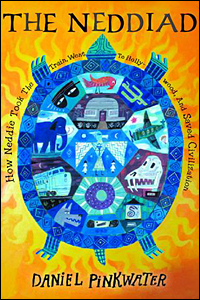
The second book of the summer is Daniel Pinkwater's The Neddiad: How Neddie Took The Train, Went To Hollywood, And Saved Civilization. In this book, Pinkwater takes the epic quest/hero's journey fantasy and turns it on its ear. It is the early fifties and Neddie Wentworthstein is moving with his family to Los Angeles. On the way he meets a shaman named Melvin, who gives him a small stone turtle, telling him not to lose it. Neddie, of course, has many adventures and encounters both friends and foes, before he is able to complete his quest.
 If you are not familiar with the writing of Daniel Pinkwater, you don't know what you're missing. His sly sense of humor isn't necessarily of the laugh-out-loud-'til-your-stomach-hurts variety, but he had me chuckling throughout the entire book. He pokes fun at Jews, Republicans, military establishments, Madison Avenue, Hollywood, and anything else you can think of. A couple of high points, but I don't want to spoil all of the jokes for you:
For me that means reading. Lots of reading. I have read 2 books so far, as different from each other as night and day, as the saying goes.
First is Ben Logan's memoir of growing up on a Wisconsin farm, The Land Remembers. You don't have to be from Wisconsin to enjoy this book. (And by the way, real Wisconsinites do not refer to themselves as "Sconnies.") Ben Logan was born in 1920 at his family's "Seldom Seen Farm" in the hill country between Gays Mills and Mount Sterling, Wisconsin. Reading it, I was struck by two things:1) Everything Logan writes about happened just one generation ago, my parents' generation. His father farmed with horses, they had no indoor plumbing or electricity, and his family was entirely self-sufficient. I remember visiting relatives on a farm like this in northern Wisconsin, 40 years ago. The changes that have been wrought in a single generation are almost beyond belief, and not all bad of course, but something was surely lost in the headlong rush forward in the name of "progress".
2) The land ethic that Logan learned from his parents seems way ahead of its time. He was taught to be a steward of the land. His father did not jump on every (or even most) agricultural bandwagons, because he was cautious of the long-term effects. Farmers were peddled a lot of snake oil in those days, much of which has led to the environmental crises we are facing today.
The Land Remembers is a beautifully -- even poetically -- written book. Ben Logan left Wisconsin as a young man and had a successful career as a writer and radio broadcaster on the east coast. He returned to Wisconsin in the eighties and bought back Seldom Seen Farm (it had been sold at some point) and lived there until a few years ago. When he moved off the farm, he donated it to the Mississippi Valley Conservancy, with the agreement that they would keep it in use as a sustainably-managed farm.
Highly recommended, especially for people with an interest in sustainability or lovers of memoir.
The second book of the summer is Daniel Pinkwater's The Neddiad: How Neddie Took The Train, Went To Hollywood, And Saved Civilization. In this book, Pinkwater takes the epic quest/hero's journey fantasy and turns it on its ear. It is the early fifties and Neddie Wentworthstein is moving with his family to Los Angeles. On the way he meets a shaman named Melvin, who gives him a small stone turtle, telling him not to lose it. Neddie, of course, has many adventures and encounters both friends and foes, before he is able to complete his quest.
If you are not familiar with the writing of Daniel Pinkwater, you don't know what you're missing. His sly sense of humor isn't necessarily of the laugh-out-loud-'til-your-stomach-hurts variety, but he had me chuckling throughout the entire book. He pokes fun at Jews, Republicans, military establishments, Madison Avenue, Hollywood, and anything else you can think of. A couple of high points, but I don't want to spoil all of the jokes for you:We only stopped for gas, plus once, when we were across the state line in San Bernardino, California, at McDonald's fifteen-cent hamburger stand, where you Buy 'Em by the Bag. "This is a good idea," Seamus Finn said. "They should open more of these."I can hardly wait to read the companion book, The Yggyssey, next up. These books would make an excellent gift for any 11-13 year olds you know, especially if they're getting a little overdosed on the kid wizard from Britain.and"There's only so far we can go with this sort of thing," Aaron Finn whispered. "I think it may be against the law to torture people, even if you're a movie star and a Republican."
Sunday, June 14, 2009
In A Dark Wood Wandering: A Novel of the Middle Ages
 This is a book I picked up on a whim, used in a library resale shop. According to the blurb on the cover, it has been in print continuously since 1949. I figured that may indicate a good book.
The introduction tells how the book came to be translated into English, a fascinating story unto itself. Published in 1949 in Holland, it was a bestseller throughout continental Europe, but virtually unknown in the U.S. In the early fifties a postal clerk/writer in Chicago named Lewis C. Kaplan, whose avocation was translating obscure pieces of literature into English, happened to see a reference to the book in a literary magazine and decided that he wanted to translate it. He wrote to the Dutch publisher and the author, received permission, and began. Mr. Kaplan did not speak Dutch, so the translation was an arduous process. He finished a first draft and was beginning to work on a revision when he died in 1958.
His distraught widow disposed of all his effects, but held on to the last manuscript he was working on, putting it into a briefcase in a closet in her apartment. Twenty years later when her apartment had a fire, Kaplan's son came to help his mother clean up the mess and discovered the briefcase with the sodden manuscript in it. He took it, dried it out and set about trying to discover what it was. (It had no identifying title or other information.) By chance, Kaplan's widow found a slip of paper with the author's name on it, and the son tracked her down through the Library of Congress.
Here's the part I like: Of the 20 years that the manuscript sat in the back of a closet the introduction says, "During that time Hella Haasse [the author] thought occasionally of Mr. Kaplan and the English version of Het voud der verwachting; it seemed to her that he was taking considerable time to complete his work, but she knew that he had tackled a formidable task and, with commendable sensitivity, she hesitated to give him the impression that he was being rushed."
There were more chance events that led eventually to the U.S. publication of In A Dark Wood Wandering in 1989, 40 years after it was first published!
The novel itself takes place in the late fourteenth and early to mid-fifteenth centuries during the Hundred Years War between England and France. The main protagonist is Charles d' Orléans, nephew to King Charles VI. The novel traces his long and eventful life as it was interwoven with the politics of the day. At the age of 20 Charles d'Orléans was taken hostage by the English after the infamous battle of Agincourt, and imprisoned in England for the next 20 years. During his exile, Charles wrote poetry for his beloved wife left behind in France and his even more beloved homeland which he recognized was being torn apart by the political skirmishes of the French nobility. He returned to France determined to live out his remaining years quietly, but couldn't avoid being sucked back into the political current from time to time. He lived to be quite old and fathered 3 children, one of whom ultimately became King Louis XII of France.
I enjoyed this book immensely. I like historical fiction in general, and this had the added bonus of being something completely new. I knew very little about the Middle Ages, and found it quite compelling. The writing was fresh and modern. I was struck by the realization that, time may pass, but politics are always the same, driven by the thirst of the gentry for power and money. (That's rather depressing, isn't it?)
In A Dark Wood Wandering is well worth reading.
Saturday, June 13, 2009
22 Years
 In what is possibly a first, Mr. Ether (a.k.a. Enriched Geranium) beat me to a blog post about our wedding anniversary. Over the years -- and particularly in the struggle for marriage equality for all people -- I've thought deep philosophical thoughts about the meaning of having the State sanction one's relationship with another person. Having it all to do over again, perhaps we would have chosen otherwise, BUT (and you know there's always a big but) even had we not gone through all of the legal mumbo-jumbo and the ceremony and the celebration (which I am sure is the only wedding in history to include a Gumby pinata and a seeing eye dog,) it would not have changed the wanting to spend my life with Ed.
 To get to the point, I married my best friend and it was the best thing I ever did. Happy anniversary, Ed. I love you.
Tuesday, June 09, 2009
In Memorium: Linda Farley
By John Nichols, writing in Madison's Capital Times:
Dr. Linda Farley did not live to see her dream -- the establishment of a universal health care plan that would provide quality care to all Americans -- come to fruition.
But the Verona physician who sought to heal a broken health care system survived long enough to see the first outlines of what she hoped would be a fundamental reform take shape.
Farley died Tuesday morning, on the very day that press reports indicated President Barack Obama would demand that Congress enact sweeping changes in the health care system before the end of the year, changes that reportedly will include a public option that reformers hope will lead to the establishment of a national health care plan like those now operating in most developed nations.
Farley, an ardent champion of a single-payer health care system run by the government as a public good rather than by for-profit insurers, would have loved to have been a part of the coming debate.
And she would have joined it as she did all others -- for peace, for economic and social justice, for civil liberties, for the environment -- with a rare and remarkable combination of urgency, warmth and good humor.
"I know we have a lot of work to do, so many barriers, so many challenges, so many powerful foes," she told me a few weeks ago, at another rally on another night when a woman of 80 who was battling cancer might have been excused for staying home. "But we've got to do it, so what's the point of getting frustrated. After all, we're right."
Farley, almost always in tandem with her husband and fellow physician, Dr. Eugene Farley, redefined health care activism in Madison and Wisconsin over the past several decades. Bringing lifetimes of medical experience and the calm, cheerful demeanors of the family physicians of another era -- when doctors had the time and the wherewithal to get to know, and love, their patients -- the Farleys made the case for fundamental reform in human terms.
At community forums, in church basements and union halls, on the stage before thousands at BobFest, the Farleys created a constituency for single-payer health care, and they changed the politics of the region. After Gene Farley toyed with a congressional run in 1996 on a health-care reform platform, a young state representative named Tammy Baldwin took up the mantle in 1998 and got elected in large part because she championed single-payer.
Baldwin adored the Farleys, and they her. A few years ago, the congresswoman nominated Linda Farley to be honored as part of the National Library of Medicine's "Local Legends" program. Baldwin, who is no slouch in this department, hailed her nominee as Wisconsin's "passionate crusader for health care reform."
But that didn't stop the intrepid Farley from lobbying the congresswoman, as she did every other official. And when the politicians fell a little short, she kindly -- but firmly -- prodded them. And they listened.
They listened because Farley knew of what she spoke.
Inspired as a teenager growing up in a blue-collar neighborhood in Rochester, N.Y., by novels about doctors who cared for the rural poor in Appalachia, she decided to become a physician.
Farley put herself through college and medical school working as a nurse's aide.
It was tough, but she was smart and determined. And she was cheered on by a fellow student, a young fellow named Gene Farley, who eventually convinced her that he shared her dedication to serving those who most needed, but could least afford, care.
Together, they worked at great teaching hospitals and inner-city clinics, on their own rural practice and in neighborhood health centers in big cities. They trained nurses in Jamaica and doctors in Madison. And when she retired, Linda Farley kept on caring for folks for free, making the rounds of local clinics and donating her services.
Farley "credited her two years in the mid-1950s on the northeastern Arizona Navajo Reservation as transforming her attitude and approach to medicine," recalls her biography at the National Library of Medicine. "Fifty miles from the nearest paved road, she and Gene lived in a small trailer and ran an outpatient clinic, providing medical care to the surrounding Navajo community, and also evaluating ambulatory treatment of tuberculosis using a then-new drug."The experience on the reservation was a powerful one for the Farleys. In fact, several weeks ago, to celebrate her 80th birthday, Farley returned with Gene and her children and grandchildren to Many Farms, Ariz., which is on the reservation. Gene said Linda delighted spending time with patients she had cared for more than 50 years ago.
Another major influence for the couple was their work at Meharry Medical School in Nashville, Tenn., -- the country's largest private, comprehensive historically black institution for educating health professionals and scientists -- where they established a faculty development program.
At the University of Wisconsin Medical School, Linda Farley served as an assistant professor of Family Medicine, and it was in this role that she received a great deal of regional and national recognition, earning the Society of Teachers of Family Medicine Task Force Appreciation Award in 1993, the Wisconsin State Medical Society Physician Citizen of the Year in 1995 and the American Academy of Family Physicians Presidents Award in 2001.
But the awards and honors were never more than cause for an awkward smile from an instinctively modest woman. Her many friends saw that smile once more this spring, when the Democratic Party of Wisconsin -- of which she was a loyal if frequently prodding member -- honored her and her dear friend, former state Rep. Midge Miller, for their decades of leadership and activism. Democratic Party of Wisconsin Chair Joe Wineke got it right Tuesday when he said that "Linda Farley was a beloved member of the Democratic Party who embodied our commitment to health care reform. Linda devoted her career in medicine and politics to helping the medically underserved and advocating for real health care reform."
While she accepted the honors -- especially if they helped advance the cause of health-care reform -- Farley got excited about caring for people, especially when she was volunteering at the South Madison Health & Family Center-Harambee and other free and low cost clinics.
She delighted in her children and grandchildren, and in her husband, Gene, who survives her. She enjoyed the Madison Quaker Meeting, and the hundreds of friendships and projects that came from it and her involvement with local peace and justice groups.
And Farley positively glowed when she was campaigning for single-payer health care, as a member of Physicians for a National Health Program, the activist group that she helped build into an organization with more than 16,000 physician members. "It's my passion," she would say.
Farley once said that "I'd like to be remembered as a good family doctor who really cared for people."
But she always added that "really caring" required doctors to do more than just give shots and write prescriptions. "We have to be active," she said. "We have to take our experience, our knowledge, and use it to shape a better health care system."
And so she did.
Gene and Linda are two of the loveliest people I have ever had the privilege of knowing. It seems to me that a fitting tribute to Linda would be to put single-payer health care at the forefront of the struggle for social justice, and make her dream a reality.
Monday, June 08, 2009
Why I Teach
I am coming to the end of my 23rd year as a public school teacher. 22 of those years have been in the same school district. I've had my highs and my lows during that time. I even considered resigning at one point about 10 years ago, because it felt like I had no reserves left. My well was dry.
Yesterday I had one of those experiences that teachers live for, the kind that you usually only get when you've been teaching for a while. I responded to a friend request on Facebook -- a high school teacher in my district. And in looking at her profile page I saw a comment from a former first grade student of mine whom I had lost track of over the years. I wrote a "Hello, do you remember me?" comment and received the sweetest message in return, telling me how influential I had been to her. In fact, she is just finishing up her first year as a 5th grade teacher!
I go along day in and day out, year in and year out. Some days I am joyful, other days I am grumpy. But I absolutely must never stop remembering that what I do -- sometimes the smallest, most commonplace, and seemingly insignificant thing I do -- can make a difference to a kid.
That is why I teach.
Yesterday I had one of those experiences that teachers live for, the kind that you usually only get when you've been teaching for a while. I responded to a friend request on Facebook -- a high school teacher in my district. And in looking at her profile page I saw a comment from a former first grade student of mine whom I had lost track of over the years. I wrote a "Hello, do you remember me?" comment and received the sweetest message in return, telling me how influential I had been to her. In fact, she is just finishing up her first year as a 5th grade teacher!
I go along day in and day out, year in and year out. Some days I am joyful, other days I am grumpy. But I absolutely must never stop remembering that what I do -- sometimes the smallest, most commonplace, and seemingly insignificant thing I do -- can make a difference to a kid.
That is why I teach.
Friday, June 05, 2009
Fun With Highly Toxic Substances
I've written before about the website Boing Boing. I always find something there to delight and distract me from the woes of the world (or sometimes it helps me see something from an entirely new and different perspective.) Here is a link to a video about freezing mercury. Hmmm ... I'm looking for fun projects to occupy my kindergartners in the last week of school.
Seriously, I remember being in about 2nd grade when the scientist father of one of my classmates brought in mercury for us to play with. Yes, we handled it. It was cool how it broke up into many small blobs and then came together again into a big blob. Back in those days it was not known how toxic mercury was.
A few years ago when we were getting my parents' house ready to sell, I had the job of emptying the rusting metal shelf in the garage and disposing of the various tubes, cans, old mayonnaise jars, etc. of substances that my father had amassed over the years. (A physician by trade, he was a tinkerer by avocation, dabbling in chemistry, mechanics, physics, you name it.) So I loaded it all into the back of my station wagon and (a year or so later, after it sat piled in my driveway) hauled it over to the county "Clean Sweep" site for disposal. The woman working there was very efficient, sorting the stuff I could put out with the trash at home from the stuff they would dispose of. Then she picked up a little glass spice jar with a rubber stopper and said, "I wonder what this is? Oh! It's mercury!" I'm sure that was one she enjoyed telling at the dinner table that night!
Gosh, if I had only kept it, I could have made frozen mercury fish and turtles like in the video.
Seriously, I remember being in about 2nd grade when the scientist father of one of my classmates brought in mercury for us to play with. Yes, we handled it. It was cool how it broke up into many small blobs and then came together again into a big blob. Back in those days it was not known how toxic mercury was.
A few years ago when we were getting my parents' house ready to sell, I had the job of emptying the rusting metal shelf in the garage and disposing of the various tubes, cans, old mayonnaise jars, etc. of substances that my father had amassed over the years. (A physician by trade, he was a tinkerer by avocation, dabbling in chemistry, mechanics, physics, you name it.) So I loaded it all into the back of my station wagon and (a year or so later, after it sat piled in my driveway) hauled it over to the county "Clean Sweep" site for disposal. The woman working there was very efficient, sorting the stuff I could put out with the trash at home from the stuff they would dispose of. Then she picked up a little glass spice jar with a rubber stopper and said, "I wonder what this is? Oh! It's mercury!" I'm sure that was one she enjoyed telling at the dinner table that night!
Gosh, if I had only kept it, I could have made frozen mercury fish and turtles like in the video.
Monday, June 01, 2009
Robber Barons
I almost can't post this because I find it so discouraging. But it's so important, it should be seen. This is from the incomparable investigative journalist Greg Palast, about the forced bankruptcy of GM.
This story stinks to high heaven.
Screw the autoworkers.I had few illusions about Barack Obama as president. I knew he wasn't progressive and had some tense moments with friends when I wouldn't just jump on the bandwagon. I hoped he would give me a respite from worry and fear, and it didn't take long to see how illusory that was as well. Steve Earle was right when he said that whoever got elected, the real work would begin on January 20, 2009. I feel so worn down after 8 years of BushCo, yet there is indeed work to be done.
They may be crying about General Motors' bankruptcy today. But dumping 40,000 of the last 60,000 union jobs into a mass grave won't spoil Jamie Dimon's day.Dimon is the CEO of JP Morgan Chase bank. While GM workers are losing their retirement health benefits, their jobs, their life savings; while shareholders are getting zilch and many creditors getting hosed, a few privileged GM lenders – led by Morgan and Citibank – expect to get back 100% of their loans to GM, a stunning $6 billion.
The way these banks are getting their $6 billion bonanza is stone cold illegal.
I smell a rat. (Read the rest ...)
This story stinks to high heaven.
Subscribe to:
Posts (Atom)