Showing posts with label book review. Show all posts

Wednesday, December 29, 2010

Have you been naughty, or nice?

Hogswatch is coming, the pigs are getting fat …


Yes, it's that time of year, when you hear the scraping of sleigh runners and the prancing of 
16 tiny hooves on your rooftop, when the fellow in the red robe comes down your chimney 
with his HO HO HO, a time to be jolly, with mistletoe and holly and -- other things ending 
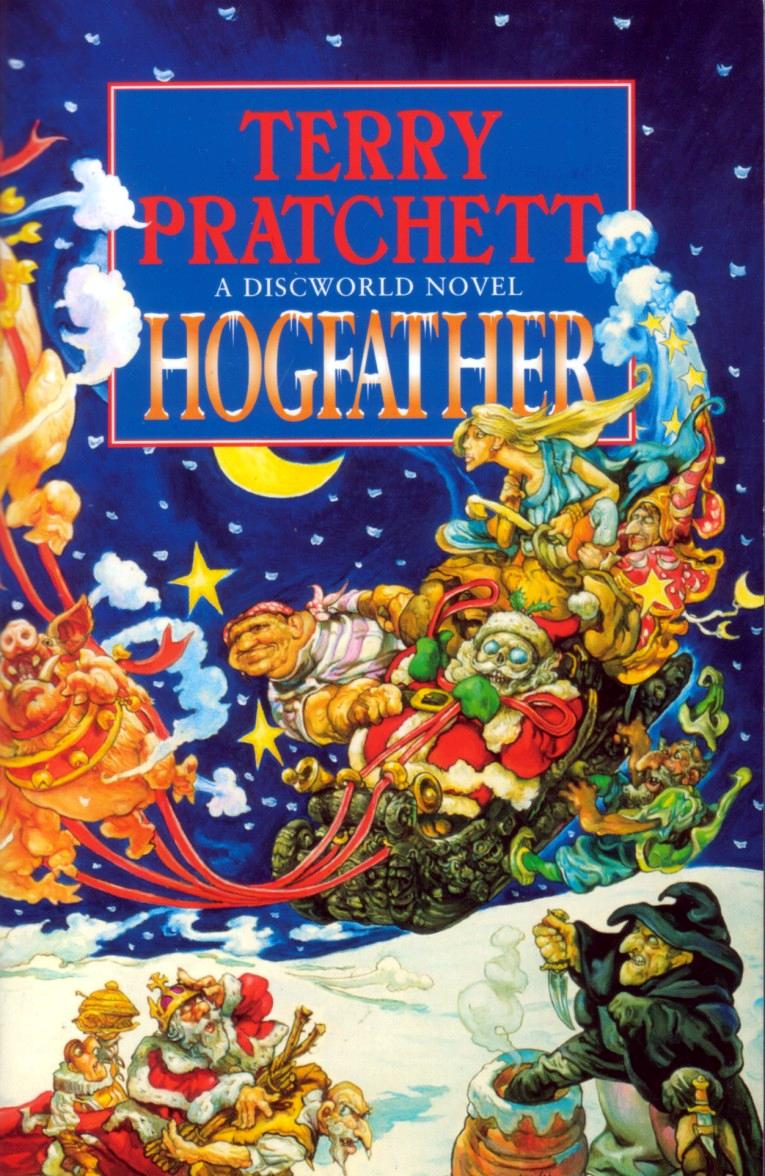
in olly. That can only mean one thing: It's time for the annual reading of Terry Pratchett's 
Hogfather!


It's Hogswatch Eve, and the Hogfather has gone missing under mysterious circumstances. 
Paid assassin, Mr. Teatime (pronounced Te-ah teem-eh) and a band of petty thieves are 
messing with the beliefs of the world's children, leaving an inconvenient surplus of belief 
elsewhere -- especially at the Unseen University in Ankh-Morpork. Someone has to step in 
to save Hogswatch so that the sun will continue to rise each day, and that someone is … 
Death? HO HO HO. Also featuring the Verucca Gnome and the Oh God of Hangovers.


Another delectable offering in the Discworld series, Hogfather manages to poke fun at 
everything associated with holidays while honoring the underpinnings of tradition. A story 
with many twists, turns, and seemingly loose ends, but in the end you are richly rewarded. 
Pratchett's books may seem light and insignificant, but they offer so much food for thought. 
Honestly, what are you waiting for? HO HO HO, Happy Hogswatch!

Monday, November 08, 2010

We interrupt this reading of Terry Pratchett for a [so far] rather depressing novel.

My book group is reading Let the Great World Spin by Colum McCann. I have 200+ pages to read in order to finish it by Thursday night's book group meeting. But that's not why I'm writing tonight. This is a book review of Terry Pratchett's most recent book -- his fourth YA novel about the young witch, Tiffany Aching.


The Tiffany Aching series begins with the delightful The Wee Free Men, when the 9-year old Tiffany first is identified as a witch, meets the Nac Mac Feegle (or "wee free men", a race of tiny blue men in kilts who enjoy drinkin', fightin', and drinkin') and goes head to head with the queen of the fairies to rescue her younger brother, as well as Roland, the son of the local baron. In A Hat Full of Sky, Tiffany is 11. She's left her home on the Chalk to go to the mountains and get formal training as a witch, but a malevolent spirit called a "hiver" has taken up residence in her body and she must outwit it or die. In the third book, Wintersmith, when the 13-year old Tiffany makes the impetuous decision to join in the age-old Morris dance honoring Winter and Summer, she attracts the amorous attention of the Wintersmith and stirs up jealousy in the heart of the real Lady Summer.

In I Shall Wear Midnight Tiffany is 16 and has returned to be the local witch for the people of her beloved Chalk. But all is not well. She has had a falling-out with Roland, whom she had supposed she would marry one day, and he is betrothed to someone else. Furthermore, there is rising sentiment against witches that threatens to break out into the kind of violence that was seen in the past, and whatever is causing it appears to be focused on Tiffany.

Like the previous Tiffany Aching books, this one is filled with Pratchett's trademark intelligent humor spiced with a little bawdiness (courtesy of the Nac Mac Feegle and the delightful old witch Nanny Ogg) and infused with serious social commentary. There is also a bittersweetness to it: Pratchett has been very public about his diagnosis with early-onset Alzheimer's disease, and this book felt like an extended good-bye to many beloved characters from his earlier Discworld books. At any rate, Tiffany Aching is a child no longer, so I suspect it is the last children's book about her.

My introduction to Terry Pratchett was The Wee Free Men, and after that I was hooked. Tiffany is one of the best female characters to come along in a very long time, and I absolutely love Pratchett's take on witchcraft. I highly recommend that you read this series (and then make the leap over to his Discworld books for adults.)

Saturday, September 25, 2010

Oh Dear Blog, Do You Still Love Me?


Blogging hasn't been happening much lately. Blame it on grad school, blame it on Facebook, blame it on the Bossa Nova. But I can at least manage book reviews, can't I? Oh yeah, I've been reading. A little of this, a little of that. And always something by Terry Pratchett to break up the monotony. I spent this past week in self-imposed exile (a.k.a. vacation) on a nearly deserted island, which seemed like a good time to reread Pratchett's most recent children's book Nation. Nation is a departure from Pratchett's other books, maybe even something of a disappointment for die-hard Pratchett fans. It isn't set on Discworld; instead Pratchett plays fast and loose with some of the history and geography of Earth to create a parallel world. It was also the first book he wrote after the sad revelation that he has a rare form of early onset Alzheimer's disease. (His disease has most noticeably affected his motor abilities; he can no longer type and must dictate his stories to a typist.)

Nation opens in a time of upheaval in the mid-nineteenth century. There has been a flu epidemic in Britain which has claimed the King and a great number of his heirs, and a ship has been dispatched to one of the furthest outposts of the British empire to fetch the next living heir. Meanwhile in the great Pelagic Ocean there has been a massive tsunami that brought death and destruction to the many island nations there.

Mau is an inhabitant of one of the islands, his people known simply as "the Nation." No longer a boy and not yet a man, Mau was returning from his initiation into adulthood on a distant island when the wave struck. He returns to his home island to find that he is the only survivor.

Daphne is a well brought up British girl, who was sailing out to join her father in Port Mercia in the Pelagic Ocean. The Sweet Judy, the ship on which she travels, has already withstood an attempted mutiny when the tsunami hits. The captain and remaining crew are drowned in the wave and the ship is driven to Mau's island. Daphne and a foul-mouthed parrot have survived.

Inevitably Mau and Daphne meet. They form a bond based on mutual survival, that grows into a friendship over time. As time goes on, more survivors of the tsunami find their way to the Nation, and Mau -- lost in his grief, in limbo between childhood and manhood, and questioning the gods of his people who would take so many innocent lives -- must act as the chief of the Nation.

In some ways Nation is less satirical than Pratchett's other books, but many of the themes are familiar. As always he raises questions about government and organized religion, and also white supremacy, class, and empire. Because it was written for a younger audience, at times the narrative seems too simple, but ultimately Nation is a very wise and thought-provoking book. I recommend it, and if you can read it while marooned on an island, so much the better.
Monday, June 28, 2010

Book Review: Ash


Ash by Malinda Lo is a novel-length retelling of Cinderella for young adult readers. Many of the elements of the plot will be recognizable: Aisling (nicknamed Ash) loses her beloved mother, her father remarries a proud woman with two daughters of her own, her father dies leaving her at the mercy of the stepmother. There are differences as well, including a subtext about conflict between the old ways still practiced among the people of the North where Aisling has grown up and the "modern" thinking in the more developed cities of the South. While some people choose to dismiss it as superstition, in Aisling's world the lines between waking and dreaming, real world and the fairy realm, are very much blurred. The magic isn't identified as good or bad, it is simply there. There are also some significant differences from Cinderella which I will not disclose here.

It took me a little while to get into Ash, and there were times when I bogged down in Lo's descriptive text. Now that I have finished it and am reflecting on it as a whole, I can say that I thoroughly enjoyed it. It is very well written. Retellings of fairy tales are a genre of fantasy unto themselves. If you enjoy reading them, you will probably like Ash.


Recommended for young teens and up. There is some sexual innuendo, but nothing explicit.

Wednesday, June 23, 2010

Book Review: The Invention of Hugo Cabret


My carefree days of summer reading were short-lived. Next week I begin a class for my school library media specialist certification, called "Trends in K-12 Literature." The reading list is extensive, and I've tried to get a head start on it. (Thank heavens, no boy wizards on the list.) I've seen The Invention of Hugo Cabret around, but I probably wouldn't have gravitated toward it if it wasn't required reading. At approximately 525 pages the book looks like a tome, but it is really more of an extended picture book with pages and pages of illustrations that are reminiscent of an old movie, interspersed with Hugo Cabret's story. (Indeed, it won the Caldecott medal -- given for best illustrations in a picture book -- in 2007.)

Hugo Cabret is an orphan who, due to tragic circumstances, lives by himself in a Paris train station. His most treasured possessions are a notebook of drawings from his deceased father and a rusty automaton from the attic of a museum. His path crosses that of an old toymaker and his young god-daughter, and there is a mystery that Hugo must solve. (I don't want to say much more because it might spoil the magic of this book.)

Author Brian Selznick says that he was inspired by real events that were recounted in the book Edison's Eve: a Magical History of the Quest for Mechanical Life. I found the format hard to get into at first, although veteran readers of comic books and graphic novels won't be disturbed by it at all. As an adult reader, I thought that the story moved a little too quickly and was tied up a little too neatly at the end. Still, I thoroughly enjoyed it, and would have loved it when I was about 10. Judging by the number of copies of this book in my summer school library, it is a popular book with middle grade readers.

If you like reading kids' books, if you like old movies, or if you're looking for a fun book for a 9-12 year old reader, I recommend this book.

Wednesday, June 16, 2010

The Book Thief


I just finished The Book Thief for the second time, sitting on the back porch with tears running down my face. Once again I am absolutely stunned by the terrible beauty of this book. How anyone could read it, and still believe that war belongs in this world, is beyond me. Narrated by Death, it tells the story of a young German girl, Liesel Meminger, sent to live with foster parents in a suburb of Munich at the outset of WWII. The Book Thief is about the power of words to bring about both evil and good in the world, and how ultimately, decency and love can transcend the daily brutality of war.

The Book Thief makes me wonder -- Do ideas and words ever just find an author for themselves? I don't mean to discredit Markus Zusak in any way. I am in awe of his writing. It's only that The Book Thief stands out from all but a handful of books that I have read, and gives the impression of a story that demanded to be told in just the way that Zusak told it. (If that makes any sense.)

At any rate, if you have not read The Book Thief, please do. Yes, it is sad and brutal at times. It makes the reader step up and look into the abyss of war. And then, in spite of everything, it sings. A beautiful, beautiful book.

Monday, May 03, 2010

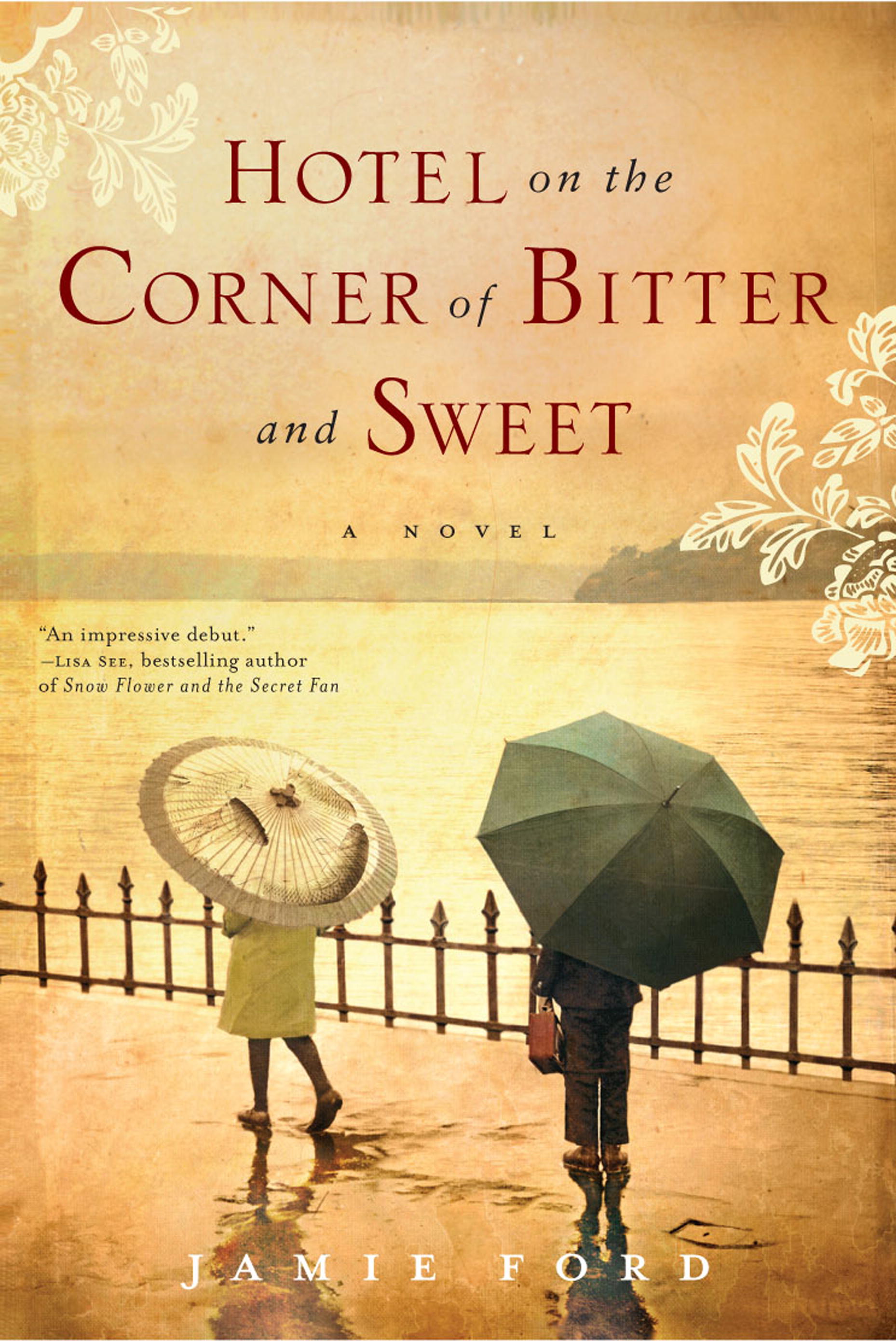
Book Review: Hotel on the Corner of Bitter and Sweet


Hotel on the Corner of Bitter and Sweet is Jamie Ford's first novel. Henry Lee is the American-born son of a fiercely nationalistic Chinese father. The story takes place in Seattle, and jumps back and forth between 1942 when Henry is 12 years old, and 1986 when he is middle-aged and recently widowed. It is the story of Henry's friendship with Keiko Okabe, a Japanese American girl, who -- along with every other Japanese-American citizen on the west coast -- is imprisoned in a U.S. concentration camp for the duration of the war, and the impact that friendship had on Henry's adult life. 


Henry and Keiko meet as the only two non-white students at their private school; both are there on work scholarships. Both are deeply resented by the other students, who make little distinction between Japanese and Chinese. But to Henry's father, who follows Japan's atrocities against China on a daily basis, Henry's friendship with Keiko is unforgivable.


I have never given any thought to the other Asians living on the west coast at the time of the Japanese-American interment. That aspect of the book was fascinating. It was also interesting that Ford mentioned the interment of both Italian- and German-Americans, a very little known part of U.S. history.

Jamie Lee has written a heartfelt historical novel about a very compelling subject. I have to say, however, that I was not blown away by this book. There were what seemed to be historically inaccurate errors: References to being in an "online support group" and doing something "24/7" in 1986 just didn't ring true; were people routinely "online" in 1986? I don't think so. Some strands of the narrative were picked up and then dropped without explanation. I also felt that Henry and Keiko would have been far more believable had they been a couple of years older. They didn't act their ages. Finally, I thought that the writing was not particularly good.


I hate to be so hard on a book that was obviously well-intentioned. I didn't hate it, but I won't necessarily recommend it either. Maybe you will read it with a less crabby disposition than mine. Who knows?

Monday, April 26, 2010

Book Review: Going Postal


Going Postal opens on the very last day of the unfortunate Moist Von Lipwig's (a.k.a. Albert Spangler and any number of other aliases) life. He's made a good run of it as a swindler and a con man, but he's been apprehended and sentenced to hang that morning.  Sometimes, however, you get an angel, this time in the guise of Ankh Morpork's tyrannical ruler Lord Vetinari. Moist has a choice to make -- execution or … become Postmaster of the Ankh Morpork Post Office, which has fallen on hard times in recent years.

Being Postmaster isn't all golden suits and wingéd hats. First, Von Lipwig must prove himself to the Post Office Workers, then he finds himself in direct competition with the Grand Trunk Semaphore Company, a telecommunications conglomerate that's "too big to fail." (Which begs the question, does Pratchett possess some weird sixth sense or does Tim Geithner read Terry Pratchett?)


Terry Pratchett is simply a genius. He has a knack for hitting every nail squarely on the head. His writing is often classified as "fantasy" because it takes place on Discworld, but make no mistake about it: Pratchett's feet are planted firmly on Earth and he is satirizing everything about it he can get his hands on.

As far as I am concerned, Terry Pratchett is among the best living writers in the English-speaking world. He incorporates science, sociology, and fantasy with a wicked sense of humor. He leaves nothing unskewered, but he does it all with an absolutely generous heart. 

Highly, highly recommended.

Saturday, April 03, 2010

Book Review: Boys and Girls Forever: Children's Classics from Cinderella to Harry Potter


This is a book of essays on children's literature by Alison Lurie, who is a Pulitzer Prize winner and a professor of children's literature at Cornell University. Most of these essays appeared at an earlier time in the New York Times Book Review. I picked this up on a whim from a display at my branch library, being a sucker for reading about children's literature.


To tell you the truth, these essays really annoyed me. I really didn't see a point to this book, except maybe to gather her essays in one place -- if gathered they needed to be. Each one read like a long-winded lecture from someone steeped in the self-importance of academia: Hans Christian Anderson (about whose writing I took an entire semester-long class in college), Louisa May Alcott, L. Frank Baum, John Masefield, Walter de la Mare, Dr. Seuss, Tove Jansson, J.K. Rowling, and then some more general essays on fairytales, nursery rhymes and games, illustrations, and the role of nature in children's literature. Each essay was a pronouncement: "This means that" and "This wrought these changes." They also read like the countless essays I had to write, demanding that I "compare and contrast A with B." (Dr. Lurie, please compare and contrast Tove Jansson's Moomintroll books with A.A. Milne's Winnie-the-Pooh.)


For me, as a person who spends every day in the living, breathing company of young children and books, so many of her pronouncements seemed wooden, and well, academic. I admit, that may well have been her intent, but it didn't sit well with me. I kept having flashbacks to the children's literature class I took as an undergrad at Keene State College, taught by a salty new England woman with an accent so thick you could cut it with a knife who intoned on and on about May Hill Arbuthnot (a noted children's literature scholar and the author of our textbook.)


I don't know how old Lurie is -- old enough to have 3 grandchildren to whom she dedicates the book -- or if she is still teaching, has even stepped into a book store any time recently, or when these essays were first written because her knowledge of illustrators seemed to stop with Maurice Sendak (she likes his later work -- which I find kids don't particularly care for) and Arnold Lobel (who died 23 years ago.) In other words, the essays were very narrow in their scope.


Now I am going to expose my deep-seated prejudice with a question: Why is Harry Potter considered a classic piece of children's literature, while other modern fantasies that have been around much longer (Lloyd Alexander's Prydain Chronicles, Joan Aiken's Wolves of Willoughby Chase, and The Hobbit for heaven's sake) get barely a nod in their direction?


I guess I have to say that children's literature is anything but academic to me. It is alive, and I am far moire interested in how to apply it (i.e. do the kids enjoy it when I read to them?) than what meanings might be hiding in the subtexts. Unless you want to re-live your undergraduate college literature courses, I would advise steering clear of this book. I wish I had.

Thursday, April 01, 2010

Book Review: Mr. Darcy Takes A Wife


Subtitled Pride and Prejudice Continues, this book conjectures the life that the lovely and spunky Elizabeth Bennett shared with the taciturn Mr. Darcy after their marriage. First, let me begin by saying that the amount of sex was absolutely ludicrous and I really didn't need to be constantly reminded that Mr. Darcy was, um, well-endowed. Once I got beyond that (to the point where I just rolled my eyes when "it" was mentioned) I really enjoyed this book immensely (no pun intended, really!)

If you know anything of my reading habits, you know that good writing is paramount. If a book is badly written -- no matter how interesting the topic -- I usually can't finish it. This book was well written. The author, Linda Berdoll, apparently is a huge (there's that image again) fan of Jane Austen and actually did some research for this book both into the language and the historical times. I thought it was interesting to have the familiar characters placed in a historical context -- the end of the reign of mad King George, the Napoleonic Wars -- for surely intelligent characters like Darcy and Elizabeth would have had some interest in the world around them (once they got out of bed, off of the floor, back from the lovely sun-dappled copse on the Pemberly grounds …)

What else besides sex? Intrigue, bastard children, murder, swashbuckling rescues, plus a return of the many other characters that Austen conjured up in the original Pride and Prejudice: the good and lovely Jane and her precious Bingley, the ne'er-do-well Wickham and his silly wife Lydia, Elizabeth's good friend Charlotte, the vicar Mr. Collins and his patroness the Lady Catherine de Burgh, Darcy's sister Georgiana, Mr. and Mrs. Bennett …

You want serious literature? This isn't it. Mr. Darcy Takes a Wife is pure candy, and I have to say I haven't had as much plain fun reading a book in quite a while. Heaving bosoms and all.

Sunday, March 28, 2010

Book Review: The Geography of Bliss


My newly formed book group chose Eric Weiner's The Geography of Bliss for our maiden selection. Weiner is a foreign correspondent for NPR and a self-proclaimed grump. He decides to take up a study of happiness, and starting out in Holland where Professor Ruut Veenhoven maintains the World Database of Happiness, he embarks on a 'round-the-world tour to find the secrets of true happiness. Weiner's travels take him to such disparate places as Switzerland (mmm, chocolate), Bhutan (whose king abandoned the index of Gross National Product in favor of Gross National Happiness,) Qatar, Iceland (in winter,) Moldova, Thailand, Great Britain, India, and the U.S.

Weiner writes in the style of Bill Bryson or Tony Horwitz, which makes for a mostly light-hearted and enjoyable read. I was reluctant to give myself over to it at first -- just another smug NPR commentator cashing in with a quirky travelogue. (Maybe I was experiencing some envy, which research has shown to be a happiness-killer.) However, halfway through Switzerland I was happy to be along for the ride.

I was a little put off by the chapter on Moldova, which I thought Weiner (and everyone else) treated a little unfairly. Moldova, you see, ranks fairly low in Veenhoven's happiness database and there seemed to be a fair amount of kicking a place that is already down. A country's fortunes can change fairly quickly. In fact, I would be interested in seeing how a country like Iceland is faring now after their economic collapse (although research shows that happiness is not necessarily related to money, not in ways that one might think, anyway.)

The Geography of Bliss was sometimes thought-provoking. I too, often feel like I am a grump, and it is not something of which I am exceedingly proud. It is the manner in which my particular brand of depression manifests itself, and as the child of a grumpy mother myself, it's not something I want to impart to my own children. So I have done a lot over the years to help myself be happy (something that happiness researchers say is almost uniquely American.) I was pleased to see that I have unscientifically incorporated many of the qualities that seem to mark happy people, and indeed I think I can say that my happiness index is quite high these days.

I enjoyed this book. It was not earth-shattering, it was a tad too much like an extended NPR piece, but it gave me some ideas to ponder, some pithy quotes, and was altogether quite relevant. If you enjoy travelogues and non-fiction, I recommend it.

Monday, March 22, 2010

I finally read "Pride and Prejudice!"


I don't think much needs to be said about the plot of Pride and Prejudice. It has been copied endlessly in almost every romantic comedy coming out of Hollywood. They meet, they hate each other, they part, they discover they really love each other and defy the odds to get back together again, and tra-la, they marry and (presumably) live happily ever after. Ah, but was it ever again done so well as this?


I first listened to Pride and Prejudice as an audio book a few years ago. It was snatched from the shelf of the public library in a moment of panic when we were leaving on a 12 hour road trip and had forgotten to get any episodes of Hank the Cowdog, our preferred travel listening. Mr. Feeny (I'm just getting in the P&P mood here) looked dubious when I brought it home. Maybe he was remembering the last time this had happened and I brought Prodigal Summer along, and everyone hated it but me. However, this time it was different. We all loved Pride & Prejudice, laughing heartily all the way to West Virginia and back.


Still, I hadn't read it until last week when I was looking for a book to read while I waited for my book club reads to come into the library. (Yes, I'm in a newly-minted book club.) Jane Austen's writing and humor is so fresh and modern. It is a joy, and if you haven't read it, I highly recommend doing so. 


Today my friend recommended Mr. Darcy Takes A Wife which she says is Pride and Prejudice with the addition of spicy sex scenes. Ooh la la.

Thursday, December 17, 2009

I finally finished another book!


When I went to hear Wendell Berry back in October, he read a short story entitled Making It Home from a collection of short stories. That Distant Land is the title of that collection. It spans nearly 100 years in the lives of the inhabitants of the fictional town of Port William, Kentucky. If you are at all familiar with Berry's fiction, you will find many characters that you recognize in this collection: Jayber Crow, the Coulters, Feltners, Rowanberrys, and Catletts -- all part of what Burley Coulter referred to as "the membership" of Port William who farmed the area going back 200 or more years.

Although the fact that it took me 6 weeks to finish this book of short stories might signify that I didn't find them compelling, that was not the case. I thoroughly enjoyed it. One of the things that I really appreciate about Berry's fiction is that in Port William he has created an entire world much like Terry Pratchett has in Discworld -- a world that the reader can return to again and again. Furthermore, Port William's citizens -- at least the ones that Berry allows us to get to know -- are just decent people, who hold to an ethic to which I also aspire: stewardship of the land, care for the people around you. It is pretty simple and very profound at the same time.

One of the last stories in the book is called Fidelity, an old-fashioned notion that I submit is the overarching theme of this group of stories. We may talk about loyalty, but fidelity involves so much more -- responsibility, faith, love.

If you have not read any of Wendell Berry's work, this may not necessarily be the book to start with. You might end up feeling like you're an outsider at someone else's family reunion. Once you've read other of his books, by all means give this one a try. You will get the back stories, side stories and the endings to some of the stories that started in other books.


Saturday, October 31, 2009

The Natural Laws of Good Luck: A Memoir of an Unlikely Marriage


Ellen Graf was a lonely sculptor and mother of 4 mostly grown children living in rural upstate New York, when a Chinese friend suggested that she might like to meet her brother in China, who was also a lonely divorcée. Graf decides to take a chance, travels to China to meet Zhong-hua lu, and marries him. What follows is a moving and frequently hilarious account of two people from exceedingly different cultures attempting to make a life together. Graf has an advantage, as it is Zhong-hua who emigrates and must learn English and try to fit in to American culture. However, Graf too must adapt to living with someone whose most basic assumptions about human interactions -- and in fact, life in general -- are alien to her.

I like reading memoirs of all sorts and I enjoyed this book. I marveled at the leap of faith that brought Graf and Lu together and the hurdles they managed to clear. I recommend this book.

Monday, October 26, 2009

Book Review: Hannah Coulter by Wendell Berry


This was a reread for me. When I first read Hannah Coulter a few years ago, it instantly became one of my favorites. I was a little bit worried that if I read it a second time, I wouldn't like it as much. Having finished it, I can say that the writing is nothing short of astonishing.

In Hannah Coulter, Berry continues his ongoing story of a place -- Port William, Kentucky -- and the people who make their lives there. These are the same people who are in Berry's other novels: Jayber Crow the barber; the Coulter Brothers, Burley and Jarrat; the Catletts, the Feltners and the Wheelers. Into this "membership" of Port William (as Burley Coulter calls it) comes Hannah as the young bride of Virgil Feltner. Hannah has only been married to Virgil a short time when the U.S. enters World War 2. Like all the young men at that time, Virgil is drafted and goes to war, and like too many of them, he goes "missing in action, presumed dead."

Now a young widow with a baby daughter, Hannah continues to live with Virgil's parents. Eventually she is courted by Nathan Coulter, one of the lucky ones who returned from the war. The rest of the book tells the story of the life Hannah and Nathan made together on the farm adjacent to her former in-laws.

The story is narrated by Hannah, as an old woman who has lived to see the turn of the 21st century, looking back on her life and the lives of her Port Williams neighbors. It is a simple, quiet story, but the writing absolutely shines.

I dog-eared many passages. Here is a favorite:
I began to know my story then. Like everybody's, it was going to be the story of living in the absence of the dead. What is the thread that holds it all together? Grief, I thought for a while. And grief is there sure enough, just about all the way through. From the time I was a girl I have never been far from it. But grief is not a force and has no power to hold. You only bear it. Love is what carries you, for it is always there, even in the dark, or most in the dark, but shining out at times like gold stitches in a piece of embroidery.
Another:
The chance you had is the life you've got. You can make complaints about what people, including you, make of their lives after they have got them, and about what people make of other people's lives, even about your children being gone, but you mustn't wish for another life. You mustn't want to be somebody else. What you must do is this: "Rejoice evermore. Pray without ceasing. In every thing give thanks." I am not all the way capable of so much, but those are the right instructions.
And another:
My mind, I think, has started to become, it is close to being, the room of love where the absent are present, the dead are alive, time is eternal, and all the creatures prosperous. The room of love is the love that holds us all, and it is not ours. It goes back before we were born. It goes all the way back. It is Heaven's. Or it is Heaven, and we are in it only by willingness. By whose love … do we love this world and ourselves and one another? Do you think we invented it ourselves? I ask with confidence, for I know you know we didn't.
Wendell Berry's writing speaks to my heart and soul.

Saturday, September 26, 2009

Making the Case for Manual Labor

I just finished reading the book Shop Class As Soulcraft: An Inquiry Into the Value of Work by Matthew B. Crawford. I have to say, I knew nothing about this book when I first opened it. I selected it purely because of the title. In fact, I thought it might have something to do with the sort of projects you find in the magazines Readymade or Make. Silly me. But, boy, was I glad that I read it.

Matthew Crawford holds a PhD in Philosophy, and now supports himself doing motorcycle repair. Shop Class is a difficult book to classify. Part autobiography, part pornography for motorcycle geeks, Crawford makes a very strong case for manual labor. He begins the book by talking about the history of "shop class" in the twentieth century and the dismantling of most high school shop programs in the eighties and nineties, as everyone was supposed to become "knowledge workers." He shows how disastrous this trend has been for American workers as more and more jobs have been shipped overseas where labor costs less, and points out that your x-rays can be read by a technician in India while plumbers, on the other hand, must be local.

Crawford discusses the disconnect that so many workers feel in white collar "knowledge" jobs where they never see the results of their work, compared to jobs in the trades where there is a very clear connection between the work and the results. (I was pleased that he included teachers in that second category.)

Yet the trend continues, where high school students are steered toward 4-year colleges, 2-year technical colleges are offering more "college prep", and the trades -- some of the most stable professions around -- are stigmatized. (This is personal for me as I watch my daughter struggle to pay off the $30,ooo loan she accrued in just one year of college, and people don't understand why she "dropped out" to work in a restaurant.) I found it curious when I watched President Obama address the nation's schoolchildren, that he encouraged them to go on to college, to become doctors, lawyers, teachers, join the military … and he did not say a word about entering the trades!

My one criticism of this book is that the writing was fairly dense -- or maybe just too geared toward gearheads. I am neither a motorcycle mechanic nor a rider, and there were points where my eyes glazed over and I skipped whole chunks of the text. But the overall theme resonated so strongly with me, and I had a hard time putting it down. In fact, I will be buying this book to re-read and mark certain passages. This is a very important book -- highly recommended.

Monday, September 07, 2009

Three Little Words: A Memoir by Ashley Rhodes-Courter

This book made me late yesterday. (Really, I would have been on time otherwise.) Each time I sat down to read just a little, I became so totally engrossed in Ms. Rhodes-Courter's story that I could not put the book down. When Ashley Rhodes-Courter was 3 years old, she was removed from her mother's custody and became a ward of Florida's foster care system. Thus began a 9 year long nightmare, over the course of which she had 19 different foster parents, some okay, some marginal, and one in particular, frighteningly bad. When she was finally adopted by a loving couple at the age of 12, it took many years for Ashley to trust that these parents were really there for her, and she finally began the long journey toward healing.

While the book was clumsily written at times (she wrote it as a very young adult) Ashley Rhodes-Courter impressed me with her resilience, her clear-eyed observations, and her amazingly positive outlook even after everything that she went through. This is a scathing commentary on Florida's foster care system. At a couple of different points she poses the question of why the state was willing to pay millions of dollars for a failed system where people ran foster homes like puppy mills and caseworkers looked the other way, but was utterly unwilling to spend even a penny to help teenaged mothers like Ashley's so they could provide a home for their own children. She also wondered why -- even when the evidence was in plain sight -- the caseworkers and therapists always assumed that the children were lying about their mistreatment, to get attention. (They even ignored multiple phone calls to the child abuse hotline from Ashley's teachers!)

Ashley eventually brought a suit against the state of Florida. In reviewing her files, she figured out that out of 195 people who had had some responsibility for her case over those 9 years, the two who had really advocated for her and gotten her out of the system -- a Guardian ad Litem and a lawyer -- were volunteers.

I admit that I wept while I read this book. It made me consider the carelessness with which some people treat their lives and the lives of others. Ashley's mother was not a bad person, but was herself a product of careless parenting -- as was the abusive foster mother. I found Ashley's story to be very important and moving. Highly recommended.

Book Review: A Yellow Watermelon by Ted Dunagan

A Yellow Watermelon was published by Junebug Books -- the children's division of New South Books, a publisher that specializes in contemporary Southern authors. It tells the story of one memorable summer in the life of 11 year old Ted Dillon. Ted is the youngest of 3 boys in a family that is just barely scraping by in small town Alabama. His dad works in the local sawmill which, like just about everything else in the vicinity, is owned by Mr. Cliff Creel. Ted makes pocket money by selling the weekly newspaper Grit.

One evening Ted sneaks into the sawmill after hours to explore, where he meets Jake -- a black man who has been hired to watch the mill. Through Jake he learns of the Robinsons, a dirt-poor black family who are in danger of losing their farm through the dirty dealings of Old Man Creel. Mr. Creel, in collusion with the local preacher, is also stirring up prejudice against the Robinsons. Ted befriends Poublum Robinson, a boy his own age, and is determined to help them out.

A Yellow Watermelon tells an interesting story and has a whole lot of heart, and I really, really wanted to like it, but in the end I found it disappointing. I thought that it oversimplified the whole idea of racial prejudice in the Jim Crow South, to the point of making it seem insignificant. The onus for the hateful behavior was put on mean Old Man Creel and the weak-willed drunkard preacher with everyone else being bystanders who didn't say much but acted sympathetic to the Robinsons because no one liked Mr. Creel very much. In no way was the hateful institution of Jim Crow laws ever even addressed! In fact, while it was believable that Ted might have befriended both Jake and Poublum, I found it utterly unbelievable that everybody accepted the friendships with almost nary a word, even while they all referred to their black neighbors as "niggers" and "darkies."

This may be a trifling point, but the dialogue when the black characters spoke was cartoon Southern black dialect, peppered with "sho 'nuffs" and "dis" and "dats". It reminded me of reading a vintage version of The Bobbsey Twins in the Land of Cotton and really bugged me.

There were also references that were way too modern, and seemed designed to teach young readers a lesson about prejudice rather than to make a good story; for example, when Ted crosses the invisible line in his uncle's cotton field to pick cotton with Poublum he says, "In the summer of 1948, I reverse integrated the cotton field."

One review on the back of the book compared A Yellow Watermelon to the classics To Kill A Mockingbird and Huckleberry Finn. I beg to differ. This isn't an awful book, but if you're interested in something to show kids what racial prejudice in the South was like, they'd be better off reading Mildred Taylor's Roll of Thunder, Hear My Cry or Christopher Paul Curtis' The Watsons Go to Birmingham - 1963.

Tuesday, August 04, 2009

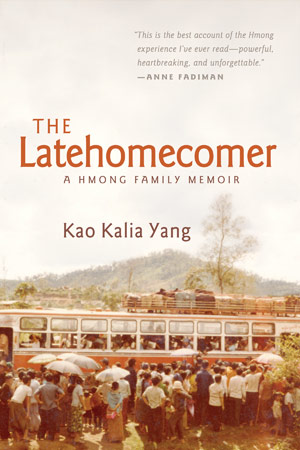
Book Review: The Latehomecomer, a Hmong Family Memoir

I am often surprised when I talk to people from other parts of the U.S. who don't know about Hmong-Americans. The Hmong were mountain people living in Laos. During the Vietnam war, they were recruited by our CIA to wage a Secret War against the communist forces in Laos (a fact that was long-denied by the U.S.) When the Americans departed in 1975, the Communist government of Laos waged genocide on the Hmong people. Thousands were massacred, while others fled into the jungles of Laos to hide or to make their long way to the Mekong River, to cross to Thailand and life in a refugee camp. In the mid-eighties Thailand no longer wanted to be host to thousands of Hmong refugees, and many of them came to the U.S., settling primarily in southern California, central and southern Wisconsin, and the Minneapolis/St. Paul area. In the mid-nineties when Clinton "ended welfare as we know it", there was another large Hmong migration from California to Minnesota, which had kinder policies toward people in poverty.

The Latehomecomer was written by Kao Kalia Yang, a young woman who was born in the Ban Vinai Refugee Camp in Thailand in 1980 and came to Minnesota with her parents and sister when she was 6 years old. They were eventually joined by many aunts and uncles, as well as her beloved paternal grandmother. She tells a story of hard work and abject poverty, the parents working long hours in mostly menial, low-paying jobs, always with the goal of their children getting ahead through education, but not losing their essential Hmong-ness. This is also very much a love story for Yang's grandmother, a woman whose strength and fortitude kept her family together through unimaginably trying circumstances.

Madison has a sizable Hmong community and I have had a handful of Hmong students over the years, but I still know very little about the culture and would like to know more. The Latehomecomer was a beautifully written and fascinating book, and certainly provides food for thought as a teacher. It was also interesting to compare it with the only other book about the Hmong I've read: The Spirit Catches You and You Fall Down by Anne Fadiman.

I highly recommend The Latehomecomer. The author, Kao Kalia Yang, has also produced a documentary about Hmong American refugees, The Place Where We Were Born.

Book Review: Up In the Old Hotel


Up In the Old Hotel by Joseph Mitchell is a collection of articles that Mitchell wrote for The New Yorker over a period of time spanning from the early 1930s to the mid-1960s. They were originally collected and published in 4 separate books, long out of print. McSorley's Wonderful Saloon profiles characters Mitchell met in and around the Bowery in his early days in New York City. These include saloon-owners, a self-described Gypsy king, a colorful street preacher, the "Don't Swear Man", a freak show bearded lady, and many others, as well as several works of fiction. Old Mr. Flood describes one elderly man living around the Fulton Fish Market. The Bottom of the Harbor is about the fish market, and the fishermen -- the bay men and the river men -- who kept it supplied. The book ends with Joe Gould's Secret, a follow-up to one of Mitchell's earlier profiles (which my brother informs me was made into a movie a few years ago.)

I thoroughly enjoyed reading this book. It paints a picture of a New York city that is mostly long gone, a fact that is echoed in places all around the country and is to be mourned. It was dense reading, like a well-aged fruitcake. I read with a dictionary close at hand to look up unknown words, which is always fun.

If you enjoy the kind of books that explore one subject in depth -- in the vein of John McPhee or Mark Kurlansky -- check out Up In the Old Hotel. It was a treat.