Reading
Quaking now seems like ancient history -- I think I finished it last Sunday -- but I intended to write a review of it, so I will. I have a little extra time today since school was canceled because of snow, our second snow day in as many weeks. This one is particularly sweet as it butts up against winter break.
On to the book review!
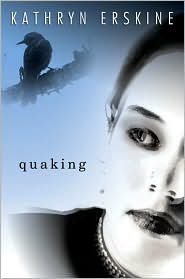
Quaking by Katherine Erskine is a young adult novel, about a 14 year old girl named Matt. Matt has been living under the care of various distant relatives since her abusive father murdered her mother one day while Matt was at grade school. Matt has been shunted from relative to relative, largely, it is implied, because of her poor behavior.
The story opens with her in the car with a woman she calls "Loopy", an evangelical Christian who can no longer care for Matt because she's going on a mission. They are on the way to live with Sam and Jessica, distant cousins in a small town in Pennsylvania, who happen to be Quakers. Loopy tells Matt that they are her "last chance", I guess to stay out of the criminal justice system.
Matt is angry and rebellious. She dresses in black, wears lots of eyeliner, and paints a black widow spider on her face every day. She is determined to alienate everyone around her. She comes to live with Sam and Jessica, who are determined to love her unconditionally as they love their other foster child, a disabled toddler whom Matt calls "the blob." In keeping with the Quaker peace testimony, Sam is actively involved in protesting an ongoing war, taking an unpopular stance in their community.
I wanted to like
Quaking. The author has created a likable protagonist, and you'd have to have a heart of stone not to be rooting for Matt. She also got the facts right, as well as capturing many of the nuances of one particular group of U.S. Quakers. I particularly appreciated that she portrayed modern Quakers; so often the only glimpse readers get of Friends is in a historical context -- all bonnets and thees and thous.
I wanted to like
Quaking but (and as Pee Wee says, there's always a big but) I didn't, for a few reasons. In an interview with the author about the book, she said that she intentionally didn't identify the war because she wanted to create a timeless sense. However, she did clearly set her story in a post-9/11 world and I found the generic quality of the war to be irritating, to say the least. I believe, to really take a stand against the Iraq war -- as she genuinely seemed to want to do -- it is important to be specific. I mean, even the Bush White House sends out Christmas cards that say "Peace On Earth."
I felt that the Friends she created in Sam and Jessica were reduced to being cartoon Quakers. Sure, they weren't wearing bonnets, but she managed to work in every other Quaker idiom, and I found it tiresome after a while. To a non-Quaker -- especially a teen -- it may serve to underscore the peculiarity of Friends in a nonflattering way.
Then there was Matt. Her past sounded horrific -- abuse, the violent death of her mother, abandonment, lack of stability ... yet, seemingly without any counseling of any sort, just the love of two earnest and well-meaning Quakers in a relatively short period of time, Matt becomes a whole person.
Finally, she managed to incriminate the war, while never once implicating those in power who started this war. The book gave the impression that this (nameless) war just happened, kind of like natural disasters just happen. Acts of God, or whatever. Once again, I feel very strongly that if the author wanted to use it as more than a literary device, she should have been more specific. The war on Iraq was started by individuals and based on lies, I'm sure Erskine's Sam would agree.
Of course, I am an adult (and an opinionated one at that) reading a book written for adolescents. Would I recommend this book to a teen? Yes, I would. It is a compelling story and may open their eyes about a few things. However, I didn't think it was great.
 Blogging will be slim to none for a few days. Tomorrow Sparkly Seacow and I are taking the train to visit fambly in upstate New York. Back on Friday. Everybody have a safe and happy New Year's eve and day.