There came a time sometime in the last year or so, when I feared I was no longer much of a reader. Books just weren't grabbing me the way I remembered that they once did. I would pick up the latest title my book group was reading and read 2 or 3 pages before I just had to close my eyes. Or I'd get a stack of books from the library, and one after another would fall by the wayside … just … not … that … interesting. What was happening to me?
And now … summer. I'm not working, except to make stabs at getting things whipped into shape around the house. I'm reading again! It's like I've recovered from a long malaise and my appetite has returned. Let me see, what have I read?
A coming of age novel that takes place in 1987, still the dark ages when it came to public awareness about AIDS. While 14-year old June Elbus struggles to come to terms with the untimely death of her beloved uncle Finn, she slowly comes to realize that there are other people in her life who also miss him. Sometimes I felt that June's voice was just a little too wise for a 14-year old, but all in all I found this story to be really compelling and well-written.
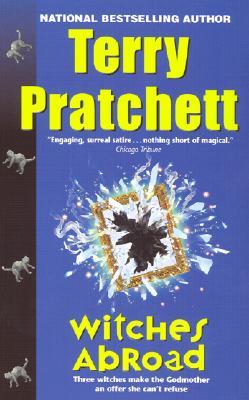
What do you read when you want something light and refreshing, yet not stupid? Terry Pratchett, of course! The first of the "Witches" strand of the Discworld series, a glorious send-up of MacBeth with overtones of Hamlet, seen through the lenses of the incomparable Nanny Ogg, Granny Weatherwax, and Magrat Garlick:
The wind howled. Lightning stabbed at the earth erratically, like an inefficient assassin. Thunder rolled back and forth across the dark, rain-lashed hills. The night was a s black as the inside of a cat. It was the kind of night, you could believe, on which gods moved men as though they were pawns on the chessboard of fate. In the middle of this elemental storm a fire gleamed among the dripping furze bushes like the madness in a weasel's eye. It illuminate three hunched figures. As the cauldron bubbled an eldritch voice shrieked, "When shall we three meet again?" There was a pause. Finally another voice said, in far more ordinary tones, "Well, I can do next Tuesday."

This is a biography of Mary Granville Pendarves Delaney, a woman whose life spanned most of the eighteenth century, always on the fringes of British high society. She befriended a substantial number of luminaries of the day, was married twice -- unhappily at 17 (and widowed at 23) and again in her thirties to an Irish clergyman, from all accounts the kind of happy marriage that many people only dream about -- but the extraordinary story begins when Mrs. Delaney is 73 years old, widowed again, and begins to create stunning cut paper flower collages (all of which can be viewed at the
British Museum's website.) The weak link in this book was the biographer's attempt to muse on the nature of creativity; I found the parallels she drew to her own life to be somewhat tiresome. Mary Delaney's story stands quite well all on its own (kind of like Mary Delaney herself.)
I love reading about Vietnam. In some ways it reminds me of Ireland or Palestine, an underdog of a country, a place that has maintained its culture and dignity through a history of occupation by a succession of bully-nations and despots.
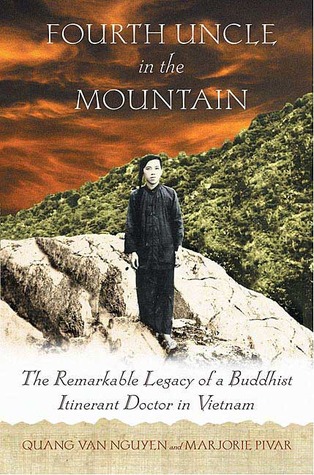
Fourth Uncle is a memoir of Quang Van Nguyen
, a Vietnamese man who escaped to the U.S. during the reign of Pol Pot and the Khmer Rouge (whose influence extended from Cambodia into Vietnam.) He was adopted as an infant by an extraordinary Buddhist monk/doctor and trained to follow in his footsteps. The book chronicles Quang's education (including his teenaged rebellion when he dabbles in sorcery.) While some of his accounts stretch the boundaries of belief for someone like me, I was also reminded (again) that there is waaaaay more to this world than meets the eye. Good book.
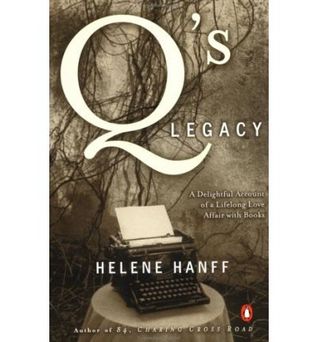
Call me a nerd, but some of my favorite books are books about books. And this one is a book about a book about books. I've reached new heights in nerd-dom. One of my top top top all-time favorite books is
84, Charing Cross Road by Helene Hanff. If you haven't read it, well, you don't know what you're missing. (The movie adaptation -- in a sweet addendum to the story the rights to produce it were a gift from Mel Brooks to his wife Anne Bancroft -- was pretty good too.)
Q's Legacy is partly about how Helene Hanff came to write her mega-bestseller, and then what happened after people like me fell in love with it. I just love her voice: she's funny, self-deprecating, down-to-earth, all salt and vinegar … but she loves what she loves fiercely. Sadly Ms. Hanff
died, mostly penniless in a nursing home, in 1997.
More later. I just started reading Helene Hanff's
Apple of My Eye in which she wrote the narrative to accompany a late seventies tourist's guide to New York City. I'll let you know what I think. Stay tuned …