Showing posts with label summer reading. Show all posts

Wednesday, July 17, 2013

Summer Reading, Pt. 2

Barreling ahead halfway through July …

In the mid-seventies Helene Hanff took a job writing a guide book of New York City for visitors, and as she set out to research the book (by becoming a tourist herself, with her intrepid friend Patsy by her side) she realized that there are a lot of places that native New Yorkers never go. As a guide book it is quite dated -- the World Trade Center was almost new, the tram to Roosevelt Island was brand new, and Ellis Island had just opened as a historic site. It is, however, written in Hanff's highly entertaining style and filled with the kind of people's history tidbits that I like, such as her observations that many of the wonderful artistic venues of New York (Carnegie Hall, the Frick Museum, the Cloisters, etc.) were essentially paid for with the lives of mine and factory workers. Good book, I recommend it, especially for New Yorkers.


 This one is really hard to classify. The author calls it "domestic fantasy". It is the story of a family that lives a seemingly idyllic life in the village of Applekirk, a place that exists in the middle of time. Further east is ruled by gods and goddesses (who seem awfully human,) while the land to the west is largely ruled by reason. Trouble arises when a scholar from the west arrives in Applekirk to study a long-vanished civilization at the same time that an elderly woman -- a former lord of Applekirk -- arrives from the east fleeing the wrath of the goddess of marriage. At times I was bugged by the language that Walton invented for the inhabitants of Applekirk, but the story raised a lot of interesting questions about what constitutes marriage and family. I liked it. (But if you want your novels to move in a linear fashion through time, you might go bonkers reading this book.)
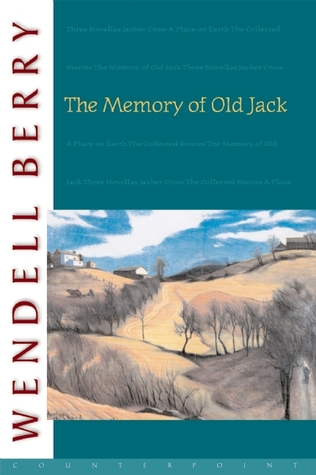


I am a huge fan of Wendell Berry's writing. This is another story set in Berry's fictional Kentucky river town, Port William. It takes place over the course of one day -- the last day, in fact, in the life of 93-year old Jack Beechum -- as he recalls the many turnings of his long life. I've read enough of Berry's Port William stories that the recurring characters are like old friends, and it was wonderful to be among them again. Beautiful, tender, evocative writing. I cannot get enough of it.


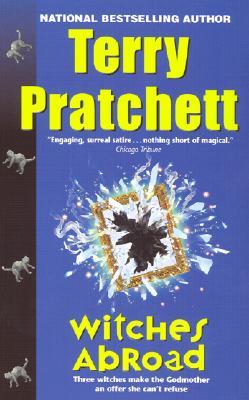
The second book in the witches' strand of Terry Pratchett's Discworld series. Desiderata, one of two fairy godmothers has died and bequeathed her magic wand to the young witch Magrat, with explicit directions that she is to travel to Genua to prevent  Emberella from marrying the prince. Magrat embarks on her quest, accompanied by her formidable companions Granny Weatherwax and Nanny Ogg.


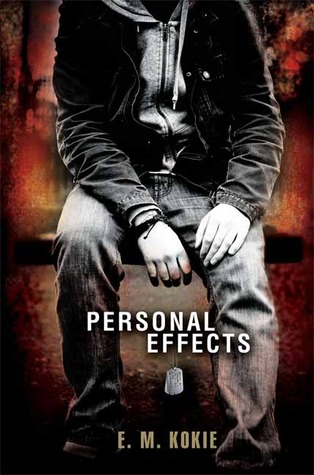
I finally got around to reading Personal Effects. (It's been in my "to read" pile only since it came out last fall.) This is a debut YA novel that happens to have been written by my neighbor Emily, so I can tell you that not only has she written one heck of a good novel, but she's also a good dog walker and lawn mower, not to mention a lovely person. But the book: Matt Foster is a 17-year old boy living with his emotionally distant and abusive father as he struggles to cope with his brother TJ's death in the Iraq War. When the family receives TJ's "personal effects", Matt discovers letters and photos that send him on a journey to find out more about his brother. I loved this book -- I could not stop reading it! The author did such a good job of portraying a grief-stricken, emotionally stuck, teenaged boy and I wanted to find out how the story would resolve for all of the characters. On a side note, it was fun that part of the story took place in Madison, in places that I recognized. I highly recommend this book!


Next up: The Lost Garden by Helen Humphreys.

Wednesday, June 27, 2007

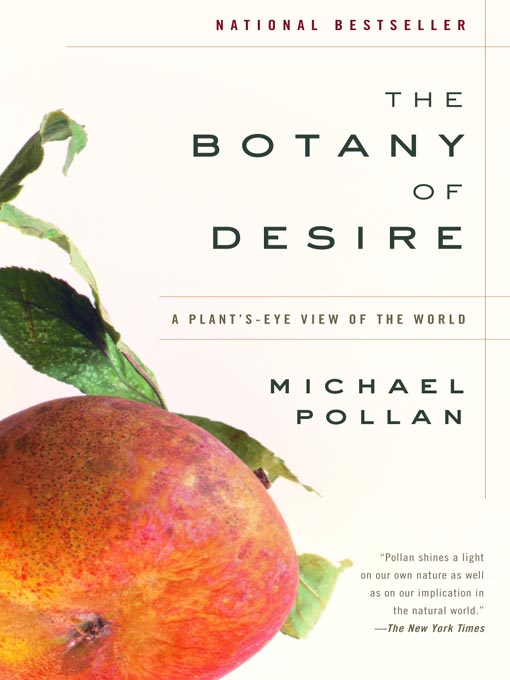
The Botany of Desire: A Plant's-Eye View of the World

Working my way through my stack of books, I finished this one yesterday. This book takes a close look at the way 4 ubiquitous plants -- the apple, the tulip, marijuana and the potato -- have co-evolved with humans (with our help of course) to fulfill 4 very different human desires -- sweetness, beauty, intoxication, and control.

This book was a wonder, from start to finish. You might say, "But I'm no gardener!" to which I'll say that Pollan's book has little to do with gardening and a lot to do with what it means to be human.

It is full of fascinating information, from a history of John Chapman (a.k.a. Johnny Appleseed) to the ins and outs of growing marijuana in our current era of prohibition. (I was still way back in the seventies in my knowledge of that! I confess, it made me want to experience that kind of an altered consciousness again.)

Along the way Pollan weaves in hilarious anecdotes, mystery, intrigue, and ultimately illuminates the idiocy of the so-called War on Drugs, as well as the danger that biotech giant Monsanto poses to the world's food supply and life as we know it.

Highly recommended!

Remember, if you buy this book from Amazon, I won't share my Crackerjacks with you.

Sunday, June 17, 2007

It's Summer ...

... and that means more time for reading! We added a screened back porch to our house 2 summers ago, and it is my favorite reading place.

I just finished An Unreasonable Woman: A True Story of Shrimpers, Politicos, Polluters and the Fight For Seadrift, Texas -- Diane Wilson's account of her (largely) one person stand against the Formosa Plastic Corporation. While similar stories have been told over and over since "ecology" first became a buzzword in the early seventies, Diane's feistiness and the connections she makes between environmental movements, sustainable living (including those who make their living as commercial fishermen/women) and workers' rights are invaluable. At times it is excruciatingly frustrating; when it appears that she has lost and Formosa will be able to continue polluting her beloved bay unchecked, Diane muses
"I felt like a huge game was being played - on me, on ordinary, regular people! In this game there were ten thousand stupid rules, like dot all your i's, and send in your petition properly and timely, and file all your legal briefs with the proper and duly appointed judge, and follow the proper sequence in the Codified Federal Registers. As long as us regular, ordinary people kept busy playing the game and we believed we were doing everything right and it would make a difference and we could control our own lives and make things better and safer ... well, then the game was working!"

But she goes on to show that one person, one unreasonable woman, can make a difference. This book is an inspiration.

Other books in my (impossibly towering) stack:

Mary Rose O'Reilly, The Love of Impermanent Things
Ian McEwan, Atonement Paul Hawken, Blessed Unrest
Kenneth Helphand, Defiant Gardens: Making Gardens in Wartime
Sonia Nieto, Why We Teach
Robert Hinshaw, Living With Nature's Extremes: The Life of Gilbert Fowler White
Hugh Barbour, The Quakers
John D'Emilio, Lost Prophet: The Life and Times of Bayard Rustin
Michael Pollan, The Botany of Desire
Sy Montgomery, The Good Good Pig

I need to insert some more fiction or I will burn out. The trouble is, Terry Pratchett has spoiled me for anything else. What am I to do? Last summer I took a young adult literature course and discovered Gary Paulsen, among others. (But not Hatchet.) Maybe I'll check out what's new in YA lit. I'm (almost) always open to suggestions; however, I much prefer historical fiction to anything futuristic or post-Apocalypse.