Barreling ahead halfway through July …
In the mid-seventies Helene Hanff took a job writing a guide book of New York City for visitors, and as she set out to research the book (by becoming a tourist herself, with her intrepid friend Patsy by her side) she realized that there are a lot of places that native New Yorkers never go. As a guide book it is quite dated -- the World Trade Center was almost new, the tram to Roosevelt Island was brand new, and Ellis Island had just opened as a historic site. It is, however, written in Hanff's highly entertaining style and filled with the kind of people's history tidbits that I like, such as her observations that many of the wonderful artistic venues of New York (Carnegie Hall, the Frick Museum, the Cloisters, etc.) were essentially paid for with the lives of mine and factory workers. Good book, I recommend it, especially for New Yorkers.
This one is really hard to classify. The author calls it "domestic fantasy". It is the story of a family that lives a seemingly idyllic life in the village of Applekirk, a place that exists in the middle of time. Further east is ruled by gods and goddesses (who seem awfully human,) while the land to the west is largely ruled by reason. Trouble arises when a scholar from the west arrives in Applekirk to study a long-vanished civilization at the same time that an elderly woman -- a former lord of Applekirk -- arrives from the east fleeing the wrath of the goddess of marriage. At times I was bugged by the language that Walton invented for the inhabitants of Applekirk, but the story raised a lot of interesting questions about what constitutes marriage and family. I liked it. (But if you want your novels to move in a linear fashion through time, you might go bonkers reading this book.)
I am a huge fan of Wendell Berry's writing. This is another story set in Berry's fictional Kentucky river town, Port William. It takes place over the course of one day -- the last day, in fact, in the life of 93-year old Jack Beechum -- as he recalls the many turnings of his long life. I've read enough of Berry's Port William stories that the recurring characters are like old friends, and it was wonderful to be among them again. Beautiful, tender, evocative writing. I cannot get enough of it.
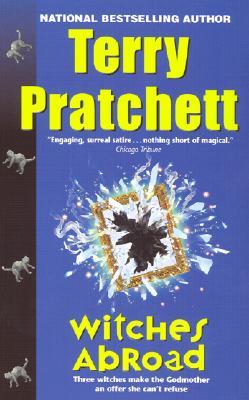
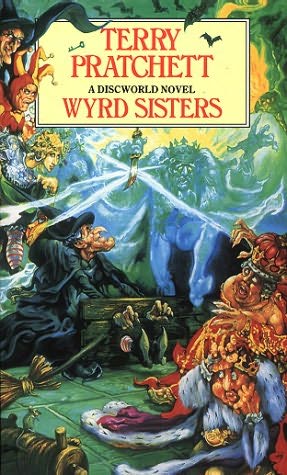
The second book in the witches' strand of Terry Pratchett's Discworld series. Desiderata, one of two fairy godmothers has died and bequeathed her magic wand to the young witch Magrat, with explicit directions that she is to travel to Genua to prevent Emberella from marrying the prince. Magrat embarks on her quest, accompanied by her formidable companions Granny Weatherwax and Nanny Ogg.
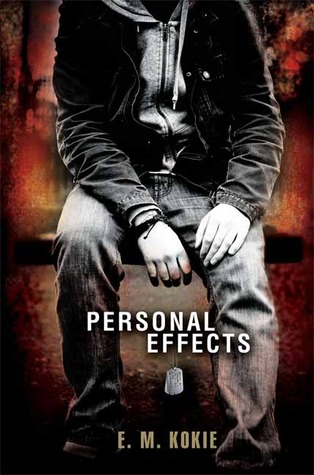
I finally got around to reading Personal Effects. (It's been in my "to read" pile only since it came out last fall.) This is a debut YA novel that happens to have been written by my neighbor Emily, so I can tell you that not only has she written one heck of a good novel, but she's also a good dog walker and lawn mower, not to mention a lovely person. But the book: Matt Foster is a 17-year old boy living with his emotionally distant and abusive father as he struggles to cope with his brother TJ's death in the Iraq War. When the family receives TJ's "personal effects", Matt discovers letters and photos that send him on a journey to find out more about his brother. I loved this book -- I could not stop reading it! The author did such a good job of portraying a grief-stricken, emotionally stuck, teenaged boy and I wanted to find out how the story would resolve for all of the characters. On a side note, it was fun that part of the story took place in Madison, in places that I recognized. I highly recommend this book!
Next up: The Lost Garden by Helen Humphreys.
Showing posts with label Terry Pratchett. Show all posts
Wednesday, July 17, 2013
Wednesday, December 29, 2010
Have you been naughty, or nice?
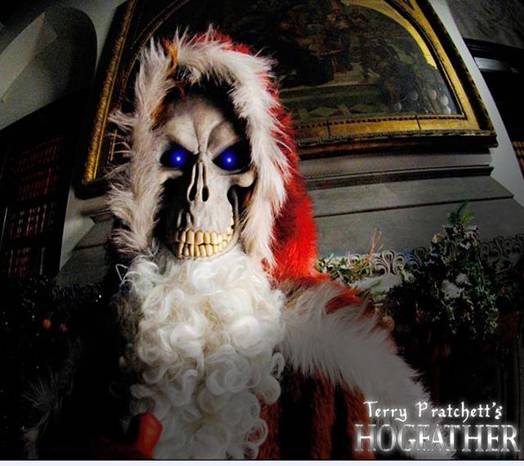
Hogswatch is coming, the pigs are getting fat …

Yes, it's that time of year, when you hear the scraping of sleigh runners and the prancing of
16 tiny hooves on your rooftop, when the fellow in the red robe comes down your chimney
with his HO HO HO, a time to be jolly, with mistletoe and holly and -- other things ending
in olly. That can only mean one thing: It's time for the annual reading of Terry Pratchett's
Hogfather!
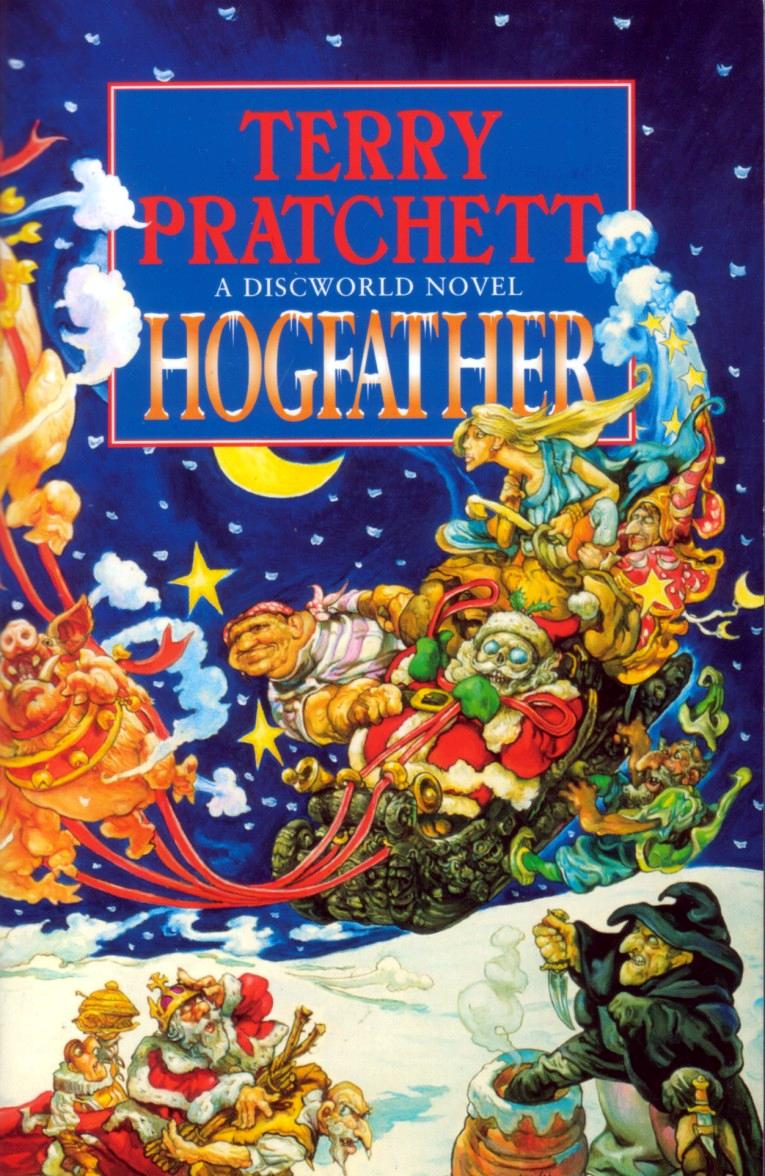
It's Hogswatch Eve, and the Hogfather has gone missing under mysterious circumstances.
Paid assassin, Mr. Teatime (pronounced Te-ah teem-eh) and a band of petty thieves are
messing with the beliefs of the world's children, leaving an inconvenient surplus of belief
elsewhere -- especially at the Unseen University in Ankh-Morpork. Someone has to step in
to save Hogswatch so that the sun will continue to rise each day, and that someone is …
Death? HO HO HO. Also featuring the Verucca Gnome and the Oh God of Hangovers.
Another delectable offering in the Discworld series, Hogfather manages to poke fun at
everything associated with holidays while honoring the underpinnings of tradition. A story
with many twists, turns, and seemingly loose ends, but in the end you are richly rewarded.
Pratchett's books may seem light and insignificant, but they offer so much food for thought.
Honestly, what are you waiting for? HO HO HO, Happy Hogswatch!
Labels:
book review,
Hogfather,
Terry Pratchett
Monday, November 08, 2010
We interrupt this reading of Terry Pratchett for a [so far] rather depressing novel.
My book group is reading Let the Great World Spin by Colum McCann. I have 200+ pages to read in order to finish it by Thursday night's book group meeting. But that's not why I'm writing tonight. This is a book review of Terry Pratchett's most recent book -- his fourth YA novel about the young witch, Tiffany Aching.
The Tiffany Aching series begins with the delightful The Wee Free Men, when the 9-year old Tiffany first is identified as a witch, meets the Nac Mac Feegle (or "wee free men", a race of tiny blue men in kilts who enjoy drinkin', fightin', and drinkin') and goes head to head with the queen of the fairies to rescue her younger brother, as well as Roland, the son of the local baron. In A Hat Full of Sky, Tiffany is 11. She's left her home on the Chalk to go to the mountains and get formal training as a witch, but a malevolent spirit called a "hiver" has taken up residence in her body and she must outwit it or die. In the third book, Wintersmith, when the 13-year old Tiffany makes the impetuous decision to join in the age-old Morris dance honoring Winter and Summer, she attracts the amorous attention of the Wintersmith and stirs up jealousy in the heart of the real Lady Summer.
In I Shall Wear Midnight Tiffany is 16 and has returned to be the local witch for the people of her beloved Chalk. But all is not well. She has had a falling-out with Roland, whom she had supposed she would marry one day, and he is betrothed to someone else. Furthermore, there is rising sentiment against witches that threatens to break out into the kind of violence that was seen in the past, and whatever is causing it appears to be focused on Tiffany.
Like the previous Tiffany Aching books, this one is filled with Pratchett's trademark intelligent humor spiced with a little bawdiness (courtesy of the Nac Mac Feegle and the delightful old witch Nanny Ogg) and infused with serious social commentary. There is also a bittersweetness to it: Pratchett has been very public about his diagnosis with early-onset Alzheimer's disease, and this book felt like an extended good-bye to many beloved characters from his earlier Discworld books. At any rate, Tiffany Aching is a child no longer, so I suspect it is the last children's book about her.
My introduction to Terry Pratchett was The Wee Free Men, and after that I was hooked. Tiffany is one of the best female characters to come along in a very long time, and I absolutely love Pratchett's take on witchcraft. I highly recommend that you read this series (and then make the leap over to his Discworld books for adults.)
The Tiffany Aching series begins with the delightful The Wee Free Men, when the 9-year old Tiffany first is identified as a witch, meets the Nac Mac Feegle (or "wee free men", a race of tiny blue men in kilts who enjoy drinkin', fightin', and drinkin') and goes head to head with the queen of the fairies to rescue her younger brother, as well as Roland, the son of the local baron. In A Hat Full of Sky, Tiffany is 11. She's left her home on the Chalk to go to the mountains and get formal training as a witch, but a malevolent spirit called a "hiver" has taken up residence in her body and she must outwit it or die. In the third book, Wintersmith, when the 13-year old Tiffany makes the impetuous decision to join in the age-old Morris dance honoring Winter and Summer, she attracts the amorous attention of the Wintersmith and stirs up jealousy in the heart of the real Lady Summer.
In I Shall Wear Midnight Tiffany is 16 and has returned to be the local witch for the people of her beloved Chalk. But all is not well. She has had a falling-out with Roland, whom she had supposed she would marry one day, and he is betrothed to someone else. Furthermore, there is rising sentiment against witches that threatens to break out into the kind of violence that was seen in the past, and whatever is causing it appears to be focused on Tiffany.
Like the previous Tiffany Aching books, this one is filled with Pratchett's trademark intelligent humor spiced with a little bawdiness (courtesy of the Nac Mac Feegle and the delightful old witch Nanny Ogg) and infused with serious social commentary. There is also a bittersweetness to it: Pratchett has been very public about his diagnosis with early-onset Alzheimer's disease, and this book felt like an extended good-bye to many beloved characters from his earlier Discworld books. At any rate, Tiffany Aching is a child no longer, so I suspect it is the last children's book about her.
My introduction to Terry Pratchett was The Wee Free Men, and after that I was hooked. Tiffany is one of the best female characters to come along in a very long time, and I absolutely love Pratchett's take on witchcraft. I highly recommend that you read this series (and then make the leap over to his Discworld books for adults.)
Labels:
book review,
I Shall Wear Midnight,
Terry Pratchett
Saturday, September 25, 2010
Oh Dear Blog, Do You Still Love Me?
Nation opens in a time of upheaval in the mid-nineteenth century. There has been a flu epidemic in Britain which has claimed the King and a great number of his heirs, and a ship has been dispatched to one of the furthest outposts of the British empire to fetch the next living heir. Meanwhile in the great Pelagic Ocean there has been a massive tsunami that brought death and destruction to the many island nations there.
Mau is an inhabitant of one of the islands, his people known simply as "the Nation." No longer a boy and not yet a man, Mau was returning from his initiation into adulthood on a distant island when the wave struck. He returns to his home island to find that he is the only survivor.
Daphne is a well brought up British girl, who was sailing out to join her father in Port Mercia in the Pelagic Ocean. The Sweet Judy, the ship on which she travels, has already withstood an attempted mutiny when the tsunami hits. The captain and remaining crew are drowned in the wave and the ship is driven to Mau's island. Daphne and a foul-mouthed parrot have survived.
Inevitably Mau and Daphne meet. They form a bond based on mutual survival, that grows into a friendship over time. As time goes on, more survivors of the tsunami find their way to the Nation, and Mau -- lost in his grief, in limbo between childhood and manhood, and questioning the gods of his people who would take so many innocent lives -- must act as the chief of the Nation.
In some ways Nation is less satirical than Pratchett's other books, but many of the themes are familiar. As always he raises questions about government and organized religion, and also white supremacy, class, and empire. Because it was written for a younger audience, at times the narrative seems too simple, but ultimately Nation is a very wise and thought-provoking book. I recommend it, and if you can read it while marooned on an island, so much the better.
Monday, April 26, 2010
Book Review: Going Postal
Going Postal opens on the very last day of the unfortunate Moist Von Lipwig's (a.k.a. Albert Spangler and any number of other aliases) life. He's made a good run of it as a swindler and a con man, but he's been apprehended and sentenced to hang that morning. Sometimes, however, you get an angel, this time in the guise of Ankh Morpork's tyrannical ruler Lord Vetinari. Moist has a choice to make -- execution or … become Postmaster of the Ankh Morpork Post Office, which has fallen on hard times in recent years.
Being Postmaster isn't all golden suits and wingéd hats. First, Von Lipwig must prove himself to the Post Office Workers, then he finds himself in direct competition with the Grand Trunk Semaphore Company, a telecommunications conglomerate that's "too big to fail." (Which begs the question, does Pratchett possess some weird sixth sense or does Tim Geithner read Terry Pratchett?)
Terry Pratchett is simply a genius. He has a knack for hitting every nail squarely on the head. His writing is often classified as "fantasy" because it takes place on Discworld, but make no mistake about it: Pratchett's feet are planted firmly on Earth and he is satirizing everything about it he can get his hands on.
As far as I am concerned, Terry Pratchett is among the best living writers in the English-speaking world. He incorporates science, sociology, and fantasy with a wicked sense of humor. He leaves nothing unskewered, but he does it all with an absolutely generous heart.
Highly, highly recommended.
Labels:
book review,
Going Postal,
Terry Pratchett
Tuesday, July 07, 2009
Book Review: Monstrous Regiment by Terry Pratchett
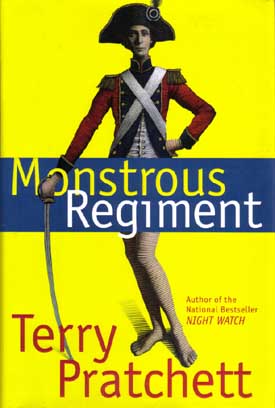
It is difficult to say much about Monstrous Regiment without giving too much away and spoiling it for you, so I'll keep my review brief. In Monstrous Regiment Pratchett skewers the military industrial complex, the war on Iraq, religious fundamentalists, and traditional English folk songs. This is among my favorite books by Terry Pratchett. It's a hoot.
Labels:
book review,
Terry Pratchett,
war is stupid
Wednesday, July 01, 2009
Delicious Synchronicity
I am rereading my favorite book by Terry Pratchett, Monstrous Regiment, and was moved to copy down the following quote:"The presence of those seeking the truth is infinitely to be preferred to the presence of those who think they've found it."Then, as I perused my favorite news sites this morning I found this pearl from "Joe" the "Plumber":
Asked if he has plans to run for public office, he replied, “I hope not. You know, I talked to God about that and he was like, ‘No.’”Weird, huh?
Saturday, April 25, 2009
Book Review: Men At Arms by Terry Pratchett
My name is Suzy and, friends, I have an addiction to the writing of Terry Pratchett. It is not necessarily a harmful addiction by standard definitions. I still go to work, stay clean and sober, and feed my family. However, it does set the bar ridiculously high for literary quality. In short, because of Terry Pratchett I can no longer read just anything. His books are that good. In fact, there is a book -- currently out of print and stupidly expensive so I have not read it -- called Guilty of Literature. It's a collection of essays by other authors (A.S. Byatt, for one) about Pratchett's writing.Men At Arms is the second book about the Watch, the police force of the ancient city of Ankh-Morpork. When the story opens, the Watch -- a typical old boys' club -- is struggling to integrate some new affirmative action recruits: a dwarf, a troll, and a w-. Captain Samuel Vimes, a 25-year Watch veteran, is retiring in 24 hours when he marries Lady Sybil Ramkin and becomes a part of Ankh-Morpork's society elite. Corporal Carrot ( a dwarf by adoption), Sergeant Fred Colon, and Corporal Nobby Nobbs round out the core group of Watchmen.
In the midst of this internal upheaval, a series of murders rocks the city of Ankh-Morpork. A murder in Ankh-Morpork is nothing unusual, but these murders appear to have been committed with a one-of-a-kind weapon invented by the genius Leonard of Quirm, and believed to have been destroyed by the Assassin's Guild: Ennog Eht. (Leonard of Quirm preferred to write in mirror writing.) Worse yet, Ankh-Morpork's patrician, Lord Vetinari -- a former assassin himself -- has ordered Vimes not to investigate.
Men At Arms is an excellent example of the brilliance of Pratchett's writing. He combines explicit and relevant social commentary with great stories, memorable characters, and exquisitely bad puns. Dear [blog] readers, there is a reason that Pratchett became Sir Terry Pratchett last year and is the second most popular fantasy writer in Britain. (OK, that one's easy: It's because J.K. Rowling had a lot of money backing her.) Maybe his writing isn't for everyone, but if you enjoy a good book -- I mean a really well-written book -- and you like to be made to think and laugh, then for Pete's sake, don't make me say it again: Read Terry Pratchett!!
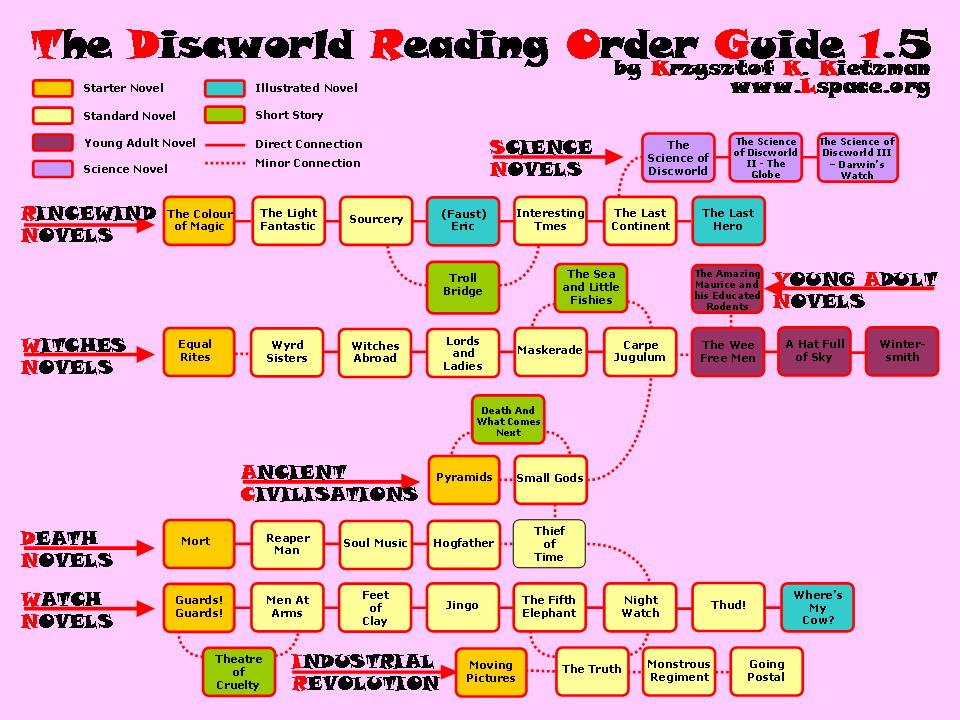
The Watch series begins with the book Guards, Guards, then Men At Arms, Feet of Clay, Jingo, The Fifth Elephant, Nightwatch, and Thud!
Sunday, February 08, 2009
Pass the Popcorn Please
Because I love Terry Pratchett so much, I was a little loathe to see a screen adaptation of one of his books. Thanks to Cinderbelle however, and her Netflix membership, we spent the last two evenings watching the BBC production of Hogfather. It wasn't bad. In fact, I quite enjoyed it. Some of the characters were not quite as I had pictured them, but all in all it was very true to the book (which I reviewed here a few days ago.)One question: HAVE YOU BEEN NAUGHTY OR NICE?
Recommended!
Sunday, February 01, 2009
What Duck?
The Discworld books are frequently shelved with fantasy books, but they are very much satire. Bright and joyful satire. Terry Pratchett clearly loves his fellow human beings, with all their foibles and idiosyncrasies. And he loves poking fun at them.
When I try to name a favorite character, each one makes me think of 3 more favorites: Sam Vimes, Captain Carrot, the Librarian, Quoth the Raven, Leonard of Quirm, Bloody Stupid Johnson, Death, Nobby Nobbs, Nanny Ogg, Granny Weatherwax, the Igors, Lu Tse, Gaspode the wonder dog ... they are all wonderful, imaginative, and likable.
I recommend Pratchett to many people, and I am frequently surprised when people come back to me and say that they tried a Pratchett book but just couldn't get into it. So let me offer a few tips for reading Terry Pratchett. First of all, he has been writing for many years now, and I have to say that the earlier books in the Discworld series are not as well developed as the more recent ones. Furthermore, while all of the books comprise one series, there are different series' within the series that follow specific characters or groups of characters. I like some of them better than others. If you want to follow a specific thread, you can consult the L-Space. Finally, I think people see that he has so many books and assume that they will be a quick, fluffy, fantasy read. So be forewarned: when you pick up a Pratchett book, you are reading literature. The plots are multi-layered and may take a while to figure out what's going on.
All of this is to lead up to a book review of Hogfather. It is December 32, Hogswatchnight. The night when the Hogfather travels around the Disc in his sleigh pulled by 4 pigs, delivering presents to all of the good little boys and girls. But the Hogfather has disappeared and a proxy is filling in for him. Only a few people have noticed that strange things are afoot: Susan Sto-Helit (Death's granddaughter) and the wizards at the Unseen University have just a few hours to figure out what is going on and put things right so that the sun will rise on the new day.
If you haven't read any Pratchett, this is a good one to start with. It explores one of his favorite recurring themes, belief, in a way that I certainly can believe in. I thoroughly enjoyed reading Hogfather and intend to make the reading of it an annual tradition each December.
Millennium hand and shrimp. Buggr'it!
Sunday, August 03, 2008
What I'm reading ..., pt. 2
I'm ba-a-a-ck!I packed 4 books to take with me to Rock Island. No blockbusters, in the end wisely deciding that they simply weigh too much and are difficult to hold up for reading in the hammock. At the last minute I threw in 3 more, all Terry Pratchett books.
7 books? What was I thinking??? I ended up reading only 2! I read Wyrd Sisters by Pratchett, tried to read one of my other books (a novel by Peter S. Beagle, author of the cult classic The Last Unicorn) but got bored because he doesn't write like Terry Pratchett, and then read Witches Abroad by TP. I'm such a dork sometimes.
One year I'd like to try going to the island with just one book, or NO books (scary thought) and see what kind of entertainment I can make for myself. It's not as if there is nothing to do.
I should say that it feels good to be home, and it does, but I miss Rock Island. It is such a wonderful place. I have never put it to the test, but I think I could happily stay there for 2 weeks, pit toilets, hauling water, sleeping on the ground, and all. More on the week later.
Subscribe to:
Posts (Atom)