Showing posts with label children's literature. Show all posts

Monday, October 21, 2013

Fifty … No, Fifty-two … Wait, FIFTY-SIX Books That I Love

I started this list some time ago on a sticky on my desktop, and just felt compelled to finish it (for the time being) tonight. Drop me a line and tell me your top 10 (or more.) You'll note that I don't discriminate between literature for children vs. adults. As far as I'm concerned, great books are great books.


1. To Kill a Mockingbird
2. The Wizard of Loneliness
3. Nightwatch
4. How Green Was My Valley
5. A Tree Grows in Brooklyn
6. Savage Inequalities
7. Storming Heaven
8. The Secret Garden
9. Red Sky at Morning
10.  The Book Thief
11.  Endurance
12.  The Chronicles of Prydain
13.  The Last Unicorn
14.  A Prayer for Owen Meany
15.  The Summer Book (Tove Jansson)
16.  Lord of the Rings
17.  Cider With Rosie
18.  Cold Comfort Farm
19.  Singing Family of the Cumberlands
20.  Of Human Bondage
21.  The Razor's Edge
22.  The Absolutely True Diary of a Part-time Indian
23.  A Christmas Carol
24.  The Country of the Pointed Firs
25.  Twig
26.  Yellow Raft on Blue Water
27.  The Last Report on the Miracle at Little No Horse
28.  The Wonderful Adventures of Kavalier and Clay
29.  Into the Beautiful North
30.  Charlotte's Web
31.  The Bean Trees
32.  All Creatures Great and Small
33.  The Ark
34.  The Outsiders
35.  Bridge to Terabithia
36.  Little Women
37.  Wise Child/Juniper
38.  My Family and Other Animals
39.  84 Charing Cross Road
40.  The Country Bunny and the Little Gold Shoes
41.  The Pushcart War
42.  The Wuggie Norple Story
43.  Rain Makes Apple Sauce
44.  Bud, Not Buddy
45.  The Graveyard Book
46.  "Little House" series (and yes I know it is racist)
47.  The Story of Ferdinand
48.  The Singing Creek Where the Willows Grow
49.  The Dark Is Rising series
50.  Elsie Piddock Skips In Her Sleep
51.  The Island of the Blue Dolphins
52.  Apple Tree Lean Down
53.  My Side of the Mountain
54.  The Monstrous Regiment
55.  The Wee Free Men
56. Hannah Coulter (but any number of Wendall Berry's books could be on this list.)

Saturday, April 03, 2010

Book Review: Boys and Girls Forever: Children's Classics from Cinderella to Harry Potter


This is a book of essays on children's literature by Alison Lurie, who is a Pulitzer Prize winner and a professor of children's literature at Cornell University. Most of these essays appeared at an earlier time in the New York Times Book Review. I picked this up on a whim from a display at my branch library, being a sucker for reading about children's literature.


To tell you the truth, these essays really annoyed me. I really didn't see a point to this book, except maybe to gather her essays in one place -- if gathered they needed to be. Each one read like a long-winded lecture from someone steeped in the self-importance of academia: Hans Christian Anderson (about whose writing I took an entire semester-long class in college), Louisa May Alcott, L. Frank Baum, John Masefield, Walter de la Mare, Dr. Seuss, Tove Jansson, J.K. Rowling, and then some more general essays on fairytales, nursery rhymes and games, illustrations, and the role of nature in children's literature. Each essay was a pronouncement: "This means that" and "This wrought these changes." They also read like the countless essays I had to write, demanding that I "compare and contrast A with B." (Dr. Lurie, please compare and contrast Tove Jansson's Moomintroll books with A.A. Milne's Winnie-the-Pooh.)


For me, as a person who spends every day in the living, breathing company of young children and books, so many of her pronouncements seemed wooden, and well, academic. I admit, that may well have been her intent, but it didn't sit well with me. I kept having flashbacks to the children's literature class I took as an undergrad at Keene State College, taught by a salty new England woman with an accent so thick you could cut it with a knife who intoned on and on about May Hill Arbuthnot (a noted children's literature scholar and the author of our textbook.)


I don't know how old Lurie is -- old enough to have 3 grandchildren to whom she dedicates the book -- or if she is still teaching, has even stepped into a book store any time recently, or when these essays were first written because her knowledge of illustrators seemed to stop with Maurice Sendak (she likes his later work -- which I find kids don't particularly care for) and Arnold Lobel (who died 23 years ago.) In other words, the essays were very narrow in their scope.


Now I am going to expose my deep-seated prejudice with a question: Why is Harry Potter considered a classic piece of children's literature, while other modern fantasies that have been around much longer (Lloyd Alexander's Prydain Chronicles, Joan Aiken's Wolves of Willoughby Chase, and The Hobbit for heaven's sake) get barely a nod in their direction?


I guess I have to say that children's literature is anything but academic to me. It is alive, and I am far moire interested in how to apply it (i.e. do the kids enjoy it when I read to them?) than what meanings might be hiding in the subtexts. Unless you want to re-live your undergraduate college literature courses, I would advise steering clear of this book. I wish I had.

Monday, June 22, 2009

Summer Reading -- The Yggyssey by Daniel Pinkwater

You know, I had never thought about the The Wizard of Oz being based on Homer's Odysseus. However, Daniel Pinkwater clearly had, when he wrote this book. The Iggyssey: How Iggy Wondered What Happened to All the Ghosts, Found Out Where They Went, and Went There is a sequel to The Neddiad. Yggdrasil Birnbaum is familiar with the ghosts of Los Angeles (of whom there are many) and she becomes concerned when they begin to disappear. Determined to solve the mystery, Iggy and her friends Neddie Wentworthstein and Seamus Finn follow a ghostly bunny through a portal that leads ... somewhere.

The Yggyssey pays homage to some great moments in children's literature. It is also filled with Pinkwater's signature humor -- intelligent, self-deprecating, puckish at times. The Neddiad and The Yggyssey are both quick reads, very entertaining, highly recommended.

Friday, June 19, 2009

Another Day, Another 2 Book Reviews

"And it was summer, warm, beautiful summer ..."

For me that means reading. Lots of reading. I have read 2 books so far, as different from each other as night and day, as the saying goes.

First is Ben Logan's memoir of growing up on a Wisconsin farm, The Land Remembers. You don't have to be from Wisconsin to enjoy this book. (And by the way, real Wisconsinites do not refer to themselves as "Sconnies.") Ben Logan was born in 1920 at his family's "Seldom Seen Farm" in the hill country between Gays Mills and Mount Sterling, Wisconsin. Reading it, I was struck by two things:

1) Everything Logan writes about happened just one generation ago, my parents' generation. His father farmed with horses, they had no indoor plumbing or electricity, and his family was entirely self-sufficient. I remember visiting relatives on a farm like this in northern Wisconsin, 40 years ago. The changes that have been wrought in a single generation are almost beyond belief, and not all bad of course, but something was surely lost in the headlong rush forward in the name of "progress".

2) The land ethic that Logan learned from his parents seems way ahead of its time. He was taught to be a steward of the land. His father did not jump on every (or even most) agricultural bandwagons, because he was cautious of the long-term effects. Farmers were peddled a lot of snake oil in those days, much of which has led to the environmental crises we are facing today.

The Land Remembers
is a beautifully -- even poetically -- written book. Ben Logan left Wisconsin as a young man and had a successful career as a writer and radio broadcaster on the east coast. He returned to Wisconsin in the eighties and bought back Seldom Seen Farm (it had been sold at some point) and lived there until a few years ago. When he moved off the farm, he donated it to the Mississippi Valley Conservancy, with the agreement that they would keep it in use as a sustainably-managed farm.

Highly recommended, especially for people with an interest in sustainability or lovers of memoir.

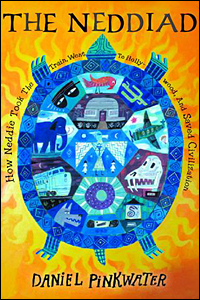
The second book of the summer is Daniel Pinkwater's The Neddiad: How Neddie Took The Train, Went To Hollywood, And Saved Civilization. In this book, Pinkwater takes the epic quest/hero's journey fantasy and turns it on its ear. It is the early fifties and Neddie Wentworthstein is moving with his family to Los Angeles. On the way he meets a shaman named Melvin, who gives him a small stone turtle, telling him not to lose it. Neddie, of course, has many adventures and encounters both friends and foes, before he is able to complete his quest.

If you are not familiar with the writing of Daniel Pinkwater, you don't know what you're missing. His sly sense of humor isn't necessarily of the laugh-out-loud-'til-your-stomach-hurts variety, but he had me chuckling throughout the entire book. He pokes fun at Jews, Republicans, military establishments, Madison Avenue, Hollywood, and anything else you can think of. A couple of high points, but I don't want to spoil all of the jokes for you:
We only stopped for gas, plus once, when we were across the state line in San Bernardino, California, at McDonald's fifteen-cent hamburger stand, where you Buy 'Em by the Bag. "This is a good idea," Seamus Finn said. "They should open more of these."
and

"There's only so far we can go with this sort of thing," Aaron Finn whispered. "I think it may be against the law to torture people, even if you're a movie star and a Republican."
I can hardly wait to read the companion book, The Yggyssey, next up. These books would make an excellent gift for any 11-13 year olds you know, especially if they're getting a little overdosed on the kid wizard from Britain.

Wednesday, April 29, 2009

Maybe You Can Help Me

I would like very much to acquire a copy of this book
but I do not wish to spend upwards of $75.00 on it. If you should ever run across it at a thrift store or yard sale, would you be so kind as to purchase it for me? Or if you happen to have it sitting in your book case ... (hint, hint. I'm not naming names, but you know who you are. I'll give you a small amount of cash and a signed note that I will never again dis' J.K.Rowling in public. I promise!)

Wednesday, July 16, 2008

The Grumpy Librarian


While weeding the fiction section of the library today I came upon a book written by someone I knew: Keys For Signe, written by Marion Fuller Archer and published in 1965! Marion and her husband Leonard were long-time members of the Madison Monthly Meeting. They were both librarians. Leonard exuded Old World grace, while Marion always had a Puckish twinkle about her. As the convener of our meeting's library committee, she would periodically stand up after meeting for worship, and with a completely deadpan demeanor, identify herself as "the grumpy librarian" before giving a forthright scolding about overdue books checked out from the meetinghouse library. When I first began attending Quaker meeting I was a little intimidated by her (as well I should be -- I am a terrible offender when it comes to overdue library books.) Over time, I became aware of what a lovely person she was.

She was the consummate librarian. They don't make them like her anymore (one reason that I am so frustrated with the master's program that I'm in.) I had no idea that she was also an author. I showed the book to the librarian who is mentoring me, and then I got another surprise. He said, "Oh, she's the founder of the Golden Archer Award." Unlike other awards given for children's literature -- like the Newbery and Caldecott Awards -- which are selected by committees of adults, the Golden Archer Award, and its picture book counterpart, the Little Archer, is given each year to a book that is selected by schoolchildren all across Wisconsin. That's a pretty special kind of recognition.

Marion Archer died last year. Her husband preceded her in death by several years. I am sad that I didn't know them better. I feel as if I found a little buried treasure today.

Wednesday, January 02, 2008

Book Review: Lois Lenski, Journey Into Childhood

One of my first, and enduring, passions is children’s literature. When I was in high school, I thought that I would become an author/illustrator, but I chose the teaching route instead. (Julia Cameron might call me a “shadow artist.”) Never has there been more of a market for children’s books, and I try to keep somewhat current, but I also love many older books, and I often obtain copies of them when they are “weeded” from library collections.

For a child of the sixties, the books of Lois Lenski were ubiquitous. Strawberry Girl, Cotton in My Sack, the Mr. Small series were all fixtures in the school library. Nowadays they are frequently overlooked or discarded for being outdated. I remember one of my children’s literature professors, in a thick New Hampshire accent, dismissing Mr. Small for its gender stereotyping!

My interest in Lois Lenski was aroused this winter when I received the latest issue of Quaker Action, the bulletin from the American Friends’ Service Committee and this sentence caught my eye: “And the juvenile fiction writer Lois Lenski Covey included AFSC in her trust, and the organization receives quarterly donatons as a result.” Wow! All of a sudden she was no longer a long-ago author of quaint, slightly sexist books, but perhaps something of an activist, and I wanted to find out more.

Google ... my virtual hero. There is actually quite a bit of information available on Lenski. I found that she had published an autobiography, Journey Into Childhood, which was in our local library system, so I read it. What a life! From a near-idyllic childhood as a minister’s daughter in turn-of-the-century rural Ohio to scraping by as an art student in New York City to marriage to distinguished twentieth-century muralist Arthur Covey to recognition as an author/illustrator who pioneered a realistic portrayal of childhood in America, it was quite the journey.

What touched me most is her obvious love of children, and her concern for their physical, emotional, spiritual, and creative wellbeing. It was that concern which led her to being a writer (and she used that term, “being led” which this Quaker finds interesting.) Her books, far from being quaintly old-fashioned, were an expression of a very gritty concern for the poor and downtrodden -- especially children -- in this country, very much on a par with the works of Woody Guthrie, John Steinbeck or Dorothea Lange.

A few years ago I read a biography of another icon of children’s literature, Margaret Wise Brown (author of Goodnight Moon,) who was very involved with the Bank Street School of Education and wrote quite self-consciously in a style that was "scientifically proven" to be “good” for children. Lenski’s pedagogy was based on what she knew in her heart to be good for children, first the children in her own life and later, the children she met through her writing. She was the quintessential teacher. And it was easy to understand her gift to the AFSC.

Lenski’s life may not speak to you in the same way it did to me, but if you like memoirs or you want a view of America in the last century, seek out this book.

This review is cross-posted at the Winter Reading Challenge.

Monday, December 31, 2007

Book Review: How to Get Your Child to Love Reading ...

(cross-posted at Winter Reading Challenge)

A Parent's Guide for Ravenous and Reluctant Readers Alike: Activities, Ideas, and Inspiration for Exploring Everything in the World Through Books by Esmé Raji Codell. There are few things that get me as excited as books, and as a parent, a teacher, and a soon-to-be (fingers crossed) librarian, this book just about makes me hyperventilate every time I pick it up! My daughter gave it to me for Christmas last year and I lugged it around for a while (and I do mean lugged -- it's a tome.) I was inspired to crack it open again yesterday when I had a couple of hours to myself ... good thing Molly the rescue Dalmation was here to lick my face when I fainted from the excitement!

If you have children in your life, or you simply enjoy children's literature, this book is an invaluable resource. It contains a plethora of lists of books, arranged thematically, interspersed with data about the power of reading aloud, ideas for volunteering, good movies, web sites. Codell wraps it all up in a package she calls "potato pedagogy". You take one humble potato, cut it up into many pieces, plant each of those pieces, and before you know it you have thousands of potatoes. Children's literature, she says, is our national potato.

Can you tell that I love this book? Two drawbacks, however. One, because of its nature, it will need to be updated every couple of years -- or at least Codell needs to release a supplement to it from time to time. Two, and this one is purely personal -- Esmé Codell has irritated me ever since she wrote that book Educating Esmé about the ONE year she spent as a classroom teacher, after which she quit because she couldn't hack it, but went on to write a bestseller about what a great teacher she was. It raises the hackles on this twenty-one year veteran teacher just a little. Jealous? Maybe. But I maintain that learning the art of compromise is not a bad thing, and I've done more for more kids over a long period of time than one crackerjack teacher can do in one year. So there!

That said, I recommend this book.

If you are a serious lover of children's literature, you should be aware of the Cooperative Children's Book Center. Each year they enlist volunteers to read every children's book published, then they in turn publish the CCBC Choices, a list of what they feel are the best books of the year. It is an amazing resource. They also take a keen interest in the issue of intellectual freedom, and are an excellent clearinghouse for information if your community is dealing with a book challenge.