Showing posts with label sustainability. Show all posts

Thursday, July 02, 2009

A Fruity Book Review

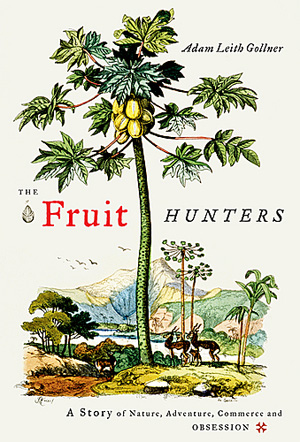
I am a fan of those monomaniacal nonfiction books, the ones that go into great depth on one subject. In this case the subject is fruit and the book is Adam Leith Gollner's The Fruit Hunters: A Story of Nature, Adventure, Commerce and Obsession. Why fruit? It hasn't really ever before been an obsession of mine. I try to eat my 5 servings a day with varying degrees of success. However, as I read the book, I became aware that I may be a little more fruit-obsessed than I thought. I like growing fruit in my yard: I've been quite successful with currants and raspberries, less so with cherries, choke cherries, and service berries. Those are fruits of the north. Gollner's book is filled with tropical fruits, more fruits than you can imagine.
"The diversity is dizzying: most of us have never heard of the araça, but Amazonian fruit authorities say there are almost as many types of araças as there are beaches in Brazil. Within the tens of thousands of edible plant species, there are hundreds of thousands of varieties – and new ones are continually evolving. Magic beans, sundrops, cannonballs, delicious monsters, zombi apples, gingerbread plums, swan egg pears, Oaxacan trees of little skulls, Congo goobers, slow-match fruits, candle fruits, bastard cherries, bignays, belimbings, bilimbis and biribas. As Hamlet might’ve said: 'There are more fruits in heaven and earth, Horatio, than are dreamt of in your philosophy.' ”
Suddenly I feel fruit-deprived; of the small percentage of the world's fruits that are grown or allowed into the U.S., by the time they get to my landlocked city, they will have been on the road for days, sometimes weeks, and the flavor a mere shadow of what it should be. There are the hundreds of varieties of more familiar fruits that have been neglected in our commercial fruit monoculture, so we only ever get to eat one or two varieties of pears, strawberries, bananas, figs, avocadoes, pomegranates, etc. etc. etc. And then there are the fruits that will never make it here: the chupa chupas, bignays, sapotes, gourkas ... Sigh.

(I can't say I'm sad about the durian though. I once had the bad fortune to eat a durian-filled cookie from the Asian grocery store. I absolutely could not choke it down, ended up gagging into the garbage can, and even so, I burped up durian taste all day long. Then again, some people say they have the same reaction to cheese.)

If you ever thought that fruit was just a side dish, an afterthought, guess again. Gollner shows, in no uncertain terms, how fruit has shaped and defined life on earth in general, and human life in particular. He takes the reader to the very extreme edges of his subject: the fanatics who stop at nothing to get their hands on a fruit and the fruitarians -- people who eat nothing but fruit (and their subsets such as the "rockguacamolians" who only eat avocadoes sprinkled with asteroid dust,) and shows us the underbelly of the fruit world as well. The way that the fruit trade is linked to organized crime, for example. The creepy, underhanded treatment and marketing of "wholesome" fruit. The geopolitics of fruit. Or the fact that the idling semi-trucks that serve the huge Hunts Point Fruit Market in the Bronx are responsible for way elevated, life-shortening asthma rates (which I've read about in Jonathan Kozol's books about the work he does with schoolchildren in the South Bronx.)

Reading The Fruit Hunters has made it difficult for me to think about fruit in the same way that I did before. Shopping at my local food co-op this week, I was sorely disappointed to see that, with the exception of one small bin of local apples, virtually all the other fruit was imported from California or Mexico, including the strawberries, raspberries, and blueberries. I had a hard time buying anything!

I have been, however, deeply appreciative of every red raspberry that I have plucked off the bushes in my backyard. I'm thinking of planting a paw paw tree. I am also heading back to a serviceberry tree that I found growing on a city street a few blocks from here, dropping its sweet, delicious berries onto the sidewalk. There are a lot of fruits to forage, right here.

Oh! Am I reviewing a book? Sorry, I forgot. The Fruit Hunters: dripping with sex (yes, really!) An entertaining and enlightening read. Recommended.

Sunday, February 22, 2009

Mmmmmmmmm.

We had a most wonderful dinner experience this evening and I wanted to share it with you (dear readers) in case you might want to seek out something like it in your vicinity! A friend of ours from way back is a librarian by vocation, but her first love has always been cooking for groups of people. A couple of years ago she came into an inheritance and used it to buy a house (lucky for us) right in our neighborhood. There she hosts dinner parties with home cooked food made from scratch, served family-style (except without the family-style humiliation.) She maintains a mailing list, and when she's ready to host a dinner, she sends out an announcement. The dinners are a fixed menu and fixed price ($25 for two) with appetizers, main dish, sides, and dessert. Tonight the menu included chicken pot pie -- my absolute favorite comfort food -- and butterscotch pudding for dessert.

It turned out that Mr. Ether knew most of the other diners that were there. It was a little weird in that, rather than sitting and letting the food digest, they all beat it out of there immediately after eating. I think they were all anxious to get home and watch the Oscars. Not us. (We haven't gotten a conversion box yet, so our TV is non-functioning except for the Fox channel; if I were a TV watcher, that would be my idea of Hell ... but I'm not, which is why we don't have a conversion box.)

It was lovely, especially because mean-spirited weasels like Dick Cheney were not welcome. If you care to check out the website, you can find it here or host/chef Deb's blog here.

Sunday, September 14, 2008

A Life That Spoke

My friend Donna sent me a link to this obituary in the New York Times. Don Rivera was a good friend of hers. It is a reminder to me of how any one of us can be an agent of significant change in the world, and that humble acts as well as humble materials bring about big results. (Humility seems to be my theme these days.) It also reinforces my belief in micro- over macro- economies: small, local, and sustainable works.

How are you letting your life speak?

Ron Rivera, Potter Devoted to Clean Water, Dies at 60

Ron Rivera liked to call his ceramic water filters “weapons of biological mass destruction.” For 25 years he traveled to poor villages throughout Latin America, Africa and Asia teaching local potters to make what appears to be a big terra-cotta flower pot but is in fact an ingenious device for purifying water.

“You put dirty water in — gray water that many communities still drink — and it comes out crystal clear,” he told an audience last year at the Cooper-Hewitt National Design Museum in Manhattan, where his filters were included in an exhibition called “Design for the Other 90 Percent.”

A recent study in Cambodia found that the filters cut in half the incidence of diarrhea, a leading cause of death in the third world, especially among children.

Mr. Rivera died on Sept. 3 in Managua, Nicaragua, after contracting falciparum malaria, the most dangerous form, while setting up a water-filter factory in Nigeria, said Kathy McBride, his wife. He was 60.

Mr. Rivera, a Bronx-born Peace Corps volunteer who spent much of his life as a development worker in Central and South America, discovered his life’s mission in Ecuador in the early 1980s. A Guatemalan chemist, Fernando Mazariegos, was showing local potters a ceramic pot he had invented. It was made of clay mixed with sawdust or ground rice husks that burned off during firing, leaving pores so tiny that they blocked the passage of water-borne bacteria while letting the water seep through.

After being coated with a bacteria-killing silver solution, the pot effectively eliminated 98 to 100 percent of diarrhea-causing contaminants like E. coli, cryptosporidium and giardia.

The pot was easy to make and cheap to buy. Suspended inside a five-gallon container to collect the water, it could purify one to three quarts an hour, drawn through a spigot.

Off and on, Mr. Rivera began working with charities and development groups to set up workshops for turning out the filters. He later improved the filter by developing a mechanical press and standardized molds to ensure a consistent product.

After Hurricane Mitch cut a swath through Central America in 1998, Mr. Rivera, who had been doing development work in Nicaragua for the previous decade, joined with a tiny American organization called Potters for Peace and went into high gear. “He became the guy you went to to set up a filter factory,” said Daniele S. Lantagne, an engineer working on safe water systems at the Centers for Disease Control and Prevention in Atlanta.

Mr. Rivera often said that his goal was to set up 100 enterprises. The factory in Nigeria was his 30th.

Ronald Rivera was born to Puerto Rican parents in 1948. After graduating from World University in Puerto Rico, where the family moved when he was 11, he joined the Peace Corps and spent two years working in Panama. He went on to do development work in Ecuador and Bolivia with the Peace Corps and with Catholic Relief Services, although he was an atheist.

It was while studying with the radical educational theorist Ivan Illich in Mexico that he learned to throw clay pots. “Illich said that human beings were disconnected from the earth, and Ron realized that he did not really know how to do anything with his hands,” Ms. McBride said. “So he moved in with a Mexican potter and learned.”

In 1977 he married Maggie Padilla, whom he later divorced. She survives him, as does their son, Demian Rivera of Bloomington, Ind., and Mr. Rivera’s four brothers: Larry, of Parkland, Fla.; Eddie, of Miami; Dennis, of Orlando, Fla.; and Louis, of San Diego. The marriage ended in divorce. After he moved to Managua in 1988, he and Ms. McBride, who had been high school sweethearts, reunited and eventually married. Three stepchildren survive, Camilo Power of Brooklyn, Ana Gabriela Power of Norfolk, Va., and Maria Belen Power of Minneapolis.

For the last decade of his life, Mr. Rivera traveled all over the world setting up microenterprises in Ghana, Cambodia, Yemen, Colombia and other countries. Many thrived, especially after Mr. Rivera began organizing the workshops as profit-making microenterprises. Some produced filters for a short period and then shut down, either abandoned by their sponsors or caught up in political turmoil, as was the case with a workshop in the Darfur region of Sudan.

Beverly Pillers, the chairwoman of the board of Potters for Peace, said Mr. Rivera’s factories had produced about 300,000 filters, selling for $5 to $25, and used by about 1.5 million people. At the moment, 13 more filter factories are scheduled to begin operating by the end of next year.

“I saw Ron as a Pied Piper,” said Robert Pillers, the treasurer of Potters for Peace. “He had the capacity to draw people in and then give them the means to accomplish something.”

Saturday, August 30, 2008

Pickles!

This Pickles?
No, silly ...
These pickles!
This is the first time I've made pickles. For some reason the jars are not sealing so they'll have to be refrigerator pickles. Should be good though: dill, onions, lots of garlic. Mmmmm. You can never have too much garlic.

The recipe comes from the Mennonite cookbook Eating More With Less, via my friend and fellow gardener Donna. (I met a woman last year who referred to herself as a "cookbook Mennonite." When I asked for clarification, she explained that there are people whose first experience with Mennonites -- one of the historic peace churches -- comes from the Eating More With Less cookbook. If you haven't seen it, I recommend it. I also recommend the companion book Living More With Less.)

I belatedly bought a share in a communal garden when two of the gardeners had to leave town suddenly. Unlike a CSA, where you buy a share and get produce delivered each week, the shareholders in this garden do all the work. I'm coming in at the tail end, for the harvest. Lucky me!

The farm where the garden is located belongs to my friends John, Robin, and Susan. It is exceedingly lovely. I'll try to get some pictures in the coming weeks.

So far we have partaken in potatoes, tomatoes, sweet onions, sweet red peppers, corn, tomatoes, cucumbers, tomatoes ... Later come the melons, squash, storage onions, garlic, basil, carrots, green beans, and did I mention tomatoes? I have a date with Poodle Doc to can the first bunch of tomatoes tomorrow. Last year's tomatoes sustained us until mid-March.

Tuesday, June 03, 2008

Food for People, Food for Thought

Two articles caught my eye tonight, and I think they have some ideas in common. The first is about the possible demise of the world's honeybees. I've written about it before and it is one of those things that simply scares the living daylights out of me, until I start thinking about food production on a smaller, more human, scale. Read it here, and feel free to let me know what you think in the comments. When I read about "beekeepers" who load millions of bees into semis and drive them across the country, well, that's hardly food production on a human scale, and it is really about the corporatization of our food supply. Furthermore, it seems as if the California almond growers, as well as the big-time "beekeepers", are less concerned with finding answers to the long-term questions than they are with maximizing their profits in the short-term, the future be damned.

The other article
is about small family gardens in Lesotho, as one small scale solution to the food crisis (which, by the way, I believe is largely manufactured and highly profitable for that small percentage of the Earth's citizens who always profit off the misery of the many.) Anyway, reading it was a balm for my soul tonight.

I was delighted over the weekend to find a small patch of ground in my postage stamp of a yard where tomatoes can grow. After work today I went to our Tuesday Farmers' Market and bought 4 tomato plants, 3 of them heirloom varieties, which will be going in soon. There is little as empowering as growing your own food. (Warning to Mr. Ether: This year it's tomatoes. Next year, chickens! Can backyard sheep be far behind? I hear there is a growing market for sheeps' milk cheese ...)