Showing posts with label good works. Show all posts

Sunday, September 14, 2008

A Life That Spoke

My friend Donna sent me a link to this obituary in the New York Times. Don Rivera was a good friend of hers. It is a reminder to me of how any one of us can be an agent of significant change in the world, and that humble acts as well as humble materials bring about big results. (Humility seems to be my theme these days.) It also reinforces my belief in micro- over macro- economies: small, local, and sustainable works.

How are you letting your life speak?

Ron Rivera, Potter Devoted to Clean Water, Dies at 60

Ron Rivera liked to call his ceramic water filters “weapons of biological mass destruction.” For 25 years he traveled to poor villages throughout Latin America, Africa and Asia teaching local potters to make what appears to be a big terra-cotta flower pot but is in fact an ingenious device for purifying water.

“You put dirty water in — gray water that many communities still drink — and it comes out crystal clear,” he told an audience last year at the Cooper-Hewitt National Design Museum in Manhattan, where his filters were included in an exhibition called “Design for the Other 90 Percent.”

A recent study in Cambodia found that the filters cut in half the incidence of diarrhea, a leading cause of death in the third world, especially among children.

Mr. Rivera died on Sept. 3 in Managua, Nicaragua, after contracting falciparum malaria, the most dangerous form, while setting up a water-filter factory in Nigeria, said Kathy McBride, his wife. He was 60.

Mr. Rivera, a Bronx-born Peace Corps volunteer who spent much of his life as a development worker in Central and South America, discovered his life’s mission in Ecuador in the early 1980s. A Guatemalan chemist, Fernando Mazariegos, was showing local potters a ceramic pot he had invented. It was made of clay mixed with sawdust or ground rice husks that burned off during firing, leaving pores so tiny that they blocked the passage of water-borne bacteria while letting the water seep through.

After being coated with a bacteria-killing silver solution, the pot effectively eliminated 98 to 100 percent of diarrhea-causing contaminants like E. coli, cryptosporidium and giardia.

The pot was easy to make and cheap to buy. Suspended inside a five-gallon container to collect the water, it could purify one to three quarts an hour, drawn through a spigot.

Off and on, Mr. Rivera began working with charities and development groups to set up workshops for turning out the filters. He later improved the filter by developing a mechanical press and standardized molds to ensure a consistent product.

After Hurricane Mitch cut a swath through Central America in 1998, Mr. Rivera, who had been doing development work in Nicaragua for the previous decade, joined with a tiny American organization called Potters for Peace and went into high gear. “He became the guy you went to to set up a filter factory,” said Daniele S. Lantagne, an engineer working on safe water systems at the Centers for Disease Control and Prevention in Atlanta.

Mr. Rivera often said that his goal was to set up 100 enterprises. The factory in Nigeria was his 30th.

Ronald Rivera was born to Puerto Rican parents in 1948. After graduating from World University in Puerto Rico, where the family moved when he was 11, he joined the Peace Corps and spent two years working in Panama. He went on to do development work in Ecuador and Bolivia with the Peace Corps and with Catholic Relief Services, although he was an atheist.

It was while studying with the radical educational theorist Ivan Illich in Mexico that he learned to throw clay pots. “Illich said that human beings were disconnected from the earth, and Ron realized that he did not really know how to do anything with his hands,” Ms. McBride said. “So he moved in with a Mexican potter and learned.”

In 1977 he married Maggie Padilla, whom he later divorced. She survives him, as does their son, Demian Rivera of Bloomington, Ind., and Mr. Rivera’s four brothers: Larry, of Parkland, Fla.; Eddie, of Miami; Dennis, of Orlando, Fla.; and Louis, of San Diego. The marriage ended in divorce. After he moved to Managua in 1988, he and Ms. McBride, who had been high school sweethearts, reunited and eventually married. Three stepchildren survive, Camilo Power of Brooklyn, Ana Gabriela Power of Norfolk, Va., and Maria Belen Power of Minneapolis.

For the last decade of his life, Mr. Rivera traveled all over the world setting up microenterprises in Ghana, Cambodia, Yemen, Colombia and other countries. Many thrived, especially after Mr. Rivera began organizing the workshops as profit-making microenterprises. Some produced filters for a short period and then shut down, either abandoned by their sponsors or caught up in political turmoil, as was the case with a workshop in the Darfur region of Sudan.

Beverly Pillers, the chairwoman of the board of Potters for Peace, said Mr. Rivera’s factories had produced about 300,000 filters, selling for $5 to $25, and used by about 1.5 million people. At the moment, 13 more filter factories are scheduled to begin operating by the end of next year.

“I saw Ron as a Pied Piper,” said Robert Pillers, the treasurer of Potters for Peace. “He had the capacity to draw people in and then give them the means to accomplish something.”

Saturday, December 15, 2007

10 Candles

My friend Madeline is in the Peace Corps in Lesotho. From time to time she emails a public letter, updating her loved ones about her life there. I was so moved by her most recent letter, which I received this morning, exactly when I needed it. I am sure she won't mind my publishing it here:
Candles on my Christmas Tree
Public Letter from Madeline U. in Lesotho, Africa (Dec 2007)

Those of you who've spent Christmas with me may remember I love lit candles on a live evergreen. Here in Lesotho , we're in the midst of summer, and I'm enjoying my second year of a no-commercials / no-pressures-to-buy-anything / no-Xmas-carols-in-shopping malls / no rush-around Christmas. Just the hot sun, farmers plowing with oxen, afternoon winds impregnating dust devils, and fields of aloe and wild flowers.

So my candles will be metaphorical ones – 10 candles on my Christmas tree of 2007:

Candle 1: Lit to celebrate my one year anniversary here. A decision to let go of the fast, rich life -- trading it for a slower, poorer one. Poverty is mean. Poverty wears me down, and it destroys the lives of my neighbors. But I am richer for living amidst struggling Basotho villagers, able to see how simple things mean a great deal, and how complex things intertwine to keep us in a mire of destitution. Most people in this world make the same amount of money per year as do the villagers in Mt. Moorosi . In one mere year, I've grown closer to the realities of people whose earth I share.

Candle 2: Lit for this sad and special year in my family. My brother Dave has been living with a fast growing brain tumor. From this great distance, as I see my sisters Susan and Kate, my brother Will, my mom Barbara, my cousins Donna and Annelle, and many friends and family gather around Dave to support him, I am awed at the strength and love that endures in my immediate family. Thanks to the Peace Corps, I was able to fly home in April 2007 to visit Dave, to say the hardest word in all the languages I've ever studied – good-bye, for now, dearest brother.

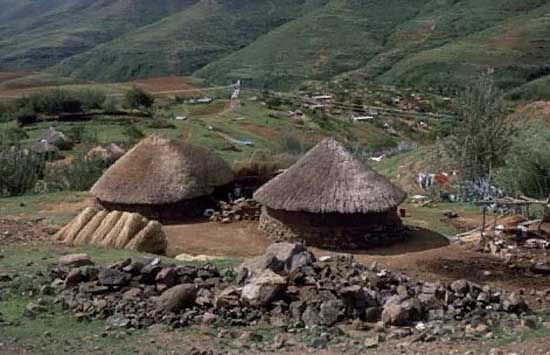
Candle 3: Lit for health. Who would have known that two years in the Peace Corps would be the best thing in 30 years for my own health? I climb mountains, eat simple meals, don't stress out with multi-tasking. I have time for everything – reading, visiting, travel. I'm rich in health, wealthy in time, prosperous with sunsets and moonrises, and a millionaire in children who love nothing better than coming into my rondavel to read books or draw with crayons.

Candle 4: Lit to salute the mountains of Lesotho . I traveled a few days ago to Lesotho 's southernmost national park, Sethlabathebe, to visit fellow Volunteer Lizbeth. When I saw the setting of her village, I recognized it from the fantasy I'd had before I got here – the dreams I'd had before I was assigned to dusty, dirty Mt. Moorosi. From her tiny rondavel, Lizbeth looks down upon valleys so deep that mountain peaks rise out of the pool of hovering clouds. I've walked miles and miles of mountain paths this year, visiting remote little schools and sites of other Volunteers. Lesotho 's beauty is awesome.

Candle 5: Lit in admiration for Lesotho 's care of its orphans. With just about the most orphans of any nation on earth, poor little Lesotho has somehow absorbed them – in the bosoms and modest huts of grandmas and aunts and neighbors. Lesotho has few orphanages. For these little people, some sleeping on city streets, all without secure futures, all without the love and identity of parents, please light a candle as well.

Candle 6: Lit for Dintle. This candle sputters a bit, and it's the reason I haven't written for awhile, trying to spare YOU from the horrors of Quthing Hospital. So despite it not being holiday material, let me be honest with you (you are strong enough) to tell you that in the last two months, 14 year old Dintle has been diagnosed as HIV-positive (raped when she was 10 years old), and has an acute case of meningitis. She has shriveled to a mere skeleton, hospitalized for over 45 days now. I fought my way into Maseru once when it turned out the hospital didn't have her blood type, and I traveled in again a month later when the hospital ran out of medicine and her survival hung by a thread.
Nurses in the hospital are so overworked they disappear entirely from wards. When I walk in, looking fresh (and white), neglected patients call to me to adjust their casts or empty bed pans. Dintle can't feed herself – so if I or one of her family members isn't there, she doesn't eat. She has bed sores on her butt and on her ear. She's lost muscle and any ability to move. Seeing the rapid deterioration of a normal, healthy, laughing teen is a knife to my heart.
Helping to keep this candle lit for me is a newly-arrived Peace Corps Volunteer named Jason (Sesotho name – Mokhaele, "son of a chief"). He's been my savior, helping me pay bus transport for Dintle's sister, cousin, and grandmother to make the long trip to the hospital, helping deliver medicines, sometimes just coming in on his own and feeding little Dintle in the twilight hours. You have to love someone like this!
And may the light of this sputtering candle also shine on the hospital's doctors from India – totally overworked – and the Clinton Foundation nurses, who make a real difference, wading into the sea of HIV/AIDS patients. I have new respect for anyone who works in health care – a field reserved for the strong of heart.

Candle 7: Lit for love and loss. When I filled in the Peace Corps application, I didn't factor in long-distance grief. It think it has mostly to do with my age. If we live to be older than 50, we have an increasing number of losses to bear, losses whose pain is as deep as the love was tall. The path of this year has been taken sharp turns as I've heard unexpectedly of the loss of dear friends ~ Mary B., who left a legacy of Dodgeville activism and laughter around her kitchen table. My cousin Doug U., a tower of strength and a deep canyon of reflection. Twinkling-eyed Sven, my fiddling, Swedish host father. No news of dearest Karen T., who shared my years in Japan with such flare. And others…. Grief is hard; grief alone is harder.

Candle 8: Lit for learning. As I look out through my open windows at the upside-down constellations in the starry sky, my mind reels with the mysteries of being a human on this planet. Can we solve problems that we create? Why not? As I fall asleep, I ponder global economics, world peace, village solutions. I wonder what sustains greed, rape, neglect of children. I wonder if I am truly strong enough to pursue a career in international development. Is hope naïve? Is optimism merited? How brilliant the Millennium Development Goals – modest solutions to staggering problems, if only each nation would do its small part. How often I've longed for a cup of good coffee and a conversation with you, dear friend.

Candle 9: Lit for you and those you love, for all your challenges, for all the great things that have happened to you this year. A great hug if you've written me a letter or e-mail, and total understanding if you've been too busy to. That "busyness" -- so American! A national treasure –many things to do. Enjoy the opportunities!

Candle 10: Lit for us, for all of us who share the planet. Who yearn for simple things like a fresh salad, a day of sunshine, a garden of flowers, a child's sweet hug. May we cherish these, support one another, and look with optimism toward a new year.

Madeline

Monday, December 10, 2007

Holiday Peace Market

We held our first ever holiday peace market yesterday at my Friends' meeting house. Doing this has long been a dream of mine, and thankfully, Ffriend Lester joined me in the organizing so that it actually happened! It was a resounding success, and many of the participants left talking about "When we do this next year ..." We had pottery, awesome posters by Lester, prints, watercolors, felted mittens made by me, baked goods, hand sewn items, body care products, cards, calendars and fair trade coffee and tea. Many of us were earmarking our proceeds for charity. I intend to split mine between a family at my school and a Quaker-run NGO in Vietnam called Steady Footsteps. Two other vendors, Glenn and Kathy, gave me a portion of their proceeds and altogether we raised a tidy sum to donate. It was a lot of work to get ready, but well worth it in the end.

An advertisement: Looking for a 2008 calendar? This Returned Peace Corps Volunteers calendar is my favorite one, and it happens to be made by friends of mine right here in Madison.

Friday, November 23, 2007

Can You Help?

A week ago, the father of a student I had last year had a sudden massive heart attack and died. He leaves behind his wife and four young children. The family emigrated to the U.S. less than a year ago. This man worked two jobs and his wife worked a job as well. As you can imagine, none of these jobs payed well or carried benefits, and they were just getting by.

On the day he died, the parents were at school for parent-teacher conferences (which they probably took off from work to attend) and expressed their desire for the children to do well in school.

Right now the family's immediate concern is paying funeral expenses and transporting the man's body to Mexico for burial. Beyond that, there is the ongoing great need for groceries, warm clothing, money for rent and heating, and other living expenses. If you have some spare money, or earmark money for charitable giving around the holidays, and you would like to contribute something to this family in crisis, could you let me know, either in the comments or via email? I would be happy to send you an address where funds can be sent.

Thank you.

Just a note: At my school, where the number of students receiving free and reduced hot lunch -- a common indicator of poverty -- tops 70%, each year several families lose a parent to death. This is just one more fact of life when you are poor. As a nation, can't we do better than this and shouldn't we be demanding this from political candidates and representatives?

Wednesday, August 08, 2007

Friends in Faraway Places


When I returned home from vacation and picked up the most recent copy of our local weekly newspaper, The Isthmus, I was surprised and delighted to find that the leading story -- A Letter From Lesotho -- was written by my friend Madeline. (It's a welcome change from the usual sensational drivel they feature.) Almost a year ago she quit her job, gave up a lovely rental house on the lakeshore, put her possessions into storage, and went into the Peace Corps. Since then I have followed her adventures in Lesotho, Africa via email letters she sends to her friends. I especially like this quote in the article:
Greeting everyone slows my day. People often talk about slower lifestyles in poor countries, but they seldom explain the richness this gives a day. I have effectively traded a 90-mile-an-hour lifestyle for one at 40 kilometers-per-hour (about 25 m.p.h.). But, going slower, you see much more.

Slowing down is something that I give a lot of thought to. During the summer I consciously slow down, walking or biking to my destinations, taking the time to hang laundry out to dry, to talk with my neighbors. It's such a welcome change.

I appreciate many of the things that I have: the computer, the car, the dishwasher, the clothes washer, decent roads ... but I do not appreciate how, if I am not mindful, they control me.

I am currently reading the book Ancient Futures: Learning From Ladakh by Helena Norberg-Hodge, where she describes how Western-style development is putting the squeeze on people all around the world (including us), essentially creating a human monoculture that only benefits the multinational corporations. She paints a pretty depressing picture, but also offers a blueprint for what she calls "counter-development" that is humane, sustainable and earth-centered.

Continuing on this train of thought ... yesterday at the vet's office I got into a conversation about our government with the receptionist. She referred to the "Pandora's Box" that BushCo has opened up, and reminded me of what was left in the box after everything else had flown out -- hope.

So when I start to despair I have to go back to hope; to focus on all of the people who are working on good things all around the world.

Peace.

Tuesday, July 10, 2007

Book Review: "Three Cups of Tea"


Sometimes a book just grabs me and I feel I must evangelize about it. Three Cups of Tea is one of those books. Subtitled "One Man's Mission to Fight Terrorism and Build Nations ... One School at a Time", it is the story of Greg Mortenson -- a former mountaineer -- who ended up in the Pakistani mountain village of Korphe after a near fatal attempt at climbing the famed K2 in 1993. Grateful for the warm hospitality shown to him by the village, he promises to come back and build a school for Korphe's children. True to his word, Mortensen returns to Korphe (and the saga of raising the money and building that first school is an adventure story unto itself.) In the process, Mortenson realizes that much of rural Pakistan is without schools (especially those that will educate girls) and a mission is born. With the help of the mountaineering community (one crotchety old man in particular, who gives him a check for $12,000 accompanied by a note -- "Don't screw up!") he founded the Central Asia Institute (CAI), which had built 55 schools as of the book's publication, as well as a number of other humanitarian projects.

Most interesting was Mortenson's account of being in Pakistan over September 11, 2001. His eyewitness descriptions of the rise of the Taliban and the Saudi-financed madrassas in the years prior to the 9/11 attacks are fascinating. It is clear that the 9/11 attacks were a long time coming. It is also clear that they had little to do with the majority of people hating America. And I woul maintain that Mortenson's work is doing much to further the cause of peace.

This is a part of the world that I admit knowing very little about. Yet today alone there were two news articles that made a little more sense to me since I read this book. (Here - h/t to Quaker Dave - and here.)

One caveat: I'm not particularly keen on the writing style of Mortenson's co-author. This story first appeared in a very abbreviated form as an article in Parade Magazine ... and not to sound like a literary snob, but it shows. On the other hand, that initial article generated the first widespread U.S. interest in Mortenson's project and raised a lot of money from ordinary individuals when the CAI was teetering on the brink of insolvency.

I was also struck by the fact that Mortenson's key supporter in Congress was Mary Bono, a Republican. Sometimes recognizing a genuinely humanitarian effort cuts across party lines. And Mortenson himself is no flag waver; he is appreciably critical of the Bush administration and their handling of the so-called War on Terror.

As I was reading it, I was reminded of another excellent book that I read a couple of years ago: Mountains Beyond Mountains, about the work that physician Paul Farmer has done in Haiti and elsewhere. I am reminded again that one person can be a catalyst for doing immense good in the world, and with a lot of contributions directed toward the large NGOs (like UNICEF, Heifer Project or AFSC) I am planning to direct my efforts this year to the CAI and Steady Footsteps (which I wrote about last week.)