I have an admission to make: I had a hand in Scott Walker's victory last November. No, I didn't vote for him and I did vote for Tom Barrett, the Democratic candidate. But voting was all I did last fall. An act that added up to about 10 minutes of my time -- walking the one block to my neighborhood polling place, filling in my ballot, and walking home. Walker won, and I went around saying, "How bad can he be?" In reality, I was despondent and had disengaged from the process. 8 years of GeeDubya compounded with the disappointment in Obama. (YES, I AM disappointed, and I'm not afraid to lose friends on Face Book for stating that. Obama is a big disappointment to me.)
Well, February came and we learned very quickly how bad Walker could be. All of a sudden virtually everything that I had taken for granted here in my beloved home state of Wisconsin was in danger. Much has changed, and it is uncertain that we will be able to get it back. The recalls did not gain a majority of Senate Democrats, though they did slim down the margin enough for one Republican who shows signs of retaining a sliver of his humanity (all the rest have sold their souls to the corporate devil, as far as I can tell) to perhaps be able to step across the breach.
Like many of my fellow Wisconsinites, what our state's "Arab spring" did was to shake me out of my despondent stupor, and get me to put my shoulder to the wheel of change. You see, for 10 years I've been singing, "Come back Woody Guthrie …" and wondering where the leaders were. Where were the charismatic and eloquent people who would lead us Americans out of the wilderness? I was waiting … and waiting … and nobody was stepping up. I am a child of the sixties who grew up in Madison, Wisconsin, one of the hotbeds of anti-Vietnam War protests. I knew what my leaders should look and sound like, and they just weren't forthcoming. And I was losing hope.
The protests of February and March were exhilarating, galvanizing, and inspiring. What I realized was,
We the People are the leaders, the agents of change. "Be the change you want to see" is more than just words. We are the ones who must turn the wheels of change. And it's not easy. It takes work. It takes time. It takes you out of your comfort zone perhaps. Puts you in danger of arrest (or in some places, worse.) But it is the only thing that makes things better. And those rights that we hold so dear? They can, will, indeed have disappeared in the blink of an eye, because the powers that be -- all of the powers other than the power of We the People -- don't really believe we should have those rights. They have always been precarious. We were lulled into thinking that they were a given, but they're not … unless we fight for them.
There are leaders -- politicians and whatnot -- who will help us fight for our rights, but it is my responsibility as a citizen to be out there being a leader. What can I do? I am required to teach my students social studies … civics! Sure, I teach the larvae, the kindergartners, but there are appropriate ways to teach them important concepts that lay the groundwork for being good citizens. Ta dah!
We've got the big recall coming up -- the puppet himself, Scott Walker. With the gerrymandering and the voter suppression (yup, I believe that's what it is) getting voters to the polls is more important than ever, and it is a tangible place to put energy.
I'm not asleep anymore. I am not despondent. I've made me some hope. It was civil rights activist Bayard Rustin -- look him up if you don't know him -- who said that hope wasn't something you find, you have to make it.
Today my dear friend Chuck sent me this article -- the inspiration for my post. I hope that it inspires you the way it did me.
Showing posts with label hope. Show all posts
Showing posts with label hope. Show all posts
Saturday, August 20, 2011


Thursday, November 27, 2008
Still Moved
These pictures of President-elect Barack Obama, particularly the ones from election night, still move me to tears.
Pico Iyer, in his book The Open Road: the Global Journey of the Fourteenth Dalai Lama, says,
Pico Iyer, in his book The Open Road: the Global Journey of the Fourteenth Dalai Lama, says,
"No one at the beginning of 1989 expected that, by year's end, the Cold War would effectively be over, and no one imagined when Mandela emerged from prison, that apartheid would soon be driven out of his country. The Dalai Lama reposes his faith on such surprises -- the sudden result of what has been building invisibly for years -- as if to say, as he put it once, "Until the last moment, anything is possible."I couldn't help thinking about election night (was it only a month ago?) as I read that passage.
Saturday, November 15, 2008
Worth Reading
Amy Goodman on Democracy Now! is devoting 2 days to an interview with Bill Ayers and Bernadine Dohrn. Part 1 aired yesterday. Here is the transcript. Part 2 airs on Monday.
Note: This is a far more honest interview than the one on Good Morning America yesterday. Yesterday's interviewer so badly wanted Ayers to say that he was intimate friends with Barack Obama, something that so clearly is not true.
I also want to say that Obama handled the allegations during the campaign gracefully, without throwing Ayers under the bus. I was happy to see that Ayers felt the same way.
Note: This is a far more honest interview than the one on Good Morning America yesterday. Yesterday's interviewer so badly wanted Ayers to say that he was intimate friends with Barack Obama, something that so clearly is not true.
I also want to say that Obama handled the allegations during the campaign gracefully, without throwing Ayers under the bus. I was happy to see that Ayers felt the same way.
Wednesday, October 29, 2008
Watching the Earth Move
There have been a couple of events in my adult life that were of such global significance that they stand out in my memory. One was the fall of the Berlin Wall and the reunification of Germany. The other was the end of South African apartheid and the release of Nelson Mandela. What they had in common was that they were things that were so institutionalized it seemed impossible that they would change in my lifetime.
Tonight I watched Barack Obama's 30 minute commercial and became acutely aware that we are on the verge of another of those events. I have not been a Rah Rah Barack supporter, but as the election approaches it takes my breath away to think that we may elect a black president. I think about what that means to the students I teach, for example. And I thought I would never see it in my lifetime.
I may go and vote tomorrow.
Tonight I watched Barack Obama's 30 minute commercial and became acutely aware that we are on the verge of another of those events. I have not been a Rah Rah Barack supporter, but as the election approaches it takes my breath away to think that we may elect a black president. I think about what that means to the students I teach, for example. And I thought I would never see it in my lifetime.
I may go and vote tomorrow.
Sunday, January 20, 2008
Just One More Year! Good Riddance to George W. Bush
That is the headline of an op ed piece from Britain's fantastic newspaper, The Independent. The author of the piece, Rupert Cornwall, writes:
Today is a sombre milestone, marking the start of the last of Mr Bush's eight years in the White House. This being a leap year, exactly 366 days remain until 20 January 2009, when his successor will be sworn into office. It is a time when incumbents look to their legacies. And for this President the view could scarcely be bleaker.
Is he the worst President in US history? Mr Bush faces stiff competition from the likes of James Buchanan, who watched as America slipped towards civil war, or Warren Harding with his corrupt administration, or Herbert Hoover, who failed to halt the slide into the Great Depression, or, more recently, Richard Nixon, the only President to be forced to resign. But in terms of dogmatism, incompetence, ignorance and divisiveness, Mr Bush surely compares with any of the above. (Read it in its entirety here.)
I think he sums up the whole sorry situation very well, although I disagree with him on some points. He believes that Bush cannot be held responsible for the looming recession. I say, look at the man's record! He has turned every venture he has ever touched into dreck (although he and his buddies always seem to make out like bandits. Imagine that.)
I also take issue with this: "Belatedly, the President has learned the virtues of diplomacy, and his troop surge has at least reduced the violence in Iraq." Has he learned the virtues of diplomacy? I still believe that he will find a way to bomb Iran before his term is over. And ask a citizen of Iraq whether the troop surge has reduced the violence.I don't have a lot of faith that U.S. regime change is going to change our path anytime soon. What I do know is that we at the grassroots have to keep on working for the common good, sowing the seeds of nonviolence and of stewardship regardless of what we predict as an outcome. And I, for one, am looking forward to that day 366 days from now.
Sunday, September 23, 2007
Bring Them Home, Pete Seeger
This afternoon I went to see the documentary Pete Seeger: The Power of Song. Pete Seeger has long been a hero of mine. He is a folk music icon, but how many people know what he sacrificed when he stood up to Joseph McCarthy and the House UnAmerican Activities Committee in the fifties? For seventeen years, Pete was banned from the airwaves in the U.S., both radio and television, because he told HUAC that his politics were none of their business. Seventeen years. Yet he is a man who harbors no bitterness towards his persecutors, but speaks only of love, peace, and understanding.
During the years when Pete was blacklisted, he made his living doing school programs. I was extremely moved by the footage of him singing with children. He preaches a gospel, if you will, of community singing. This is something I have been doing with my students for a few years now, and it is very near and dear to my heart. Listening to Pete talk about it was a huge affirmation of my work.
I wept through a good half of the film. I wept with nostalgia, I wept in celebration of this life writ large, and I wept for the state of our country now.
If there was one thing wrong with the film, it is that it plays things a little too safe. There are allusions to what is happening today, but nobody overtly connects any dots. Natalie Mains is featured talking about Pete's blacklisting, but she makes nary a peep about her own. Bruce Springsteen warns that fascism could come again, not acknowledging that it is HERE and NOW. Pete's environmental work on the Hudson River is highlighted, but nothing about the environmental disasters we are facing as the world warms up. Footage of Vietnam, but no mention of Iraq. I found that disappointing and frustrating.
It was also disquieting when many of the people talked about him in the past tense, as if he was already dead. He is still very much alive.
But critiques aside, this is a film that is well worth seeing if you get the chance.
And I'll end by telling you what I tell my students: Sing. Don't ever let anyone tell you that you can't or shouldn't. There is power in singing, and that power belongs to all of us, not just the Pete Seegers of the world. (And Pete would be the first person to tell you that.) So often these days, we surrender the music to someone else, to the professionals, and we go around plugged in to our iPods or Walkmen. I tell my students that music is participatory, not a consumer product, and that their voices are an instrument that they always have with them wherever they are. I also tell them that that is the most important lesson they'll learn from me, more important than reading, writing or math. (Take that NCLB!)
Peace.
Wednesday, August 08, 2007
Friends in Faraway Places
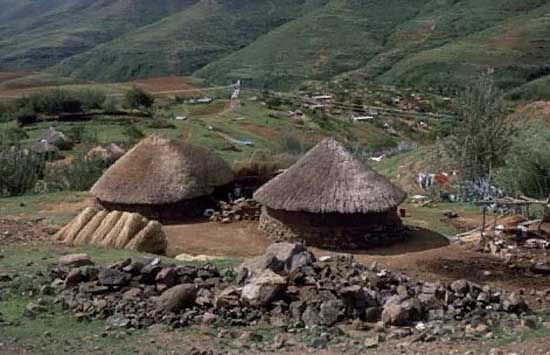
When I returned home from vacation and picked up the most recent copy of our local weekly newspaper, The Isthmus, I was surprised and delighted to find that the leading story -- A Letter From Lesotho -- was written by my friend Madeline. (It's a welcome change from the usual sensational drivel they feature.) Almost a year ago she quit her job, gave up a lovely rental house on the lakeshore, put her possessions into storage, and went into the Peace Corps. Since then I have followed her adventures in Lesotho, Africa via email letters she sends to her friends. I especially like this quote in the article:
Greeting everyone slows my day. People often talk about slower lifestyles in poor countries, but they seldom explain the richness this gives a day. I have effectively traded a 90-mile-an-hour lifestyle for one at 40 kilometers-per-hour (about 25 m.p.h.). But, going slower, you see much more.
Slowing down is something that I give a lot of thought to. During the summer I consciously slow down, walking or biking to my destinations, taking the time to hang laundry out to dry, to talk with my neighbors. It's such a welcome change.
I appreciate many of the things that I have: the computer, the car, the dishwasher, the clothes washer, decent roads ... but I do not appreciate how, if I am not mindful, they control me.
I am currently reading the book Ancient Futures: Learning From Ladakh by Helena Norberg-Hodge, where she describes how Western-style development is putting the squeeze on people all around the world (including us), essentially creating a human monoculture that only benefits the multinational corporations. She paints a pretty depressing picture, but also offers a blueprint for what she calls "counter-development" that is humane, sustainable and earth-centered.
Continuing on this train of thought ... yesterday at the vet's office I got into a conversation about our government with the receptionist. She referred to the "Pandora's Box" that BushCo has opened up, and reminded me of what was left in the box after everything else had flown out -- hope.
So when I start to despair I have to go back to hope; to focus on all of the people who are working on good things all around the world.
Peace.
Monday, February 12, 2007
Everyday Radical
I'm a novice bloggerina, and I've been following links from blogs I visit regularly to other blogs down in Blogville. I've been thinking a lot about this weird and wonderful world of blogging, and yes, I've been suffering some blogger's angst.
From whence does my angst stem?
Well, it's like this. I'm half Martha Stewart and half Rosa Parks (actually if I was ever a fraction of the person Rosa was, I'd be happy) and I wonder what I want my blog to be. Some days I visit a great many blogs of a great many creative women who post their creative endeavors, and I feel moved to post about my creative endeavors. But the other part of me is passionate (obsessed, my family would say) about social justice, especially as it pertains to children and education, peace, nonviolence. So my blog is inspired by other current event-related blogs, really my cyber-soapbox where I expound and pontificate about things very close to my heart.
I've been ruminating on this for a few days, really looking for the place that these two parts of who I am intersect -- and I think I have a glimpse of clarity about it. It came to me in the phrase "everyday radical."
I believe that every time I (or anyone) creates something, it is a radical act. Every time that I am a creator, rather than a consumer -- every time I sing in the car instead of turning on the radio, bake bread instead of buying it, pick up my guitar and play it, knit socks, write something, make dinner for my family -- all of those things are everyday radical. They are a statement of hope, of faith, of a vision of what I'd like the world to be.
So I'll just continue as I have been, but I might post a photo of a perfect loaf of French bread or Poodle Doc's mittens, or the little mousie slippers that are drying on the kitchen counter ... just every now and again. 'Cause I'm not really Martha Stewart (praise Annoya, the goddess of things that get stuck in kitchen drawers!)
Just know, when I'm in the middle of a rant, that I can also knit a mean pair of socks -- turn the heel and everything. I can even knit shoelaces, and come the Revolution, everyone's going to need to know how to knit shoelaces.
From whence does my angst stem?
Well, it's like this. I'm half Martha Stewart and half Rosa Parks (actually if I was ever a fraction of the person Rosa was, I'd be happy) and I wonder what I want my blog to be. Some days I visit a great many blogs of a great many creative women who post their creative endeavors, and I feel moved to post about my creative endeavors. But the other part of me is passionate (obsessed, my family would say) about social justice, especially as it pertains to children and education, peace, nonviolence. So my blog is inspired by other current event-related blogs, really my cyber-soapbox where I expound and pontificate about things very close to my heart.
I've been ruminating on this for a few days, really looking for the place that these two parts of who I am intersect -- and I think I have a glimpse of clarity about it. It came to me in the phrase "everyday radical."
I believe that every time I (or anyone) creates something, it is a radical act. Every time that I am a creator, rather than a consumer -- every time I sing in the car instead of turning on the radio, bake bread instead of buying it, pick up my guitar and play it, knit socks, write something, make dinner for my family -- all of those things are everyday radical. They are a statement of hope, of faith, of a vision of what I'd like the world to be.
So I'll just continue as I have been, but I might post a photo of a perfect loaf of French bread or Poodle Doc's mittens, or the little mousie slippers that are drying on the kitchen counter ... just every now and again. 'Cause I'm not really Martha Stewart (praise Annoya, the goddess of things that get stuck in kitchen drawers!)
Just know, when I'm in the middle of a rant, that I can also knit a mean pair of socks -- turn the heel and everything. I can even knit shoelaces, and come the Revolution, everyone's going to need to know how to knit shoelaces.
Tuesday, January 16, 2007
Where are the leaders?

Yesterday -- the birthday of Martin Luther King, Jr. -- Quaker Dave at the Quaker Agitator had a very compelling post with a collection of photographs of iconic leaders that many of us are familiar with -- all, sadly, dead. He wondered who is stepping up now to fill those shoes. This is something I think about a lot. Like many people, I am hungry for someone who can pull us together and lead us out of this dark time in which we are living. I can't believe there isn't someone out there to take up the mantle of Dr. King.
It's a little bit like waiting for the Second Coming (John Lennon, of course, is who I mean.) I'm not sure it's going to happen in the way I'd like it to, which is a thought that can make me feel quite sad.
In the sixties, people came together around the big ticket movements, civil rights and ending the war in Viet Nam. One would think that the war in Iraq and the rising fascism here in the U.S. would pull people together in the same way, and perhaps that is still to come. Right now it seems like there are many people putting energy toward good causes, but the focus seems very fragmented between many different things.
So I was walking to the post office this afternoon and thinking about this, and thinking about people who do good in the world, and wondering whether small actions will add up to the big changes that I want to see happen. It occurred to me that, while it appears fragmented, all of these small actions are the fruit of the movements from the sixties. That is, that the activism of the sixties instilled in many people a desire to make a difference in the world, and to seek out ways in which to do that. That idealism is precisely what led me to public school teaching.
And that sense of giving back has continued, so that you get people like my friends: 20 year old Laina who just returned from helping someone rebuild their house in New Orleans, or Madeline who retired and joined the Peace Corps this year at age 60, or Mike Boehm, a local Viet Nam veteran who shepherds an ongoing project between my Monthly Meeting and the people of My Lai.
Is this enough to save us? I don't know. But while I wait for the big movement to grow, it helps me to remember that there are many small seeds sprouting in many places. Here's what one of my favorite optimists, Pete Seeger, had to say in last winter's issue of Sing Out!:
"I confess I'm more optimistic than ever. Why? In spite of the horrendous things coming out of Washington, our country is full of hundreds of thousands of good little things going on. The powers that be have so much money that they can kill any big thing they want to. Attack it from the outside, corrupt it from the inside. But what can they do about ten million little things? Wipe out one and two more like it spring up."We can hope.
Subscribe to:
Posts (Atom)