For some reason this memory of my dad popped into my head tonight.
My dad was a connoisseur of opera. Saturday afternoons the radio broadcast of the Metropolitan Opera was always on (and invariably gave me a headache, although the true cause might have been his stinky pipe tobacco.) He was especially fond of Mozart and Gilbert & Sullivan. He had no interest in the popular music of his generation and he seemed totally unaffected by the popular music his kids listened to: Herman's Hermits, the Beatles, Sam Sham and the Pharoahs … their popularity with the younger generation in our house waxed and waned, but never seemed to register on his radar screen -- except for two notable exceptions in my memory:
Sylvia's Mother by Dr. Hook and the Medicine Show and A Horse With No Name by America. There was something about these two songs that he found particularly irksome, enough to comment on it each and every time he heard them. I think he found Sylvia's Mother to just be awfully whiney. I chuckle when I think about his reaction to A Horse With No Name. I can hear his voice saying in a slightly amused and incredulous tone, "What the hell is this song supposed to mean?"
He wasn't narrow in his musical tastes. He gave me my love for Tom Lehrer and the British duo Flanders & Swann. We had Ed McCurdy's and Alan Arkin's recording of bawdy Renaissance songs, When Dalliance Was In Flower. When I was older and had discovered The Bonzo Dog Band, my dad was really taken with their song Hunting Tigers Out in India; their brand of humor was right up his alley.
Thanks Daddy, for making me smile, so many years later.
Thursday, May 13, 2010


Monday, May 10, 2010
NCLB, AYP and other Egregious Acronyms
NCLB is the "No Child Left Behind" Act, a legacy of the Bush Administration. You would be hard-pressed to find any educator who thinks it is good policy, but a whole lot of politicians -- Rethuglicans and Dimocrats -- thought it sounded good [for them] back in 2001 when they voted it in. There was some hope that the Obama Administration might take another look at it, and at least get rid of the more offensive aspects of it, but if anything, the policy seems to be "Let's get even more punitive." Never mind that they've done nothing about child poverty, which is a major indicator of school success. Nope, punish the staff at the "failing" schools.
And what are they failing to do? Why, meet AYP -- Adequate Yearly Progress. Every year, almost exclusively using data collected from standardized tests, each and every public school is given a grade. If your school fails to meet AYP, sanctions are imposed. The sanctions become harsher every year; ultimately an entire staff can be fired. School superintendents can be removed and replaced with someone selected by the mayor of a city (as happened in Milwaukee), and the replacement superintendents don't have to be educators. For example, school districts can be (and have been) placed under the leadership of military personnel, as well as CEOs of major corporations. Not educators.
The kicker is, AYP is not a fixed thing. The percentage of students expected to make AYP goes up every year, until it reaches 100%. NCLB does not distinguish between students with special needs, students who are English language learners, or anyone else. Everyone takes the same test. Everyone is held to the same standard. If you were raised by wolves for the first nine years of your life and walked into school in fourth grade, guess what: your score counts the same as every other fourth grader's. So essentially schools are being expected to do something that is questionably worthy, and a statistical impossibility.
Schools that aren't making AYP are identified as SIFI (no, not Sci-Fi although you might think so with such a loony-tunes policy.) SIFI -- Schools Identified For Improvement. What I realized today -- what I should have realized long ago -- is that AYP only applies to schools receiving Title I federal funds, in other words, high poverty schools. If NCLB continues as it is right now, there will come a time when every Title I school in the country will be SIFI, and subject to the sanctions. Just another road to school privatization (or corporatization, the more accurate term.)
My school is a SIFI school, projected not to make AYP next year. At our staff meeting today we had a visit from two district muckety mucks to talk to us about what that means. Word from other schools was that they were going to be harsh and beat us over the head with the sanctions. In reality, I was most pleasantly surprised. They were both exceedingly positive about our school, the path we are on, and the efforts we are making. Clearly, as lifelong educators (even though they have crossed over to the Dark Side of administration) they have deep misgivings about NCLB.
To the credit of our State Department of Public Instruction, they have been directing more, not less, money to the schools that are "in need of improvement." Our school district has been using the extra funds for staff development, and I can say that, veteran teacher I may be, but it has made me a much more effective teacher. I can see a big difference in the progress my students have made. We have been thinking strategically, and are making steps to help all of our students, and I do think that's a good thing.
I absolutely hate the carrot and stick approach, however. "Race to the Top" and the punitive sanctions of NCLB are two sides of the same coin.
One colleague was asking today, given the bleak outlook and the sanctions, what incentives are there to remain a teacher at a high poverty school like ours? It's a good question, and certainly one that each teacher has to answer for him/herself. For me it's simple: I have taught at wealthy schools and I have taught at high poverty schools. I was mostly miserable at the wealthy schools, where at least a percentage of the parents treat you like you're the hired help. The last six years that I've been at my current school (my neighborhood school and my kids' alma mater) have been wonderful, the best years of my teaching career. I plan to stay, and I predict that we will spit in the eye of NCLB as we continue refining what we've been doing.
Monday, May 03, 2010
Book Review: Hotel on the Corner of Bitter and Sweet
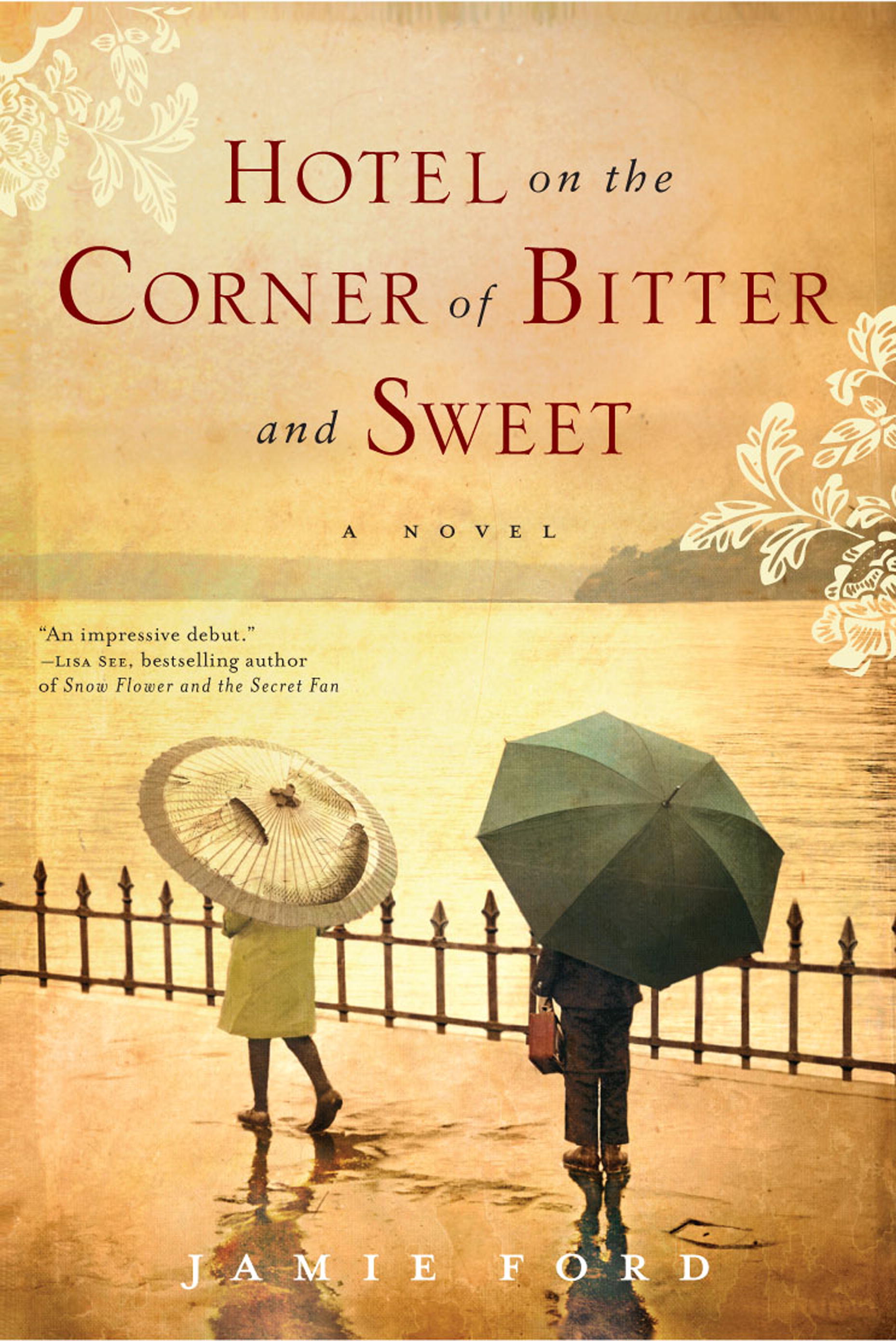
Hotel on the Corner of Bitter and Sweet is Jamie Ford's first novel. Henry Lee is the American-born son of a fiercely nationalistic Chinese father. The story takes place in Seattle, and jumps back and forth between 1942 when Henry is 12 years old, and 1986 when he is middle-aged and recently widowed. It is the story of Henry's friendship with Keiko Okabe, a Japanese American girl, who -- along with every other Japanese-American citizen on the west coast -- is imprisoned in a U.S. concentration camp for the duration of the war, and the impact that friendship had on Henry's adult life.
Henry and Keiko meet as the only two non-white students at their private school; both are there on work scholarships. Both are deeply resented by the other students, who make little distinction between Japanese and Chinese. But to Henry's father, who follows Japan's atrocities against China on a daily basis, Henry's friendship with Keiko is unforgivable.
I have never given any thought to the other Asians living on the west coast at the time of the Japanese-American interment. That aspect of the book was fascinating. It was also interesting that Ford mentioned the interment of both Italian- and German-Americans, a very little known part of U.S. history.
I hate to be so hard on a book that was obviously well-intentioned. I didn't hate it, but I won't necessarily recommend it either. Maybe you will read it with a less crabby disposition than mine. Who knows?
Deep, Dark Secrets of a Bad Grad Student
I've been trying to be a graduate student for almost 9 years now. I take classes one at a time, until I can't stand it anymore, and then I stop for a while. In this fashion I've earned a license to be a school library media specialist (a.k.a. school librarian.) However, here is the rub -- we have a two-tier licensing system in Wisconsin. My license is non-renewable, so now I am taking the courses to earn my professional license, which I have to finish within the next three years. There is no reprieve now; if I want the license (and I do) I have to push on through, one class every semester -- including the summer -- until December 2011 when I am finally done.
I tried a regular graduate program where I would have gotten a Masters in Library Science along with my license. I lasted for two semesters there, before throwing in the towel. I hated it so much! Now I am in an online program designed to get classroom teachers into school libraries. It has been a much better fit for me, relevant, interesting …
It is always a challenge. I'm a fairly intelligent person (I think.) I read a lot, I am able to apply what I am learning to real-life situations. However, when I am enrolled in a class I constantly feel rotten, like I am a bad person. I believe I have finally pinpointed what that is about. School these days involves a lot of the dreaded group project. In an online course, this involves group projects with people I may have only met in person one time; all of our communication takes place in that tricky medium of email and online discussion. I realize that my overall feeling in this context is one of shame. I beat myself up if I don't go to the discussion forum often enough, don't add to the Googledoc or wiki in a timely enough manner, when it's my turn I don't summarize the discussion until the end of the day on which it's due. I feel as if I am always letting my group-mates -- who are essentially strangers to me, but in my mind, far better students than I am -- down.
It's so bad that once I turn in an assignment I don't want look at it again, because I'm so ashamed of my work. I have to browbeat myself before I log onto the class site. I'm procrastinating right now as I write this blog post!
Basically I always feel like a fuck-up as a graduate student. (Pardon my language, but I do.) I just don't want to do this. I would rather be walking my dog, playing my guitar, reading for fun, knitting, decorating Ukrainian Easter eggs, making soap, sewing, and being with my family. I don't care if I get an A. I just want to pass each course.
Whew -- got that off my chest. I feel as if I've been in the confessional. I have two more weeks of this course. The next one is a literature course; hopefully it will be more flying solo.
Monday, April 26, 2010
Book Review: Going Postal

Going Postal opens on the very last day of the unfortunate Moist Von Lipwig's (a.k.a. Albert Spangler and any number of other aliases) life. He's made a good run of it as a swindler and a con man, but he's been apprehended and sentenced to hang that morning. Sometimes, however, you get an angel, this time in the guise of Ankh Morpork's tyrannical ruler Lord Vetinari. Moist has a choice to make -- execution or … become Postmaster of the Ankh Morpork Post Office, which has fallen on hard times in recent years.
Being Postmaster isn't all golden suits and wingéd hats. First, Von Lipwig must prove himself to the Post Office Workers, then he finds himself in direct competition with the Grand Trunk Semaphore Company, a telecommunications conglomerate that's "too big to fail." (Which begs the question, does Pratchett possess some weird sixth sense or does Tim Geithner read Terry Pratchett?)
Terry Pratchett is simply a genius. He has a knack for hitting every nail squarely on the head. His writing is often classified as "fantasy" because it takes place on Discworld, but make no mistake about it: Pratchett's feet are planted firmly on Earth and he is satirizing everything about it he can get his hands on.
As far as I am concerned, Terry Pratchett is among the best living writers in the English-speaking world. He incorporates science, sociology, and fantasy with a wicked sense of humor. He leaves nothing unskewered, but he does it all with an absolutely generous heart.
Highly, highly recommended.
Sunday, April 25, 2010
Jerry, the Mail Carrier
Last Tuesday, my stepfather Bob was taking his daily walk to Einstein Bagels for coffee. He had been commenting recently how tired he gets (which doesn't seem surprising because he is in his late eighties.) On Tuesday he barely made it to the strip mall where Einstein's is located, when he started having severe chest pains, causing him to almost fall over. Jerry was delivering mail at the time, saw him, and rushed to him. He got Bob to an outdoor seating area of a Chinese restaurant, got Bob's pills from his pocket and gave him one, called 911, and stayed with him until he was on the ambulance.
I intend to go find Jerry this week, so that I can personally thank him. And after I ascertain that he won't get in trouble (you never know with the Post Office) I will let his superiors know what he did.
Meanwhile, Bob arrived at the hospital where it was determined that he had a blocked artery, and as he was being taken to the cardiac cath lab, he had a second heart attack because another artery was blocked as well. So he received two stents at the same time.
All is well that ends well. Bob is doing okay and going home today. Had Jerry not been there or not been paying attention, I'm afraid that the outcome would have been very different. Jerry is a hero in my mind.
Friday, April 23, 2010
What about a simple kiss?
The dramatic play can become quite dramatic in my kindergarten classroom. Take today, for instance. There was a group of five or six children in the housekeeping area. One child -- obviously a princess -- took a bite of a poisoned apple, and fell down dead. The other children laid her out on a bier, covered her with a blanket and surrounded her with plastic fruit. My teaching partner intervened momentarily when they commenced with the CPR compressions (apparently the fruit wasn't working its magic) because she was afraid they would hurt the victim patient. Then they all kneeled around her in a circle and put their hands together and prayed. And a miracle occurred! The expired princess leapt to her feet, alive again, and then the whole group refused to clean up their mess. Hallelujah!
Ah yes, never a boring moment in my profession.
Saturday, April 03, 2010
Book Review: Boys and Girls Forever: Children's Classics from Cinderella to Harry Potter

This is a book of essays on children's literature by Alison Lurie, who is a Pulitzer Prize winner and a professor of children's literature at Cornell University. Most of these essays appeared at an earlier time in the New York Times Book Review. I picked this up on a whim from a display at my branch library, being a sucker for reading about children's literature.
To tell you the truth, these essays really annoyed me. I really didn't see a point to this book, except maybe to gather her essays in one place -- if gathered they needed to be. Each one read like a long-winded lecture from someone steeped in the self-importance of academia: Hans Christian Anderson (about whose writing I took an entire semester-long class in college), Louisa May Alcott, L. Frank Baum, John Masefield, Walter de la Mare, Dr. Seuss, Tove Jansson, J.K. Rowling, and then some more general essays on fairytales, nursery rhymes and games, illustrations, and the role of nature in children's literature. Each essay was a pronouncement: "This means that" and "This wrought these changes." They also read like the countless essays I had to write, demanding that I "compare and contrast A with B." (Dr. Lurie, please compare and contrast Tove Jansson's Moomintroll books with A.A. Milne's Winnie-the-Pooh.)
For me, as a person who spends every day in the living, breathing company of young children and books, so many of her pronouncements seemed wooden, and well, academic. I admit, that may well have been her intent, but it didn't sit well with me. I kept having flashbacks to the children's literature class I took as an undergrad at Keene State College, taught by a salty new England woman with an accent so thick you could cut it with a knife who intoned on and on about May Hill Arbuthnot (a noted children's literature scholar and the author of our textbook.)
I don't know how old Lurie is -- old enough to have 3 grandchildren to whom she dedicates the book -- or if she is still teaching, has even stepped into a book store any time recently, or when these essays were first written because her knowledge of illustrators seemed to stop with Maurice Sendak (she likes his later work -- which I find kids don't particularly care for) and Arnold Lobel (who died 23 years ago.) In other words, the essays were very narrow in their scope.
Now I am going to expose my deep-seated prejudice with a question: Why is Harry Potter considered a classic piece of children's literature, while other modern fantasies that have been around much longer (Lloyd Alexander's Prydain Chronicles, Joan Aiken's Wolves of Willoughby Chase, and The Hobbit for heaven's sake) get barely a nod in their direction?
Thursday, April 01, 2010
Book Review: Mr. Darcy Takes A Wife

Subtitled Pride and Prejudice Continues, this book conjectures the life that the lovely and spunky Elizabeth Bennett shared with the taciturn Mr. Darcy after their marriage. First, let me begin by saying that the amount of sex was absolutely ludicrous and I really didn't need to be constantly reminded that Mr. Darcy was, um, well-endowed. Once I got beyond that (to the point where I just rolled my eyes when "it" was mentioned) I really enjoyed this book immensely (no pun intended, really!)
If you know anything of my reading habits, you know that good writing is paramount. If a book is badly written -- no matter how interesting the topic -- I usually can't finish it. This book was well written. The author, Linda Berdoll, apparently is a huge (there's that image again) fan of Jane Austen and actually did some research for this book both into the language and the historical times. I thought it was interesting to have the familiar characters placed in a historical context -- the end of the reign of mad King George, the Napoleonic Wars -- for surely intelligent characters like Darcy and Elizabeth would have had some interest in the world around them (once they got out of bed, off of the floor, back from the lovely sun-dappled copse on the Pemberly grounds …)
What else besides sex? Intrigue, bastard children, murder, swashbuckling rescues, plus a return of the many other characters that Austen conjured up in the original Pride and Prejudice: the good and lovely Jane and her precious Bingley, the ne'er-do-well Wickham and his silly wife Lydia, Elizabeth's good friend Charlotte, the vicar Mr. Collins and his patroness the Lady Catherine de Burgh, Darcy's sister Georgiana, Mr. and Mrs. Bennett …
You want serious literature? This isn't it. Mr. Darcy Takes a Wife is pure candy, and I have to say I haven't had as much plain fun reading a book in quite a while. Heaving bosoms and all.
Sunday, March 28, 2010
Book Review: The Geography of Bliss

Weiner writes in the style of Bill Bryson or Tony Horwitz, which makes for a mostly light-hearted and enjoyable read. I was reluctant to give myself over to it at first -- just another smug NPR commentator cashing in with a quirky travelogue. (Maybe I was experiencing some envy, which research has shown to be a happiness-killer.) However, halfway through Switzerland I was happy to be along for the ride.
I was a little put off by the chapter on Moldova, which I thought Weiner (and everyone else) treated a little unfairly. Moldova, you see, ranks fairly low in Veenhoven's happiness database and there seemed to be a fair amount of kicking a place that is already down. A country's fortunes can change fairly quickly. In fact, I would be interested in seeing how a country like Iceland is faring now after their economic collapse (although research shows that happiness is not necessarily related to money, not in ways that one might think, anyway.)
The Geography of Bliss was sometimes thought-provoking. I too, often feel like I am a grump, and it is not something of which I am exceedingly proud. It is the manner in which my particular brand of depression manifests itself, and as the child of a grumpy mother myself, it's not something I want to impart to my own children. So I have done a lot over the years to help myself be happy (something that happiness researchers say is almost uniquely American.) I was pleased to see that I have unscientifically incorporated many of the qualities that seem to mark happy people, and indeed I think I can say that my happiness index is quite high these days.
I enjoyed this book. It was not earth-shattering, it was a tad too much like an extended NPR piece, but it gave me some ideas to ponder, some pithy quotes, and was altogether quite relevant. If you enjoy travelogues and non-fiction, I recommend it.
40 Years
One of my happy pastimes is going to events that mark passages in the lives of old family friends, people who I am connected to through my parents mostly. I generally go with my oldest brother Dave, though sometimes by myself. I love it -- even the funerals, sad though they may be. They connect me with my parents, who have both been gone for some time now, and with my past which, seen through the lens of 50 years is actually looking and feeling pretty happy for the most part. Attending these events, being the steward of these connections is a role I have taken on, and one that I love.
Today was no funeral, however.
This afternoon I had the honor and pleasure of going to a party to honor 40 years of marriage for old friends of my family, Charlie and Louise Uphoff. The Uphoffs and the Grindrods go way back, back to my parents' youth and their days as young Socialists. My parents frequented a place called Fellowship Farm, that was overseen by Walter and Mary Jo Uphoff, the ad hoc "parents" I guess, being a few years older. In fact, my parents were married at Fellowship Farm, under the auspices of Walt and Mary Jo (and a radical minister named Shorty Collins.) Many years later, their son Charlie brought his wife Louise to live at Fellowship Farm. It was the late sixties/early seventies. I was on the cusp of adolescence and I thought they were one of the coolest, hippest couples I had ever met. They lived in a ramshackle farmhouse with tattered peace posters on the wall. They had a chair in their living room made out of the hood of a VW Bug -- how cool is that? I'll answer for you -- REALLY cool! And then they did something even cooler -- they had a baby, and I got to babysit for her!
So now 40 years have passed and I was reflecting on all of that. We're coming up on our 23rd anniversary. I hope that we can celebrate our 40th in such style, surrounded by loving family and friends, children and grandchildren. And I hope we inspire some other young person, show them a model of a happy marriage.
And I will keep maintaining these connections as long as I can.
Friday, March 26, 2010
Anxious to see this movie
I don't think it has been released in the U.S. Too esoteric? I'll bet there are as many Morris dancers here as in Britain, doggone it.
Monday, March 22, 2010
I finally read "Pride and Prejudice!"

I don't think much needs to be said about the plot of Pride and Prejudice. It has been copied endlessly in almost every romantic comedy coming out of Hollywood. They meet, they hate each other, they part, they discover they really love each other and defy the odds to get back together again, and tra-la, they marry and (presumably) live happily ever after. Ah, but was it ever again done so well as this?
I first listened to Pride and Prejudice as an audio book a few years ago. It was snatched from the shelf of the public library in a moment of panic when we were leaving on a 12 hour road trip and had forgotten to get any episodes of Hank the Cowdog, our preferred travel listening. Mr. Feeny (I'm just getting in the P&P mood here) looked dubious when I brought it home. Maybe he was remembering the last time this had happened and I brought Prodigal Summer along, and everyone hated it but me. However, this time it was different. We all loved Pride & Prejudice, laughing heartily all the way to West Virginia and back.
Still, I hadn't read it until last week when I was looking for a book to read while I waited for my book club reads to come into the library. (Yes, I'm in a newly-minted book club.) Jane Austen's writing and humor is so fresh and modern. It is a joy, and if you haven't read it, I highly recommend doing so.
Today my friend recommended Mr. Darcy Takes A Wife which she says is Pride and Prejudice with the addition of spicy sex scenes. Ooh la la.
Sunday, March 21, 2010
Sweet Sixteen
It is hard to believe that my daughter Sophie would be 16 today. I know it's a fruitless exercise, but I spend a lot of time wondering what she would look like and who she would be. I wholeheartedly embrace her life and death as one of my life's enormous mysteries, but there are times when I just feel bereft, and I know I will feel that way until the end of my days. I often feel as if I am holding my breath for these ten days that she was alive. Mostly it is okay; the sad moments remind me that she is very much present in my life and nothing can change that.

Sophie Olivia Grindrod-Feeny, ¡Presenté!

Sophie Olivia Grindrod-Feeny, ¡Presenté!
Friday, March 19, 2010
21 Years Ago …
21 years ago was the beginning of an incredible adventure: the birth of my first child, Anna Fiona. Being a mother has brought me unimaginable joy, and I wish this child of mine the happiest of birthdays today.


I have refrained from posting any of the naked ones. No need to thank me, Anna. Just one of the many little kindnesses I have performed over the last 21 years.
Tuesday, March 16, 2010
It's Wick!
Well, we have gone from winter to spring in a few short days. Piles of snow as high as my head have melted away so quickly, that it's a little disorienting to walk Molly around the neighborhood. I'm simply not used to seeing grass and lawns that are level with the sidewalk!
I have begun a daily circumnavigation of my house checking for "things coming up", i.e. signs of new growth: the bulbs I planted last fall, perennials coming back, buds on trees. (I am holding my breath that my redbud tree is okay; it was looking sick last year.) When I do this, I am always reminded of one of my favorite books from childhood, The Secret Garden by Frances Hodgson Burnett. Mary, a sickly, surly little girl who has up until the time of her parents' death lived in India, moves to her uncle's estate on the English moors. Her uncle is a bitter and broken widower, and his mansion holds secrets: Mary's invalid cousin Colin and a walled garden that was locked up when the mistress of the house died.
Mary is drawn to the garden, and with the help of Dickon -- a local boy -- the children find their way in to it in the very early spring. I love the part where Dickon roams the garden looking for signs of life and pronounces it "wick" -- local dialect for alive. Of course as the garden comes to life, so do Mary, Colin, and Colin's broken-hearted father. It is a lovely and satisfying book.
I have crocuses blooming, tulips, irises and daffodils peeking out of the ground, forsythia buds swelling. It's wick!
Saturday, March 13, 2010
Why am I such a misfit?
My program for Friends General Conference Annual Gathering arrived in the mail a couple of days ago. For the uninitiated, that is the annual gathering of one of the branches of Quakers. It is held every July at a different college campus, almost always in the continental United States. A few years ago it was held in Wisconsin, and with the benefit of a very generous scholarship from FGC and my home Meeting, my daughters and I attended.
There is something very appealing about the idea of it: an entire week of hanging out with Quakers can be a heady thing. Week-long workshops are offered; there are many opportunities to explore one's spirituality or to connect with others like-minded …
… And I didn't like it! I was reminded of that once again as I perused this year's invitation. I start to wonder, is there something wrong with me? It should be fun. It's like summer camp! Do I have a serious character flaw?
What I remember was that it was a lonely experience. The only thing worse than being lonely by yourself is being lonely in the midst of a thousand people. I would feel somewhat connected in my workshop (it was about right relationship with money and I discovered that it is an easier topic to explore when you have a little extra money to begin with … and you certainly need to commit a chunk of money to attend Gathering, so maybe that was part of the problem) but then the workshop time would end and I felt at loose ends. Not connected enough with anyone to seek them out -- except my friend Poodle Doc, and I didn't want to be a nuisance to him -- I would walk into the enormous cafeteria at mealtimes and it was full of tables of people, longtime friends and new acquaintances eating and chatting, and it didn't seem as if there was any room for me anywhere.
That was compounded by the fact that my younger daughter was having a hard time in her workshop -- a theatrical production of an African folk tale using giant puppets that the kids constructed. She wasn't really connecting either. (Oh no, is my social malady something I've passed down to my children?) And I still have some deep concerns about how the adults in charge of her workshop ran the week, but that's water under the bridge.
All around me everybody else seemed to be having a great time. I have friends who plan their summers around Gathering, they go back year after year. I guess I'm just not that person. What I find myself yearning for is some kind of a hermitage -- maybe a hermitage with regular conjugal visits -- but no demands. No workshops, no graduate school projects due, no work come Monday, no expectations. A gathering of one -- me. Now that idea speaks to me. I could knit, read, play my guitar, walk my dog. See my family some (because I would miss them pretty quickly.)
I'm waiting for that brochure to arrive in the mail.
Sunday, February 14, 2010
Two Movies
I used to love going to movies. I'd go to movies every night of the week, sometimes even double features! Lately, I don't know. I'm tired of going and being disappointed. Watching them at home, there are so few that inspire me. Even when I enjoy them at the time, I hate myself in the morning. But I can't always be the wet blanket, so this weekend I agreed to rent a movie with my younger daughter on Friday night, and go out to see a movie with my eldest tonight. Here's the rundown:

Taking Woodstock -- "Based on a true story", a tale about the small town that hosted the Woodstock festival in 1969. This had gotten so-so reviews, and having lived through the sixties, I was prepared to hate it. Surprisingly, it was altogether enjoyable. Accurate? I doubt it. But fun and poignant at the same time. I think what saved it was the fact that, where the film maker could have been extremely heavy-handed with the visual imagery and the hippy stereotypes, instead it was handled with a very light touch. So you could laugh about the theater troupe doing Chekov in the nude, instead of sink into your chair and squirm with embarrassment. And the best part? When the protagonist's father, a Russian Jewish immigrant, called someone a schnook. I haven't heard that word -- haven't even thought of it -- since my parents died.

An Education -- A screenplay by Nick Hornby is reason enough to see this one. Takes place in 1961, the story of a 16 year old English schoolgirl who takes up with an older, more worldly man. I don't want to say too much for fear of spoiling it for you, but it is definitely well worth seeing. Well acted, entertaining, thought-provoking …
Both movies are recommended.
Taking Woodstock -- "Based on a true story", a tale about the small town that hosted the Woodstock festival in 1969. This had gotten so-so reviews, and having lived through the sixties, I was prepared to hate it. Surprisingly, it was altogether enjoyable. Accurate? I doubt it. But fun and poignant at the same time. I think what saved it was the fact that, where the film maker could have been extremely heavy-handed with the visual imagery and the hippy stereotypes, instead it was handled with a very light touch. So you could laugh about the theater troupe doing Chekov in the nude, instead of sink into your chair and squirm with embarrassment. And the best part? When the protagonist's father, a Russian Jewish immigrant, called someone a schnook. I haven't heard that word -- haven't even thought of it -- since my parents died.
An Education -- A screenplay by Nick Hornby is reason enough to see this one. Takes place in 1961, the story of a 16 year old English schoolgirl who takes up with an older, more worldly man. I don't want to say too much for fear of spoiling it for you, but it is definitely well worth seeing. Well acted, entertaining, thought-provoking …
Both movies are recommended.
Tuesday, February 02, 2010
Happy Birthday to one of the Lights of my life!


She was almost a groundhog. It was February 3, 1996 around 10 a.m. when our third daughter, Grace Marguerite, entered the world. Outside was bitterly cold -- -27˚F. While in labor I made my husband and my friend Fay walk me around the block in the wee hours of morning. Twice.
I haven't looked at the photos from her birth-day in a long time. I am a little unprepared for the emotions that are welling up. Grace's birth was such an enormous joy, but -- perhaps unfairly for her -- it was imbued with an incredible mix of emotions: grief, anxiety, and hope. She was born exactly a month after my dad's sudden passing, and we were still reeling from that. Also, as many of my faithful readers know, Grace was born subsequently to her older sister Sophie's death. (It pleases me to notice that in the upper left corner of the photo of Ed holding Grace, is another photograph of Anna holding her newborn baby sister Sophie.)
Grace came and helped us heal. I smile like the sun when I think about that day. Happy Birthday, dear Grace!
Photographs taken by Fay McClurg
Wednesday, January 27, 2010

Subscribe to:
Posts (Atom)