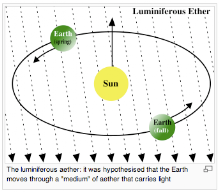
Who says that affordable health care isn't available to everyone?
Friday, September 25, 2009


Saturday, September 19, 2009
Looking forward to …
- seeing Brandi Carlile in concert this Monday. Gratitude to David for introducing me to her music!
- going to hear author/local food advocate Michael Pollan speak on Thursday. (No, he's not local; he passionately advocates for the buying and eating of locally grown food.) He is also speaking at a $200/plate fundraiser for my daughter's middle school, which is just so cool.
- going to hear author/poet/farmer Wendell Berry speak on October 11. (He is the author of one of my favorite novels ever, Hannah Coulter.)
Friday, September 18, 2009
INDOCTRINATION!!!
I finally saw President Obama's speech to the nation's schoolchildren in its entirety. It was bad enough that children were being forced to listen to subversive messages like, "Obey your parents and teachers" and "Do your homework." But when he said, "Wash your hands so you don't get sick," well, I felt downright unclean.
(It was shown at our first all school assembly of the school year. One youngster was escorted out in tears. When the principal questioned her about why she was crying she said, "I'm - I'm just so happy he's president, it makes me cry.")
(It was shown at our first all school assembly of the school year. One youngster was escorted out in tears. When the principal questioned her about why she was crying she said, "I'm - I'm just so happy he's president, it makes me cry.")
Wednesday, September 09, 2009
Paddling My Own Canoe
I have canoes on my mind. Maybe it's because I'm reading the book Three Men in a Boat (To Say Nothing of the Dog). We've owned a canoe for several years. It's a big old aluminum Grumman that we inherited when Mr. Ether's parents moved from their house to a condo. When we first acquired it we were very excited, and bought new PFDs and paddles for our anniversary. I envisioned sunset picnics and Sunday afternoon outings on Madison's 4 lakes.
Well, since we've had it, we've gone canoing exactly twice -- once when we loaded it on top of the car and drove across town to Lake Wingra, our smallest lake. It was lovely. We paddled across the lake to the University of Wisconsin Arboretum and visited haunts that we normally access by foot. The other time we took it up to Lake Michigan with us on our annual camping trip. It is definitely not designed for the bigger waves. I got scared, Mr. Ether got exasperated with me, and we had a little fight out on the water. Since then the canoe has held the concrete of our driveway down very nicely and that's all.
Recently I had been thinking of getting rid of it. It's monstrously heavy. We live, literally, two blocks from a gentle peaceful river that connects two of our lakes, and we never use the canoe. Last weekend I was talking with a friend about it, and she threw out the idea that some of us could go in on a nice lightweight canoe as a kind of time-share and rent space from the city parks department to store it.
*Lightbulb above my head* Why don't we -- DUH -- instead of buying a new canoe, just rent a spot for the canoe we already possess? I called the parks department today, and for $75/year I am leasing a berth on a canoe rack that is right next to the river three blocks from our house! I am psyched!
Tuesday, September 08, 2009
Kindergartners -- Can't Live With 'Em, Can't Live Without 'Em
Day 5 of the new school year. I finished work, went home for a little while and then it was back to school for the PTO meeting. (I am a regular attender, along with my knitting.) Leaving the meeting to go home and walk the dog, my principal stopped me in the hall to inform me that one of my students had smuggled his scissors onto the school bus in his backpack after school, and given himself -- and a friend -- haircuts! The other child's parent was at the PTO meeting. Fortunately she was laughing about it. Fortunately my principal was laughing about it too. I'm wondering, is it enough of a logical consequence to have to go around with funky hair until it grows out? I'll say one thing for certain about my job -- it is never boring.
Monday, September 07, 2009
Three Little Words: A Memoir by Ashley Rhodes-Courter
 This book made me late yesterday. (Really, I would have been on time otherwise.) Each time I sat down to read just a little, I became so totally engrossed in Ms. Rhodes-Courter's story that I could not put the book down. When Ashley Rhodes-Courter was 3 years old, she was removed from her mother's custody and became a ward of Florida's foster care system. Thus began a 9 year long nightmare, over the course of which she had 19 different foster parents, some okay, some marginal, and one in particular, frighteningly bad. When she was finally adopted by a loving couple at the age of 12, it took many years for Ashley to trust that these parents were really there for her, and she finally began the long journey toward healing.
While the book was clumsily written at times (she wrote it as a very young adult) Ashley Rhodes-Courter impressed me with her resilience, her clear-eyed observations, and her amazingly positive outlook even after everything that she went through. This is a scathing commentary on Florida's foster care system. At a couple of different points she poses the question of why the state was willing to pay millions of dollars for a failed system where people ran foster homes like puppy mills and caseworkers looked the other way, but was utterly unwilling to spend even a penny to help teenaged mothers like Ashley's so they could provide a home for their own children. She also wondered why -- even when the evidence was in plain sight -- the caseworkers and therapists always assumed that the children were lying about their mistreatment, to get attention. (They even ignored multiple phone calls to the child abuse hotline from Ashley's teachers!)
Ashley eventually brought a suit against the state of Florida. In reviewing her files, she figured out that out of 195 people who had had some responsibility for her case over those 9 years, the two who had really advocated for her and gotten her out of the system -- a Guardian ad Litem and a lawyer -- were volunteers.
I admit that I wept while I read this book. It made me consider the carelessness with which some people treat their lives and the lives of others. Ashley's mother was not a bad person, but was herself a product of careless parenting -- as was the abusive foster mother. I found Ashley's story to be very important and moving. Highly recommended.
Book Review: A Yellow Watermelon by Ted Dunagan
 A Yellow Watermelon was published by Junebug Books -- the children's division of New South Books, a publisher that specializes in contemporary Southern authors. It tells the story of one memorable summer in the life of 11 year old Ted Dillon. Ted is the youngest of 3 boys in a family that is just barely scraping by in small town Alabama. His dad works in the local sawmill which, like just about everything else in the vicinity, is owned by Mr. Cliff Creel. Ted makes pocket money by selling the weekly newspaper Grit.
One evening Ted sneaks into the sawmill after hours to explore, where he meets Jake -- a black man who has been hired to watch the mill. Through Jake he learns of the Robinsons, a dirt-poor black family who are in danger of losing their farm through the dirty dealings of Old Man Creel. Mr. Creel, in collusion with the local preacher, is also stirring up prejudice against the Robinsons. Ted befriends Poublum Robinson, a boy his own age, and is determined to help them out.
A Yellow Watermelon tells an interesting story and has a whole lot of heart, and I really, really wanted to like it, but in the end I found it disappointing. I thought that it oversimplified the whole idea of racial prejudice in the Jim Crow South, to the point of making it seem insignificant. The onus for the hateful behavior was put on mean Old Man Creel and the weak-willed drunkard preacher with everyone else being bystanders who didn't say much but acted sympathetic to the Robinsons because no one liked Mr. Creel very much. In no way was the hateful institution of Jim Crow laws ever even addressed! In fact, while it was believable that Ted might have befriended both Jake and Poublum, I found it utterly unbelievable that everybody accepted the friendships with almost nary a word, even while they all referred to their black neighbors as "niggers" and "darkies."
This may be a trifling point, but the dialogue when the black characters spoke was cartoon Southern black dialect, peppered with "sho 'nuffs" and "dis" and "dats". It reminded me of reading a vintage version of The Bobbsey Twins in the Land of Cotton and really bugged me.
There were also references that were way too modern, and seemed designed to teach young readers a lesson about prejudice rather than to make a good story; for example, when Ted crosses the invisible line in his uncle's cotton field to pick cotton with Poublum he says, "In the summer of 1948, I reverse integrated the cotton field."
One review on the back of the book compared A Yellow Watermelon to the classics To Kill A Mockingbird and Huckleberry Finn. I beg to differ. This isn't an awful book, but if you're interested in something to show kids what racial prejudice in the South was like, they'd be better off reading Mildred Taylor's Roll of Thunder, Hear My Cry or Christopher Paul Curtis' The Watsons Go to Birmingham - 1963.
Friday, September 04, 2009
Whoa, W-a-a-a-y Behind On My Book Reviews
That's what happens when school starts. The train leaves the station and all I can do is hang on. I have read a few books in the last month, and I will attempt to give a brief synopsis/review of each one. You may have noticed that I like most of the books that I read. I'll let you in on a little secret: If I start a book and really dislike it, I give myself permission to not read any further. I rarely buy books anymore, especially books that I haven't already read, so it is no big deal to just close the stinkin' book and return it to the public library. I LOVE my public library!
The Invention of Air by Steven Johnson is a biography of Joseph Priestly, the eighteenth century scientist who, among other things, discovered a process for carbonating water, founded Unitarianism, counted Benjamin Franklin and Thomas Jefferson among his friends, and conducted pioneering experiments in his home laboratory on the nature of the air we breathe. He was hounded as a heretic from his comfortable life in England and settled in the United States in its infancy as a nation. This was a fascinating and fun book to read. Highly recommended. (Steven Johnson also wrote The Ghost Map, a story of the last cholera epidemic to hit London. Also a fine book.)
I have a love-hate relationship with Made From Scratch: Discovering the Pleasures of a Handmade Life by Jenna Wogenrich. On the one hand, she is writing about many of the things that have long been near and dear to my heart: shopping at thrift stores, making your own music, knitting, preserving food, living sustainably, raising chickens … it was like looking into a mirror! (In fact, Mr. Ether declared that she had stolen my identity and I might have to kill her.) On the other hand, here she is, a sniveling 26 year old upstart who has essentially lifted all these things from other people and then has the chutzpa to write a bestseller about it as if she had discovered all of these wonders and was imparting them to us. Harumph. (Here's the super mortifying part. It is a library book and I took it with me on our camping trip. We had a torrential rain storm and the book got wet. I didn't realize how bad it was, returned it to the library, and got a call from a librarian in Monroe, Wisconsin informing me that the book I had returned was wet and moldy! I was so embarrassed! So now I own the book, and I didn't even like it all that much! Oh well.)
Dr. Monkey and I share a common interest in the artist Dahlov Ipcar, author/illustrator of many children's picture books. A few years ago I picked up a copy of A Dark Horn Blowing, a novel she wrote for young adults, and I finally got around to reading it. What a treat! The story is based on several different traditional Scots ballads, as well as Norse folktales. If you like fantasy, this is a great addition to the genre. It reminded me of both Peter S. Beagle's The Last Unicorn and an obscure little book by folklorist Katherine Briggs, called Kate Crackernuts.
Most recently I finished The Evolution of Calpurnia Tate by Jacqueline Kelly. Written for the middle grades, it tells the story of one year in the life of an 11 year old Texas girl at the end of the 19th century. Calpurnia is a spunky heroine in the Anne Shirley, Jo March, Rebecca of Sunnybrook Farm tradition. The only girl in the middle of 6 brothers, she is expected to learn "the science of housewifery" when she really wants to be studying the world around her. She finds an unlikely ally in her grandfather, who educates her in the scientific method, loans her his personal copy of the scandalous new book The Origin of the Species by Charles Darwin, and shows her that she can follow her dreams. I loved this book! Not to sound sexist, but I think it would be an excellent choice for a girl in the 9-12 year old range, if you know any. It's really a nice break from fantasy stories, as well as the pre-teen "problem novels" that seem to abound. It falls into the category of what my friend Sminthia calls "sciency fiction." (I am looking forward to reviewing Sminthia's book when it comes out!) Highly recommended.
Next up: A Yellow Watermelon by Ted Dunagan. I'll keep you posted.
Monday, August 24, 2009
Street Scenes
Yesterday evening we were walking to a nearby restaurant with our neighbors, when we were accosted by some seedy trench-coated ruffians. (Well, actually it was a perfectly ordinary-looking young woman and man.) "Do you want a cupcake?" the woman said. What? "No, seriously, we have a lot of cupcakes to give away. Do you want one?" They go around to the trunk of their car and pull out a big box of cupcakes. Not just any cupcakes, either. Gourmet cupcakes, with whipped cream frosting and flavors like mocha with real berries on top. As it turns out, they were in a local bakery at closing time, and the proprietors had a lot of leftover cupcakes that they didn't want to save until the next day so they gave them to the couple, who decided to share the largesse with the madding crowd. (Note to self: Go to Daisy Café at 4:55.)
It was a quintessential near-eastside Madison experience.
It was a quintessential near-eastside Madison experience.
Sunday, August 23, 2009
Reflections on Getting Older
From Britain Yearly Meeting Faith and Practice. This spoke to me today.
If we are getting older it will be harder to acknowledge that we have not been called to spectacular service, that we are unlikely now to make a stir in the world, that our former dreams of doing some great healing work had a great deal of personal ambition in them.
A great many men and women have had to learn this unpalatable lesson -- and then have discovered that magnificent opportunities lay all around them. We need not go to the ends of the earth to find them, we need not be young, clever, fit, beautiful, talented, trained, eloquent, or very wise. We shall find them among our neighbors as well as among strangers, in our own families as well as in unfamiliar circles -- magnificent opportunities to be kind and patient and understanding.
This is a vocation just as truly as some more obviously seen as such -- the vocation of ordinary men and women called to continual unspectacular acts of loving kindness in the ordinary setting of every day. They need no special medical boards before they embark on their service, need no inoculation against anything but indifference and lethargy and perhaps a self-indulgent shyness. How simple it sounds; how difficult it often is; how possible it might become by the grace of god.
-- Clifford Haigh, 1962
Saturday, August 22, 2009
Forgiveness, Part 2
I guess the lesson for this week is forgiveness. Here's a sticky one that challenges me in a different way:
William Calley, the former Army lieutenant convicted on 22 counts of murder in the infamous My Lai Massacre in Vietnam, publicly apologized for the first time this week while speaking in Columbus.
“There is not a day that goes by that I do not feel remorse for what happened that day in My Lai,” Calley told members of the Kiwanis Club of Greater Columbus on Wednesday. His voice started to break when he added, “I feel remorse for the Vietnamese who were killed, for their families, for the American soldiers involved and their families. I am very sorry.”
Calley claims that he was following orders on that day, and I suspect that he was. In fact, I have read that the orders for the massacre and the cover-up go all the way up to a certain Maj. Colin Powell. War is hell on soldiers as well as civilians, and I often wonder how some -- like Hugh Thompson, Glenn Andreotta, and Lawrence Colburn -- find the moral strength to intervene when something is so terribly wrong, while others follow orders and perpetrate events such as the My Lai massacre.
I am moved by Calley's apology. I wonder if he could/would return to My Lai on a mission of peace and restorative justice. What would that be like for him, and for the survivors of the massacre and their families?
A Question of Justice Being Served -- or Not
 My recent post about the release of the alleged "Lockerbie bomber" made me think of Leonard Peltier, and then this showed up on HuffPo today:
I ask, where is the justice or the mercy in continuing to hold Peltier? I suspect that releasing Peltier -- and there is some pretty compelling evidence that he did not pull the trigger on the weapon that killed the FBI agents -- would draw attention to other prisoners being held under questionable circumstances. In fact, Amnesty International considers him a political prisoner. So holding him prisoner serves a purpose beyond a question of justice and accountability for a crime he may or may not have committed. This underscores one of the great failures of our penal system.BISMARCK, N.D. — American Indian activist Leonard Peltier, imprisoned since 1977 for the deaths of two FBI agents, has been denied parole after authorities decided that releasing him would diminish the seriousness of his crime, a federal prosecutor said Friday.
Peltier, who claims the FBI framed him, will not be eligible for parole again until July 2024, when he will be 79 years old.
Thursday, August 20, 2009
Forgiveness
I recently read a book about the "real" teachings of Jesus. It was a scholarly book, whose author had read through the many texts attributed to Jesus, and pulled together the ones that were most likely in his own words, as opposed to the words of his disciples or later writers. When you get right down to it, Jesus's teachings were fairly simple: Love your enemies as you love yourself (which of course must be prefaced with loving yourself.) Share what you have with those poorer than you. And practice forgiveness.
I don't know if I would be able to forgive someone who took my child's life. Or a sibling's or my husband's or someone else's whom I love very much. I would like to think that I would try, even if it took the rest of my life.
I read this article with interest. Abdel Baset al-Megrahi, one of the men convicted in the downing of the Pan Am jet over Lockerbie, Scotland has been released from prison and allowed to return to Libya on "compassionate grounds." He has prostate cancer and has been given just a few more months to live. Under Scottish law, terminally ill prison inmates can be released to spend their final days with their families.
If you read the article, you will see that some of the family members of Lockerbie victims are upset and angry. The Obama administration has expressed their unhappiness with the decision. However, al-Megrahi has maintained his innocence from the start, and there are many in Britain as well as Libya who believe he was wrongfully convicted.
Isn't it interesting that the pleas for showing "no mercy" come from the U.S.?
As I said, I cannot say how I would feel about his release if my child had been on that plane. Still, questions of guilt or innocence aside, I find it very heartening that Scotland has this law. Isn't it in keeping with the essential teachings of Jesus? Yesterday I saw a bumper sticker with this quote from His Holiness, the Dalai Lama: "Compassion is the radicalism of our time."
Your thoughts?
Thursday, August 06, 2009
Near and Dear To My Heart
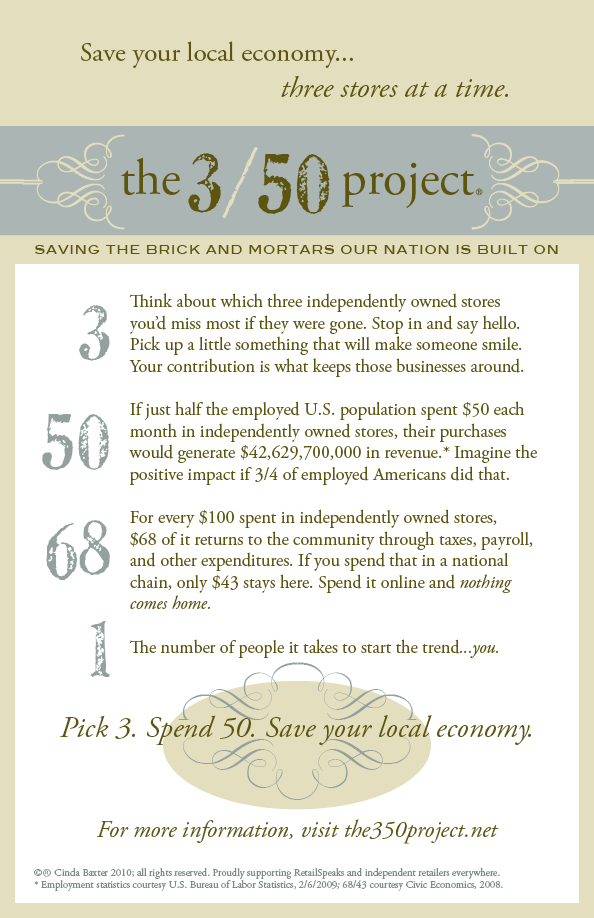
My regular readers (all 7!) know that I am passionate about "buy local" initiatives. I firmly believe that every dollar one spends is a vote, and I try to spend my dollars at locally owned businesses most of the time. So when I read about the 3/50 Project in the newspaper, I was pretty excited. The concept is easy. Choose 3 independently-owned businesses in your local community that you would really miss if they went out of business, and pledge to spend $50/month at each of them.
Can you think of 3 favorite independently-owned stores in your community that you would like to support?
Tuesday, August 04, 2009
Blogger Meet-Up
 Question: What do: Bill Clinton, Dick Cheney, Sarah Palin and New Gingrich have in common?
Answer: They are Not in the Picture above!
Who are these 4 Mysterious Bloggers?
- First Prize: A Free Subscription to one of their blogs (you choose)!
- Second Prize: A Free Subscription to two of their blogs (you choose)!
- Third Prize: Enrollment (as soon as it's available) in the Republican Party's new National Healthcare Plan - at its Market Driven - Bargain Price!
- Which 2 of these bloggers are married to each other?
- Which one was not married when the picture was snapped (2 weeks ago) but is married now?
- Which one owns a poodle?
- Which one had the farthest to go to get home?
- What's in that little white carton?
Book Review: The Latehomecomer, a Hmong Family Memoir
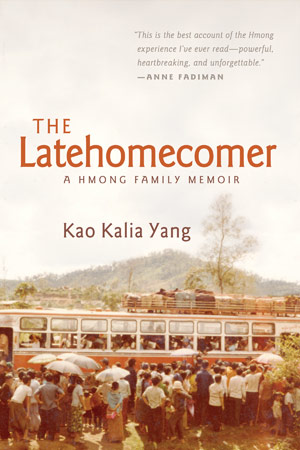 I am often surprised when I talk to people from other parts of the U.S. who don't know about Hmong-Americans. The Hmong were mountain people living in Laos. During the Vietnam war, they were recruited by our CIA to wage a Secret War against the communist forces in Laos (a fact that was long-denied by the U.S.) When the Americans departed in 1975, the Communist government of Laos waged genocide on the Hmong people. Thousands were massacred, while others fled into the jungles of Laos to hide or to make their long way to the Mekong River, to cross to Thailand and life in a refugee camp. In the mid-eighties Thailand no longer wanted to be host to thousands of Hmong refugees, and many of them came to the U.S., settling primarily in southern California, central and southern Wisconsin, and the Minneapolis/St. Paul area. In the mid-nineties when Clinton "ended welfare as we know it", there was another large Hmong migration from California to Minnesota, which had kinder policies toward people in poverty.
The Latehomecomer was written by Kao Kalia Yang, a young woman who was born in the Ban Vinai Refugee Camp in Thailand in 1980 and came to Minnesota with her parents and sister when she was 6 years old. They were eventually joined by many aunts and uncles, as well as her beloved paternal grandmother. She tells a story of hard work and abject poverty, the parents working long hours in mostly menial, low-paying jobs, always with the goal of their children getting ahead through education, but not losing their essential Hmong-ness. This is also very much a love story for Yang's grandmother, a woman whose strength and fortitude kept her family together through unimaginably trying circumstances.
Madison has a sizable Hmong community and I have had a handful of Hmong students over the years, but I still know very little about the culture and would like to know more. The Latehomecomer was a beautifully written and fascinating book, and certainly provides food for thought as a teacher. It was also interesting to compare it with the only other book about the Hmong I've read: The Spirit Catches You and You Fall Down by Anne Fadiman.
I highly recommend The Latehomecomer. The author, Kao Kalia Yang, has also produced a documentary about Hmong American refugees, The Place Where We Were Born.
Book Review: Up In the Old Hotel

Up In the Old Hotel by Joseph Mitchell is a collection of articles that Mitchell wrote for The New Yorker over a period of time spanning from the early 1930s to the mid-1960s. They were originally collected and published in 4 separate books, long out of print. McSorley's Wonderful Saloon profiles characters Mitchell met in and around the Bowery in his early days in New York City. These include saloon-owners, a self-described Gypsy king, a colorful street preacher, the "Don't Swear Man", a freak show bearded lady, and many others, as well as several works of fiction. Old Mr. Flood describes one elderly man living around the Fulton Fish Market. The Bottom of the Harbor is about the fish market, and the fishermen -- the bay men and the river men -- who kept it supplied. The book ends with Joe Gould's Secret, a follow-up to one of Mitchell's earlier profiles (which my brother informs me was made into a movie a few years ago.)
I thoroughly enjoyed reading this book. It paints a picture of a New York city that is mostly long gone, a fact that is echoed in places all around the country and is to be mourned. It was dense reading, like a well-aged fruitcake. I read with a dictionary close at hand to look up unknown words, which is always fun.
If you enjoy the kind of books that explore one subject in depth -- in the vein of John McPhee or Mark Kurlansky -- check out Up In the Old Hotel. It was a treat.
Monday, August 03, 2009
What's the trouble with Harry?
 We watched Alfred Hitchcock's 1955 comedy The Trouble With Harry last night. It was a favorite of my parents, and the first time I saw it as a kid, it scared the dickens out of me. Very funny black comedy. Recommended.
Why Oh Why Isn't Paul Krugman Our Treasury Secretary?
Oh. Yeah. 'Cause he wasn't ever a mucky-muck at Goldman-Sachs. This was in the NYT yesterday:
Americans are angry at Wall Street, and rightly so. First the financial industry plunged us into economic crisis, then it was bailed out at taxpayer expense. And now, with the economy still deeply depressed, the industry is paying itself gigantic bonuses. If you aren’t outraged, you haven’t been paying attention. (Read the rest here.)I am outraged, but feel impotent to do much. When it comes to money, I don't have a lot in the first place to use as any kind of leverage, and I'm already trying my hardest to do socially responsible things with it. I guess the best I can do is attempt to educate people.
Sunday, August 02, 2009
To Facebook Or Not To Facebook -- That Is the Question
But actually, there's no question about it. Yes, it is a time vacuum, yes it is frequently fairly shallow contact, but some really cool things can be facilitated by Facebook. Here's what happened:
Yesterday a young (F)friend's status update stated that he was going out to check the neighborhood garage sales for a bike. Reading that, I sent him a message telling him that we had some salvaged, but stalwart bicycles sitting in our garage if his shopping proved fruitless. Sometime in the afternoon he popped up in a chat window on Facebook, asking about the bikes. I invited him to come check them out. He came over yesterday evening while we were out, selected a bike and took it home.
This morning he showed up after Meeting, hands covered in grease and grime, to settle up on a price. He said he had been attending Meeting for Worship with Attention to Bicycle Repair, and had happily ridden his new bicycle over to the Meetinghouse. It's probably a pretty decent bike -- an older American-made (which in all likelihood means Wisconsin-made) 10-speed Trek touring bike. I'm happy to see it go to a good home, after rescuing it from a trip to a landfill.
As you might expect, I drive a hard bargain. "It's a graduation gift, Martin!" I said, and then added that if he wanted to donate some money to AFSC (American Friends' Service Committee) or another worthy cause, he could do so. I was rewarded with a very sweet smile. It makes me smile just to think of it.
So there you have it. Sure, it could have happened without Facebook, but that would have required Martin or his mom to come to Meeting and announce that he was looking for a bicycle or submit it to the weekly announcements, etc. etc. This way it was all so serendipitous. Community at work, facilitated by Facebook. Cool.
Friday, July 31, 2009
Common Sense Trumps Fanaticism of Celibate Old Men
This was a bit of good news today:
ROME — Italy has approved the use of the abortion drug RU-486, drawing fierce protests by the Vatican.
The drug, which terminates pregnancy by causing the embryo to detach from the uterine wall, is already available in several other European countries. But approval in Italy had been held up so far by the Catholic Church, which opposes abortion and contraception. (read the rest)
Thursday, July 30, 2009
Steve Earle Show
Steve Earle was outstanding! Lots of good stories, lots of political sermonizing, songs by Townes mixed with old and new favorites by Steve. Besides being a crackerjack (don't you like that word - "crackerjack"?) songwriter and musician, as well as a most engaging performer, there is so much that he gets right --
High points of the evening? Pancho & Lefty, Good-bye, Jerusalem, Lungs, City of Immigrants … During the encore he announced that he became a first-time grandpa a few days ago and played Little Rock & Roller. (If my kids had been there, they would have checked at that point to see if I was crying. I plead the 5th.)
It was a most satisfying show, and we were in good company with friends Alice and Rob. Here is a list of tour dates, if you're inclined to try to see it. I'd recommend it.
- nonviolence
- labor unions
- immigration
- human rights
- energy (you don't burn food -- i.e. corn -- for fuel when there are people going hungry and there's no such thing as "clean coal")
- rich vs. poor
High points of the evening? Pancho & Lefty, Good-bye, Jerusalem, Lungs, City of Immigrants … During the encore he announced that he became a first-time grandpa a few days ago and played Little Rock & Roller. (If my kids had been there, they would have checked at that point to see if I was crying. I plead the 5th.)
It was a most satisfying show, and we were in good company with friends Alice and Rob. Here is a list of tour dates, if you're inclined to try to see it. I'd recommend it.
Wednesday, July 29, 2009
Woo Hoo!
Tonight we are off to Milwaukee (only around these parts we say "M'waukee") for an evening with Steve Earle, performing the songs of his friend, the late, great Townes Van Zandt, in a solo acoustic show. If you aren't familiar with Van Zandt, he was simply one of the finest singer-songwriters around, whose songs have been covered by just about every self-respecting, country-folk musician. In general I prefer to hear Townes sing his own songs, but since he's not here to do it I'll take Steve Earle.
Here is a sample of what he'll be playing tonight:
Here is a sample of what he'll be playing tonight:
Tuesday, July 21, 2009
Attack of the Theater People!
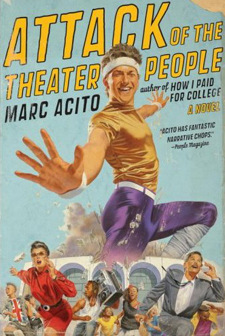 It's a book review, silly. Attack of the Theater People is the sequel to How I Paid For College: A Novel of Sex, Theft, Friendship & Musical Theater. It was slightly less madcap, and delved into the very serious issue of coming out as a gay man in the early days of AIDS awareness. Otherwise it was a delightful romp from Hell's Kitchen to Upper Manhattan. If you're looking for something to read that is both fun and intelligent, look no further. Recommended.
Friday, July 17, 2009
The Incomparable, Irreplaceable Warren Zevon
I'm so sick of the coverage Michael Jackson is getting! King of Pop? Warren Zevon was the uncrowned King of Cool. He had incredible talent and wit ... and yeah, he screwed up his life too. But he did it all by himself ... he didn't need a weird entourage that included chimpanzees, somebody else's children, and charlatan medical personnel ... and he straightened himself out at the end.
Here is Mohammed's Radio -- a timeless classic that proves the old saying: the more things change the more they stay the same. Or maybe that we never stopped mucking about in the Middle East.
Here is Mohammed's Radio -- a timeless classic that proves the old saying: the more things change the more they stay the same. Or maybe that we never stopped mucking about in the Middle East.
More Summer Reading
 I went back to bed this morning so I could finish this book, How I Paid for College: A Novel of Sex, Theft, Friendship & Musical Theater by Marc Acito. Some of you dear readers may be familiar with Marc Acito. Apparently he has a syndicated newspaper column and is a frequent common 'tater on NPR, known in some circles as the "gay Dave Barry". I have never read or heard any of his work before. A friend (as in the Facebook variety) set me up on a blind date with this book.
What can I say? Read. It. I don't want to say too much about it, but it was, in a word, delicious. With echoes of Red Sky At Morning (the Richard Bradford novel) and and A Prayer For Owen Meany -- two of my favorite coming-of-age novels, I enjoyed every minute of reading this book. It almost made me want to go back and repeat my senior year of high school. (Oh, wait. I didn't have a senior year of high school. I graduated after my junior year with about a million credits in folk dancing augmented by juggling. Life at an alternative high school in the seventies ...)
This kind of book is what summer reading is all about. Ahhhhh. Highly recommended.
Monday, July 13, 2009
Hostile Takeovers of the Corporate Kind, a book review
I have been a fan of the more recent writing of Jon Katz, and I was curious to read some of his earlier writing. Sign Off: A Novel of Men and Work was published in 1991. It chronicles the hostile takeover of United States Broadcasting (USB), a fictitious television network, as seen through the eyes of Peter Herbert, the executive producer of a nationally syndicated morning news program. UBS is taken over by David Nab, a self proclaimed "condo king" who has made a fortune in real estate and wishes to have the prestige that goes with owning a television network. Herbert watches in horror as, in a few short months, Nab lays waste to the network news, as well as the careers, and indeed the lives of his longtime associates, always wondering when the ax will fall on him.
This was a really compelling read. As a lowly Midwestern schoolteacher who has never aspired to the kind of lifestyle that Katz describes, I experienced a kind of guilty pleasure in reading about these people. It was a little like reading a Kitty Kelly tell-all.
Beyond the story however, I think that Sign Off made some important points. If the slash-and -burn mentality that Katz describes is accurate -- and I have no reason to believe otherwise; he did a stint as executive producer of the CBS Morning News -- it speaks volumes to the miserable failure of the mainstream media to take on the corporate culture of American politics, which we saw flourish under the Bush Administration, and sadly continues under Obama.
The novel also underscores something that I have thought about a lot in the last couple of years, watching people I love -- mostly middle-aged men -- struggle with unemployment. I believe from the bottom of my heart that a covenant was broken with American workers, people who spent the better part of their adult lives working hard and paying into "the system" only to be discarded as if they were yesterday's garbage. If you haven't been there, let me tell you -- it shatters a person's sense of self like nothing else can and has enormous impact on family relationships as well.
Furthermore, I question whether when businesses say that they are "losing money" is it really a matter of having a smaller profit margin? I think, in many cases, yes, absolutely. When corporations "downsize" or "cut the fat" it is all about increasing the profits for the stockholders. Tell me, where in the Constitution does it say that stockholders have a right to make huge profits?
Reading Sign Off, I would almost say that Katz was prescient. What happened to television news has also happened in print media, and in fact has reached into almost every corner of our society. I suspect though, that he was just observing the beginning of the corporatization of the U.S. (and the world.) Michael Moore was certainly talking about it and Ralph Nader, of course.
It was also utterly fascinating to see the anatomy of a hostile takeover. It is a term I have heard plenty of times, but really only had the most superficial understanding of what it meant. It strikes me that, among the provisions of that most horrible No Child Left Behind legislation are the sanctions for "failing schools" that include "reconstituting" a school's staff. That's nothing more than a hostile takeover -- welcome to corporatized America. (Don't get me started on Obama and education. I can hardly write about it, I am so furious.)
Sign Off is a very well-written, illuminating, and entertaining book. After many years of writing memoir, Katz is once again returning to fiction. I am looking forward to it.
Recommended, but it might take some digging to find it. It's worth the search.
Book Review: Ladies' Coupe by Anita Nair
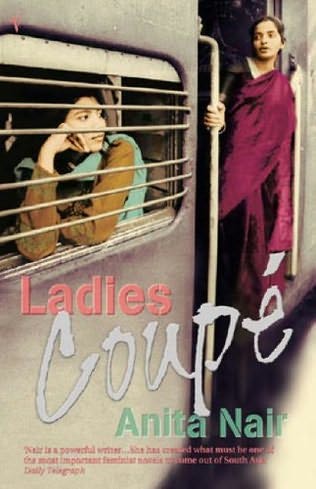 I picked up Ladie's Coupe for 80¢ in the St. Vinnie's book room, because I liked the cover. I liked the cover, OK? I defied years of people intoning, "Don't judge a book by its cover ..." and you know what? The Library Goddess did not smite me with her bun and spectacles. That's a good thing.
Reading Ladies' Coupe was a good thing too. This is a novel about Akhila, 45-years old and never married. Her father died when she was in her late teens; as an acknowledgment of his years spent working in an income tax office, Akhila is given a position as an income tax clerk so that she can support her mother, sister and two brothers. And so the years slip by, until one day Akhila realizes that she has done nothing for herself. She decides to take a short vacation to a seaside resort -- alone, much to her family's consternation.
Up until quite recently female travelers on India's railways had the option of riding in the "ladies' coupe" -- a compartment set aside strictly for women. Akhila reserves a seat in a ladies' coupe, and traveling among women whom she knows she will never see again, she feels free to ask them, does she really need a marriage to be fulfilled? During the course of the journey, each of the other 5 women in the coupe has a chance to tell her life story.
For some reason I have a special interest in India. I've loved the films of Mira Nair (no relation to the author of this book that I know of) and have read quite a few novels as well. This really was a marvelous addition to the canon. I recommend it.
Wednesday, July 08, 2009
Paul and his girlfriend Des

 Apparently this eagle, Des, was notoriously cranky with 'most everybody else at the nature center, but took a liking to my brother. He always has been a bit of a ladies' man ...
Tuesday, July 07, 2009
Bursting With Pride!
How cool is this? Pretty darned cool! Check out the by-line on that article ... THAT'S MY BIG BROTHER!! I am very proud of him, and I forgive him for all the times he teased me and made me cry, even giving me the nickname Sig (Suzy + pig) and shining a light on me and chanting, "Spotlight on stinkbomb Suzy." And you know what? He is a really good writer! Go, Paul!

 You have to embiggen this one and tilt your head to read the by-line.

 You have to embiggen this one and tilt your head to read the by-line.
Book Review: Monstrous Regiment by Terry Pratchett
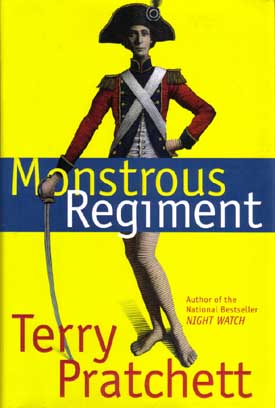 It is difficult to say much about Monstrous Regiment without giving too much away and spoiling it for you, so I'll keep my review brief. In Monstrous Regiment Pratchett skewers the military industrial complex, the war on Iraq, religious fundamentalists, and traditional English folk songs. This is among my favorite books by Terry Pratchett. It's a hoot.
Saturday, July 04, 2009
Believe it or not, I've wondered about this ...
Crooks and Liars has an interesting piece today, tracing California's current fiscal woes back to 1978's passage of Proposition 13.
Here in Wisconsin we have our own version, although ours is not part of the state constitution ... yet. The other thing unique about our revenue caps that supposedly give tax relief to property owners, is that they specifically target K-12 public school districts. Our then-Governor Tommy Thompson (remember Tommy? He ran for the Republican nomination in the last presidential election) had a personal vendetta against teachers. He gave us the revenue caps and took away our right to bargain fair contracts, two gifts that have kept on giving for the last 16 years.
Here in Wisconsin we have our own version, although ours is not part of the state constitution ... yet. The other thing unique about our revenue caps that supposedly give tax relief to property owners, is that they specifically target K-12 public school districts. Our then-Governor Tommy Thompson (remember Tommy? He ran for the Republican nomination in the last presidential election) had a personal vendetta against teachers. He gave us the revenue caps and took away our right to bargain fair contracts, two gifts that have kept on giving for the last 16 years.
Friday, July 03, 2009
Support Your Local Food Pantries!
Summer is typically a time when food pantries are hurting. Kids who normally get breakfast and lunch at school are home. There is a strain on the resources of food pantries.

Behold, the Million Can March. An alternative to the ridiculous "tea parties" being held around the country this weekend. Something that will make a real difference in the lives of members of our communities.

From Les Enrages.org (the brilliant masterminds behind this movement)
• If in doubt, call the agency you plan to donate to and ask them what they need.
Here's a basic list:
• cereal, instant oatmeal
• Canned meats & fish (tuna, salmon, deviled ham, canned chicken, etc)
• Peanut butter, jelly, crackers
• fruits and vegetables
• Soups, stews, canned pasta dishes like beefaroni, lasagna, ravioli
• Boxed potatoes and rice and pasta mixes in a box or pouch
• "Just add water" cake, pancake, muffin mixes, etc.
• Canned and powdered milk
• Infant formula and baby foods
You can also think in terms of a meal:
• Spaghetti sauce and pasta
• Tuna and macaroni and cheese
• Beans & Rice
You get the idea, and then add a vegetable, a fruit, and a sweet treat.
Really, this isn't rocket science. Give what you like to eat!
Here is a link to food pantry and meal sites in the Madison (Wisconsin) area.
Thursday, July 02, 2009
A Fruity Book Review
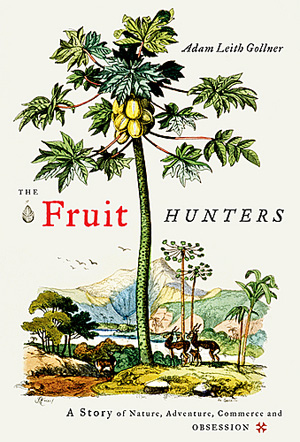 I am a fan of those monomaniacal nonfiction books, the ones that go into great depth on one subject. In this case the subject is fruit and the book is Adam Leith Gollner's The Fruit Hunters: A Story of Nature, Adventure, Commerce and Obsession. Why fruit? It hasn't really ever before been an obsession of mine. I try to eat my 5 servings a day with varying degrees of success. However, as I read the book, I became aware that I may be a little more fruit-obsessed than I thought. I like growing fruit in my yard: I've been quite successful with currants and raspberries, less so with cherries, choke cherries, and service berries. Those are fruits of the north. Gollner's book is filled with tropical fruits, more fruits than you can imagine.
"The diversity is dizzying: most of us have never heard of the araça, but Amazonian fruit authorities say there are almost as many types of araças as there are beaches in Brazil. Within the tens of thousands of edible plant species, there are hundreds of thousands of varieties – and new ones are continually evolving. Magic beans, sundrops, cannonballs, delicious monsters, zombi apples, gingerbread plums, swan egg pears, Oaxacan trees of little skulls, Congo goobers, slow-match fruits, candle fruits, bastard cherries, bignays, belimbings, bilimbis and biribas. As Hamlet might’ve said: 'There are more fruits in heaven and earth, Horatio, than are dreamt of in your philosophy.' ”Suddenly I feel fruit-deprived; of the small percentage of the world's fruits that are grown or allowed into the U.S., by the time they get to my landlocked city, they will have been on the road for days, sometimes weeks, and the flavor a mere shadow of what it should be. There are the hundreds of varieties of more familiar fruits that have been neglected in our commercial fruit monoculture, so we only ever get to eat one or two varieties of pears, strawberries, bananas, figs, avocadoes, pomegranates, etc. etc. etc. And then there are the fruits that will never make it here: the chupa chupas, bignays, sapotes, gourkas ... Sigh.
(I can't say I'm sad about the durian though. I once had the bad fortune to eat a durian-filled cookie from the Asian grocery store. I absolutely could not choke it down, ended up gagging into the garbage can, and even so, I burped up durian taste all day long. Then again, some people say they have the same reaction to cheese.)
If you ever thought that fruit was just a side dish, an afterthought, guess again. Gollner shows, in no uncertain terms, how fruit has shaped and defined life on earth in general, and human life in particular. He takes the reader to the very extreme edges of his subject: the fanatics who stop at nothing to get their hands on a fruit and the fruitarians -- people who eat nothing but fruit (and their subsets such as the "rockguacamolians" who only eat avocadoes sprinkled with asteroid dust,) and shows us the underbelly of the fruit world as well. The way that the fruit trade is linked to organized crime, for example. The creepy, underhanded treatment and marketing of "wholesome" fruit. The geopolitics of fruit. Or the fact that the idling semi-trucks that serve the huge Hunts Point Fruit Market in the Bronx are responsible for way elevated, life-shortening asthma rates (which I've read about in Jonathan Kozol's books about the work he does with schoolchildren in the South Bronx.)
Reading The Fruit Hunters has made it difficult for me to think about fruit in the same way that I did before. Shopping at my local food co-op this week, I was sorely disappointed to see that, with the exception of one small bin of local apples, virtually all the other fruit was imported from California or Mexico, including the strawberries, raspberries, and blueberries. I had a hard time buying anything!
I have been, however, deeply appreciative of every red raspberry that I have plucked off the bushes in my backyard. I'm thinking of planting a paw paw tree. I am also heading back to a serviceberry tree that I found growing on a city street a few blocks from here, dropping its sweet, delicious berries onto the sidewalk. There are a lot of fruits to forage, right here.
Oh! Am I reviewing a book? Sorry, I forgot. The Fruit Hunters: dripping with sex (yes, really!) An entertaining and enlightening read. Recommended.
Wednesday, July 01, 2009
Delicious Synchronicity
 I am rereading my favorite book by Terry Pratchett, Monstrous Regiment, and was moved to copy down the following quote:
"The presence of those seeking the truth is infinitely to be preferred to the presence of those who think they've found it."Then, as I perused my favorite news sites this morning I found this pearl from "Joe" the "Plumber":
Asked if he has plans to run for public office, he replied, “I hope not. You know, I talked to God about that and he was like, ‘No.’”Weird, huh?
Sunday, June 28, 2009
The Truth Revealed
Alright, alright ... Madison doesn't really have parking spaces reserved for octopi. It's the name of a business, silly. Octopus Carwash. Apparently it is a franchise, and I believe it's been in Madison at least as long as I have (46 years.) When our eldest daughter was a toddler, our route home from her day care took us past a number of landmarks: the giant octopus, the big black clock, the big green fish, the other giant octopus, the horses ... It was a highlight of her young life when her aunt actually took her to the car wash once. (No one has ever been able to accuse me of going to a car wash! And it shows ...) The big green fish is gone (along with the neon cockroach and dead rat sign -- landmarks from my childhood, so sad) but I am so glad that we still have the giant octopi and that we provide parking for them.

Saturday, June 27, 2009
Signs #1
 The residents of Madison, Wisconsin are frequently accused in public forums of being "politically correct." Is that a valid criticism? Well, here we are, a thousand miles from the nearest saltwater and we reserve parking for OCTOPI? PETA would be so proud!
Wednesday, June 24, 2009
Tuesday, June 23, 2009
You know, you can read a lot more books when you stay in the kids' section!

Yes, this is another book review. Already. When I Was a Boy Neruda Called Me Policarpo is a memoir by the Chiléan author Poli Délano, of a childhood frequently spent in the company of the great poet Pablo Neruda. This is a simple, yet moving little book with charming illustrations. It takes place during turbulent, even dangerous times when Neruda was in exile from Chilé, but the child Poli remembers the small moments: the crazy badger that Neruda kept as a pet, Sunday outings, going to the market to search for the weird old junk that Neruda collected, a trip to Acalpulco … He also recalls the life-lessons Neruda taught him, about social justice and standing up for one's beliefs. Each chapter is separated from the next by Neruda's poetry; the poems give Poli's memories a context.
At the end of the book there is a short biography of Pablo Neruda. I love that Délano does not minimize Neruda's political beliefs. Not only can this book serve as an introduction to Neruda for young adult readers, but I would hope that it could also be used to explore some of the history of the last century: the rise of European fascism and the relationship that the U.S. has had with Central and South America.
This is a beautiful book, and certainly one that I will be recommending to my daughter's middle school teachers and librarian. (I suspect it will not be available in the Scholastic book order!)
One more, semi-related thing: If you have not seen the film Il Postino, you would not go amiss in looking it up and watching it. It tells the story of a simple rural postman who is befriended by Neruda, and has his life irrevocably changed. It is a beautiful film.
Monday, June 22, 2009
Summer Reading -- The Yggyssey by Daniel Pinkwater
 You know, I had never thought about the The Wizard of Oz being based on Homer's Odysseus. However, Daniel Pinkwater clearly had, when he wrote this book. The Iggyssey: How Iggy Wondered What Happened to All the Ghosts, Found Out Where They Went, and Went There is a sequel to The Neddiad. Yggdrasil Birnbaum is familiar with the ghosts of Los Angeles (of whom there are many) and she becomes concerned when they begin to disappear. Determined to solve the mystery, Iggy and her friends Neddie Wentworthstein and Seamus Finn follow a ghostly bunny through a portal that leads ... somewhere.
The Yggyssey pays homage to some great moments in children's literature. It is also filled with Pinkwater's signature humor -- intelligent, self-deprecating, puckish at times. The Neddiad and The Yggyssey are both quick reads, very entertaining, highly recommended.
Sunday, June 21, 2009

Saturday, June 20, 2009
Lounging Around --A Theatah Review
 Last night was opening night for Broom Street Theater's new production, Lounging Around, an original play by Siobhan Edge. For you readers in foreign parts (i.e. not from Madison,) for the past 40+ years, BST has been delighting, shocking, offending, and entertaining theater-goers with original works. Lounging Around is a comedy woven around the conversations of a diverse group of travelers stuck in an airport lounge when their flight is delayed due to heavy fog.
My younger daughter -- the daughter formerly known as "Sparkly Seacow" -- made her Broom Street debut, with 3 roles in this play: an elderly woman (82 years old, Dearie!), a Valley Girl with a cell phone, and a bratty little girl. Thumbs up for all of them! I may be a little biased, but I think she did a fantastic job and I'm very proud of her.

 Photos by N-dig0 (tb3), used with permission
Thumbs up for the entire production! The dialogue was witty, the action was fast-paced, and the acting was good.
If you live in the Madison area, make this stage mama happy and go see Lounging Around!
Friday, June 19, 2009
Another Day, Another 2 Book Reviews
"And it was summer, warm, beautiful summer ..."
For me that means reading. Lots of reading. I have read 2 books so far, as different from each other as night and day, as the saying goes.
 First is Ben Logan's memoir of growing up on a Wisconsin farm, The Land Remembers. You don't have to be from Wisconsin to enjoy this book. (And by the way, real Wisconsinites do not refer to themselves as "Sconnies.") Ben Logan was born in 1920 at his family's "Seldom Seen Farm" in the hill country between Gays Mills and Mount Sterling, Wisconsin. Reading it, I was struck by two things:
1) Everything Logan writes about happened just one generation ago, my parents' generation. His father farmed with horses, they had no indoor plumbing or electricity, and his family was entirely self-sufficient. I remember visiting relatives on a farm like this in northern Wisconsin, 40 years ago. The changes that have been wrought in a single generation are almost beyond belief, and not all bad of course, but something was surely lost in the headlong rush forward in the name of "progress".
2) The land ethic that Logan learned from his parents seems way ahead of its time. He was taught to be a steward of the land. His father did not jump on every (or even most) agricultural bandwagons, because he was cautious of the long-term effects. Farmers were peddled a lot of snake oil in those days, much of which has led to the environmental crises we are facing today.
The Land Remembers is a beautifully -- even poetically -- written book. Ben Logan left Wisconsin as a young man and had a successful career as a writer and radio broadcaster on the east coast. He returned to Wisconsin in the eighties and bought back Seldom Seen Farm (it had been sold at some point) and lived there until a few years ago. When he moved off the farm, he donated it to the Mississippi Valley Conservancy, with the agreement that they would keep it in use as a sustainably-managed farm.
Highly recommended, especially for people with an interest in sustainability or lovers of memoir.
The second book of the summer is Daniel Pinkwater's The Neddiad: How Neddie Took The Train, Went To Hollywood, And Saved Civilization. In this book, Pinkwater takes the epic quest/hero's journey fantasy and turns it on its ear. It is the early fifties and Neddie Wentworthstein is moving with his family to Los Angeles. On the way he meets a shaman named Melvin, who gives him a small stone turtle, telling him not to lose it. Neddie, of course, has many adventures and encounters both friends and foes, before he is able to complete his quest.
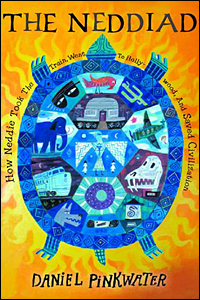 If you are not familiar with the writing of Daniel Pinkwater, you don't know what you're missing. His sly sense of humor isn't necessarily of the laugh-out-loud-'til-your-stomach-hurts variety, but he had me chuckling throughout the entire book. He pokes fun at Jews, Republicans, military establishments, Madison Avenue, Hollywood, and anything else you can think of. A couple of high points, but I don't want to spoil all of the jokes for you:
For me that means reading. Lots of reading. I have read 2 books so far, as different from each other as night and day, as the saying goes.
First is Ben Logan's memoir of growing up on a Wisconsin farm, The Land Remembers. You don't have to be from Wisconsin to enjoy this book. (And by the way, real Wisconsinites do not refer to themselves as "Sconnies.") Ben Logan was born in 1920 at his family's "Seldom Seen Farm" in the hill country between Gays Mills and Mount Sterling, Wisconsin. Reading it, I was struck by two things:1) Everything Logan writes about happened just one generation ago, my parents' generation. His father farmed with horses, they had no indoor plumbing or electricity, and his family was entirely self-sufficient. I remember visiting relatives on a farm like this in northern Wisconsin, 40 years ago. The changes that have been wrought in a single generation are almost beyond belief, and not all bad of course, but something was surely lost in the headlong rush forward in the name of "progress".
2) The land ethic that Logan learned from his parents seems way ahead of its time. He was taught to be a steward of the land. His father did not jump on every (or even most) agricultural bandwagons, because he was cautious of the long-term effects. Farmers were peddled a lot of snake oil in those days, much of which has led to the environmental crises we are facing today.
The Land Remembers is a beautifully -- even poetically -- written book. Ben Logan left Wisconsin as a young man and had a successful career as a writer and radio broadcaster on the east coast. He returned to Wisconsin in the eighties and bought back Seldom Seen Farm (it had been sold at some point) and lived there until a few years ago. When he moved off the farm, he donated it to the Mississippi Valley Conservancy, with the agreement that they would keep it in use as a sustainably-managed farm.
Highly recommended, especially for people with an interest in sustainability or lovers of memoir.
The second book of the summer is Daniel Pinkwater's The Neddiad: How Neddie Took The Train, Went To Hollywood, And Saved Civilization. In this book, Pinkwater takes the epic quest/hero's journey fantasy and turns it on its ear. It is the early fifties and Neddie Wentworthstein is moving with his family to Los Angeles. On the way he meets a shaman named Melvin, who gives him a small stone turtle, telling him not to lose it. Neddie, of course, has many adventures and encounters both friends and foes, before he is able to complete his quest.
If you are not familiar with the writing of Daniel Pinkwater, you don't know what you're missing. His sly sense of humor isn't necessarily of the laugh-out-loud-'til-your-stomach-hurts variety, but he had me chuckling throughout the entire book. He pokes fun at Jews, Republicans, military establishments, Madison Avenue, Hollywood, and anything else you can think of. A couple of high points, but I don't want to spoil all of the jokes for you:We only stopped for gas, plus once, when we were across the state line in San Bernardino, California, at McDonald's fifteen-cent hamburger stand, where you Buy 'Em by the Bag. "This is a good idea," Seamus Finn said. "They should open more of these."I can hardly wait to read the companion book, The Yggyssey, next up. These books would make an excellent gift for any 11-13 year olds you know, especially if they're getting a little overdosed on the kid wizard from Britain.and"There's only so far we can go with this sort of thing," Aaron Finn whispered. "I think it may be against the law to torture people, even if you're a movie star and a Republican."
Sunday, June 14, 2009
In A Dark Wood Wandering: A Novel of the Middle Ages
 This is a book I picked up on a whim, used in a library resale shop. According to the blurb on the cover, it has been in print continuously since 1949. I figured that may indicate a good book.
The introduction tells how the book came to be translated into English, a fascinating story unto itself. Published in 1949 in Holland, it was a bestseller throughout continental Europe, but virtually unknown in the U.S. In the early fifties a postal clerk/writer in Chicago named Lewis C. Kaplan, whose avocation was translating obscure pieces of literature into English, happened to see a reference to the book in a literary magazine and decided that he wanted to translate it. He wrote to the Dutch publisher and the author, received permission, and began. Mr. Kaplan did not speak Dutch, so the translation was an arduous process. He finished a first draft and was beginning to work on a revision when he died in 1958.
His distraught widow disposed of all his effects, but held on to the last manuscript he was working on, putting it into a briefcase in a closet in her apartment. Twenty years later when her apartment had a fire, Kaplan's son came to help his mother clean up the mess and discovered the briefcase with the sodden manuscript in it. He took it, dried it out and set about trying to discover what it was. (It had no identifying title or other information.) By chance, Kaplan's widow found a slip of paper with the author's name on it, and the son tracked her down through the Library of Congress.
Here's the part I like: Of the 20 years that the manuscript sat in the back of a closet the introduction says, "During that time Hella Haasse [the author] thought occasionally of Mr. Kaplan and the English version of Het voud der verwachting; it seemed to her that he was taking considerable time to complete his work, but she knew that he had tackled a formidable task and, with commendable sensitivity, she hesitated to give him the impression that he was being rushed."
There were more chance events that led eventually to the U.S. publication of In A Dark Wood Wandering in 1989, 40 years after it was first published!
The novel itself takes place in the late fourteenth and early to mid-fifteenth centuries during the Hundred Years War between England and France. The main protagonist is Charles d' Orléans, nephew to King Charles VI. The novel traces his long and eventful life as it was interwoven with the politics of the day. At the age of 20 Charles d'Orléans was taken hostage by the English after the infamous battle of Agincourt, and imprisoned in England for the next 20 years. During his exile, Charles wrote poetry for his beloved wife left behind in France and his even more beloved homeland which he recognized was being torn apart by the political skirmishes of the French nobility. He returned to France determined to live out his remaining years quietly, but couldn't avoid being sucked back into the political current from time to time. He lived to be quite old and fathered 3 children, one of whom ultimately became King Louis XII of France.
I enjoyed this book immensely. I like historical fiction in general, and this had the added bonus of being something completely new. I knew very little about the Middle Ages, and found it quite compelling. The writing was fresh and modern. I was struck by the realization that, time may pass, but politics are always the same, driven by the thirst of the gentry for power and money. (That's rather depressing, isn't it?)
In A Dark Wood Wandering is well worth reading.
Saturday, June 13, 2009
22 Years
 In what is possibly a first, Mr. Ether (a.k.a. Enriched Geranium) beat me to a blog post about our wedding anniversary. Over the years -- and particularly in the struggle for marriage equality for all people -- I've thought deep philosophical thoughts about the meaning of having the State sanction one's relationship with another person. Having it all to do over again, perhaps we would have chosen otherwise, BUT (and you know there's always a big but) even had we not gone through all of the legal mumbo-jumbo and the ceremony and the celebration (which I am sure is the only wedding in history to include a Gumby pinata and a seeing eye dog,) it would not have changed the wanting to spend my life with Ed.
 To get to the point, I married my best friend and it was the best thing I ever did. Happy anniversary, Ed. I love you.
Tuesday, June 09, 2009
In Memorium: Linda Farley
By John Nichols, writing in Madison's Capital Times:
Dr. Linda Farley did not live to see her dream -- the establishment of a universal health care plan that would provide quality care to all Americans -- come to fruition.
But the Verona physician who sought to heal a broken health care system survived long enough to see the first outlines of what she hoped would be a fundamental reform take shape.
Farley died Tuesday morning, on the very day that press reports indicated President Barack Obama would demand that Congress enact sweeping changes in the health care system before the end of the year, changes that reportedly will include a public option that reformers hope will lead to the establishment of a national health care plan like those now operating in most developed nations.
Farley, an ardent champion of a single-payer health care system run by the government as a public good rather than by for-profit insurers, would have loved to have been a part of the coming debate.
And she would have joined it as she did all others -- for peace, for economic and social justice, for civil liberties, for the environment -- with a rare and remarkable combination of urgency, warmth and good humor.
"I know we have a lot of work to do, so many barriers, so many challenges, so many powerful foes," she told me a few weeks ago, at another rally on another night when a woman of 80 who was battling cancer might have been excused for staying home. "But we've got to do it, so what's the point of getting frustrated. After all, we're right."
Farley, almost always in tandem with her husband and fellow physician, Dr. Eugene Farley, redefined health care activism in Madison and Wisconsin over the past several decades. Bringing lifetimes of medical experience and the calm, cheerful demeanors of the family physicians of another era -- when doctors had the time and the wherewithal to get to know, and love, their patients -- the Farleys made the case for fundamental reform in human terms.
At community forums, in church basements and union halls, on the stage before thousands at BobFest, the Farleys created a constituency for single-payer health care, and they changed the politics of the region. After Gene Farley toyed with a congressional run in 1996 on a health-care reform platform, a young state representative named Tammy Baldwin took up the mantle in 1998 and got elected in large part because she championed single-payer.
Baldwin adored the Farleys, and they her. A few years ago, the congresswoman nominated Linda Farley to be honored as part of the National Library of Medicine's "Local Legends" program. Baldwin, who is no slouch in this department, hailed her nominee as Wisconsin's "passionate crusader for health care reform."
But that didn't stop the intrepid Farley from lobbying the congresswoman, as she did every other official. And when the politicians fell a little short, she kindly -- but firmly -- prodded them. And they listened.
They listened because Farley knew of what she spoke.
Inspired as a teenager growing up in a blue-collar neighborhood in Rochester, N.Y., by novels about doctors who cared for the rural poor in Appalachia, she decided to become a physician.
Farley put herself through college and medical school working as a nurse's aide.
It was tough, but she was smart and determined. And she was cheered on by a fellow student, a young fellow named Gene Farley, who eventually convinced her that he shared her dedication to serving those who most needed, but could least afford, care.
Together, they worked at great teaching hospitals and inner-city clinics, on their own rural practice and in neighborhood health centers in big cities. They trained nurses in Jamaica and doctors in Madison. And when she retired, Linda Farley kept on caring for folks for free, making the rounds of local clinics and donating her services.
Farley "credited her two years in the mid-1950s on the northeastern Arizona Navajo Reservation as transforming her attitude and approach to medicine," recalls her biography at the National Library of Medicine. "Fifty miles from the nearest paved road, she and Gene lived in a small trailer and ran an outpatient clinic, providing medical care to the surrounding Navajo community, and also evaluating ambulatory treatment of tuberculosis using a then-new drug."The experience on the reservation was a powerful one for the Farleys. In fact, several weeks ago, to celebrate her 80th birthday, Farley returned with Gene and her children and grandchildren to Many Farms, Ariz., which is on the reservation. Gene said Linda delighted spending time with patients she had cared for more than 50 years ago.
Another major influence for the couple was their work at Meharry Medical School in Nashville, Tenn., -- the country's largest private, comprehensive historically black institution for educating health professionals and scientists -- where they established a faculty development program.
At the University of Wisconsin Medical School, Linda Farley served as an assistant professor of Family Medicine, and it was in this role that she received a great deal of regional and national recognition, earning the Society of Teachers of Family Medicine Task Force Appreciation Award in 1993, the Wisconsin State Medical Society Physician Citizen of the Year in 1995 and the American Academy of Family Physicians Presidents Award in 2001.
But the awards and honors were never more than cause for an awkward smile from an instinctively modest woman. Her many friends saw that smile once more this spring, when the Democratic Party of Wisconsin -- of which she was a loyal if frequently prodding member -- honored her and her dear friend, former state Rep. Midge Miller, for their decades of leadership and activism. Democratic Party of Wisconsin Chair Joe Wineke got it right Tuesday when he said that "Linda Farley was a beloved member of the Democratic Party who embodied our commitment to health care reform. Linda devoted her career in medicine and politics to helping the medically underserved and advocating for real health care reform."
While she accepted the honors -- especially if they helped advance the cause of health-care reform -- Farley got excited about caring for people, especially when she was volunteering at the South Madison Health & Family Center-Harambee and other free and low cost clinics.
She delighted in her children and grandchildren, and in her husband, Gene, who survives her. She enjoyed the Madison Quaker Meeting, and the hundreds of friendships and projects that came from it and her involvement with local peace and justice groups.
And Farley positively glowed when she was campaigning for single-payer health care, as a member of Physicians for a National Health Program, the activist group that she helped build into an organization with more than 16,000 physician members. "It's my passion," she would say.
Farley once said that "I'd like to be remembered as a good family doctor who really cared for people."
But she always added that "really caring" required doctors to do more than just give shots and write prescriptions. "We have to be active," she said. "We have to take our experience, our knowledge, and use it to shape a better health care system."
And so she did.
Gene and Linda are two of the loveliest people I have ever had the privilege of knowing. It seems to me that a fitting tribute to Linda would be to put single-payer health care at the forefront of the struggle for social justice, and make her dream a reality.
Monday, June 08, 2009
Why I Teach
I am coming to the end of my 23rd year as a public school teacher. 22 of those years have been in the same school district. I've had my highs and my lows during that time. I even considered resigning at one point about 10 years ago, because it felt like I had no reserves left. My well was dry.
Yesterday I had one of those experiences that teachers live for, the kind that you usually only get when you've been teaching for a while. I responded to a friend request on Facebook -- a high school teacher in my district. And in looking at her profile page I saw a comment from a former first grade student of mine whom I had lost track of over the years. I wrote a "Hello, do you remember me?" comment and received the sweetest message in return, telling me how influential I had been to her. In fact, she is just finishing up her first year as a 5th grade teacher!
I go along day in and day out, year in and year out. Some days I am joyful, other days I am grumpy. But I absolutely must never stop remembering that what I do -- sometimes the smallest, most commonplace, and seemingly insignificant thing I do -- can make a difference to a kid.
That is why I teach.
Friday, June 05, 2009
Fun With Highly Toxic Substances
I've written before about the website Boing Boing. I always find something there to delight and distract me from the woes of the world (or sometimes it helps me see something from an entirely new and different perspective.) Here is a link to a video about freezing mercury. Hmmm ... I'm looking for fun projects to occupy my kindergartners in the last week of school.
Seriously, I remember being in about 2nd grade when the scientist father of one of my classmates brought in mercury for us to play with. Yes, we handled it. It was cool how it broke up into many small blobs and then came together again into a big blob. Back in those days it was not known how toxic mercury was.
A few years ago when we were getting my parents' house ready to sell, I had the job of emptying the rusting metal shelf in the garage and disposing of the various tubes, cans, old mayonnaise jars, etc. of substances that my father had amassed over the years. (A physician by trade, he was a tinkerer by avocation, dabbling in chemistry, mechanics, physics, you name it.) So I loaded it all into the back of my station wagon and (a year or so later, after it sat piled in my driveway) hauled it over to the county "Clean Sweep" site for disposal. The woman working there was very efficient, sorting the stuff I could put out with the trash at home from the stuff they would dispose of. Then she picked up a little glass spice jar with a rubber stopper and said, "I wonder what this is? Oh! It's mercury!" I'm sure that was one she enjoyed telling at the dinner table that night!
Gosh, if I had only kept it, I could have made frozen mercury fish and turtles like in the video.
Monday, June 01, 2009
Robber Barons
I almost can't post this because I find it so discouraging. But it's so important, it should be seen. This is from the incomparable investigative journalist Greg Palast, about the forced bankruptcy of GM.
This story stinks to high heaven.
Screw the autoworkers.I had few illusions about Barack Obama as president. I knew he wasn't progressive and had some tense moments with friends when I wouldn't just jump on the bandwagon. I hoped he would give me a respite from worry and fear, and it didn't take long to see how illusory that was as well. Steve Earle was right when he said that whoever got elected, the real work would begin on January 20, 2009. I feel so worn down after 8 years of BushCo, yet there is indeed work to be done.
They may be crying about General Motors' bankruptcy today. But dumping 40,000 of the last 60,000 union jobs into a mass grave won't spoil Jamie Dimon's day.Dimon is the CEO of JP Morgan Chase bank. While GM workers are losing their retirement health benefits, their jobs, their life savings; while shareholders are getting zilch and many creditors getting hosed, a few privileged GM lenders – led by Morgan and Citibank – expect to get back 100% of their loans to GM, a stunning $6 billion.
The way these banks are getting their $6 billion bonanza is stone cold illegal.
I smell a rat. (Read the rest ...)
This story stinks to high heaven.
Subscribe to:
Posts (Atom)